Published
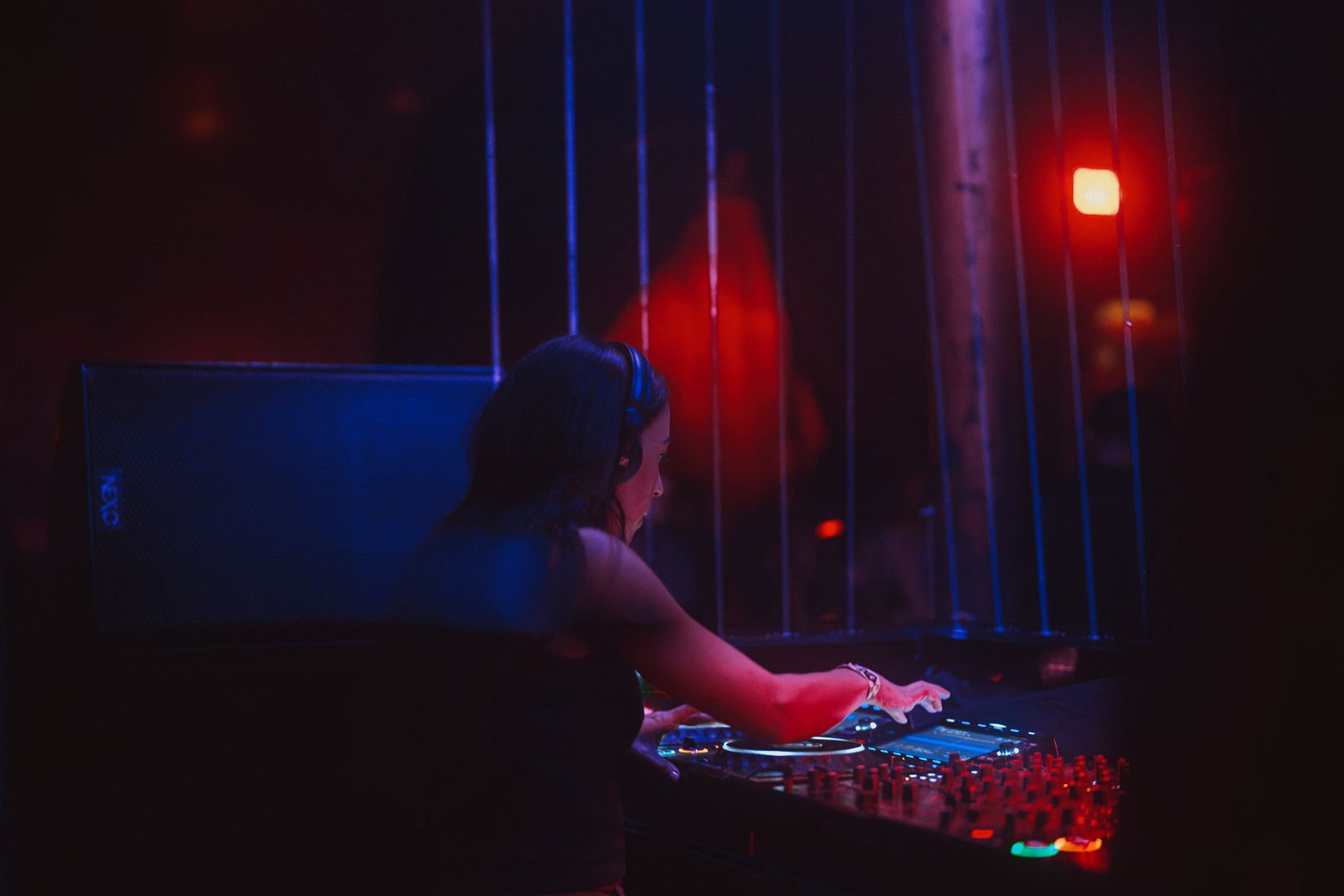
Name: Stephanie Reyes aka Feph
Nationality: American
Occupation: Producer, DJ
Current release: Feph is one of the artists contributing to the new Monday Off compilation VA vol.8, also featuring Xhato, Rasser, and Mathys Lenne. Order on bandcamp or from Triple Vision.
Recommendations for Miami, FL, USA: I was born and raised here. After you had your Miami Beach experience, please go visit the mainland because Miami is amazing and there is so much more than just the beach. And yes, the Cuban food is fantastic. Sergio’s is my favorite for cuban coffee (which is a crime if you come to Miami and don’t try it), and there is nothing more satisfying than a pan con bistec after a night out. Trust. Key West is also a vibe and totally worth visiting.
[Read our Mathys Lenne interview]
[Read our Xhato interview]
If you enjoyed this Feph interview and would like to stay up to date with her music and live dates, visit her on Instagram, Soundcloud, and bandcamp.
For a deeper dive, read our conversation on the same topic with the Monday Off founder in our Mary Yuzovskaya interview.
Are there examples of minimalism in music – and outside of music - that impressed you early on?
Absolutely.
Early in my musical journey, when I first explored dub techno, I was fascinated by how loopy and repetitive the music was, but somehow these minor, gradually changing elements kept things exciting and interesting. Those tracks can easily be 10 minutes long, yet to me it wasn’t “active listening” music, it was music you can “fall into” safely in the background.
I just remember thinking, how are they doing this? It was mysterious to me and that sort of thought process always stuck with me when I was making music.
Do you tend to find that, as many claim, “less is more?” Are the notes you don't play really as important as the ones you do play?
Sure, I would even say that it’s not so much about “less is more” for me, but more so along the lines of … how can I extract the most out of less? How far can I go with these handful of elements to make them interesting, evolving yet powerful?
Also, I am not really thinking directly about what notes I am or am not playing, maybe it’s more subconscious. However, I am intentional about making melodies that aren't predictable, whether it be through the rhythm of the melody or the notes being played.
Do you feel as that making music is a process of adding elements until it is done – or one where you chisel away pieces from something that is already there?
Both of these have a place in my creative process. For example, in the sound design phase, I am adding modulation and movement to a sound, whether it be noticeable or more of a slow, gradual thing.
When I am mixing, there is definitely a place for “carving out” space, and taking things away, especially when dealing with the relationship between similar frequencies.
Sounds need their own space, and that tends to come more from a “chiseling away” approach for me. The space is there, but it’s my job to carve it out.
Many artists are becoming more minimalist in their music as the years go on, focusing on the “essence.” How is that for yourself and how would you describe your development in this regard?
For me, I am always thinking about pushing a sound as far as I am capable of, whether it be through modulation, accentuating certain frequencies, and how the overall mix pops out.
All of these things, to me, stem from a mixing standpoint. A minimalist approach to making music requires, in my opinion, a deep understanding and respect of the mixing process. Because, if we are working with only a few elements, those sounds really need to be mixed well to have an emotional impact. It’s not just about creating a sound and being done with it.
How can I push/pull the frequencies to have an even more emotional impact? How far can I push the overall movement and groove of the track so it hits me where I want it to? How can these handful of sounds take up enough space in the frequency spectrum to sound full and balanced?
Tell me more about this idea of mixing as a key element of your work.
In terms of music, I think mixing has become a lost art.
Many people focus on sound design and arrangement, which is of course very important, but I feel like mixing sometimes gets a back seat because it’s very technical and perceived as not being emotional. I firmly disagree with that.
Especially for people who are making music primarily for a dance floor, mixing is paramount. There is so much emotion that can be extracted from your mixing decisions, so much manipulation of time and space that is done in the mixing phase. I find most of my joy and satisfaction when I’m mixing and the emotional response just pops out when I make those slight changes.
It’s also arguably the most challenging thing about making music, and something that your ear is constantly training to be better at.
What were some of the starting points for your most recent release?
My track “A Realization” on Mary Yuzovskaya’s label- Monday Off- has a big emphasis on that bubbly bass sound. I started with that.
It’s quite minimalistic in the sense that there are very few elements in the track. However, there is gradual movement, and I also made sure that I pushed the main bass sound to the forefront of the track so it’s impactful.
I tend to always start with the main, melodic/rhythmic sound before drums or percussion. Also, since I work primarily with my modular synthesizer, I find it enjoyable to work with a melodic patch first, then bring in the other elements that compliment it.
How did a minimalist mindset possibly inform the creative process?
Well, a minimalist mindset definitely helps when you’re working with quality material from the beginning that doesn’t require a lot of “fluff.” For example, if I notice that I have to do a lot of surgical, technical stuff to a sound through eq, etc., I kind of subconsciously know that this sound may not be the best to work with at that moment.
I also spent a lot of time being really intentional about the plug-ins I would be using and the DAW template that I created for myself early on. I tried to find multifunctional, quality plugins that I knew I would use for a long time, and I really got to know them.
I also have my channels, busses and plug-ins loaded and organized in a template that I always start with, just so I save my mental energy for creation and not for loading up stuff, routing things, etc. It doesn’t necessarily mean that I will be using those plug-ins on a particular channel each time, or that each bus will be used. But this way, I can focus on arrangement, sound design and mixing more immediately and just activate/deactivate whatever I need.
I start every track on a clean slate, but having these small, already streamlined approaches helps me focus on what is most important, especially when I have that random surge of inspiration- the worst thing is letting that “flow” pass because you’re too busy loading up plug ins and routing your channels and aux sends. Minimal clutter in my brain.
Do you like to set yourself limitations? If so, which were some of those limitations for the new pieces?
To be honest, I don’t really think about setting limitations when I sit down to make music.
However, working with modular is a limit in itself, simply because of the space in my rack and how intentional I need to be with whatever modules I am buying. So I suppose I do set limitations in that regard, but those thoughts come when I am playing Tetris with my modular rack on ModularGrid :P
When I am making music though, my limitation is to not expect anything. If I am forcing something, that’s my signal to take a break.
Thanks to sampling and digital synthesis, there are endless possibilities for sculpting the sounds and overall sound design of a piece or album. What are your considerations in this regard?
In the beginning of my journey, I only used digital VSTs, plug-ins and samples. However, over time I noticed I wasn’t excited to make music this way and I needed my hands to work.
The physical touch of using hardware gear made the process more immediate and enjoyable for me. Though I do use plug-ins for mixing and further processing of sounds that I make with my hardware gear.
Having this separation also helped me compartmentalize my musical process and be much more intentional with what I’m doing.
What were some of the most important pieces of gear or instruments for this release?
Definitely my modular rack and the Electron Analog Rytm.
Reducing one's options and techniques often implies a different way of working with the materials. Tell me about yours, please.
In the beginning, I was hungry to learn about all the different, shiny VSTs and plug-ins (before I began my modular journey).
I was constantly chasing things and not sticking to a handful of tools that I would get to know intimately in different scenarios. At some point, I had information overload and decided to step back and only work with a select few. That’s when I really noticed a turning point in my skills.
It also took me years to finally obtain a technique that works for me, specifically with mixing. Do I want to expand my skills and strengthen my techniques? Of course. But throwing away the years it took for me to reach this point just for the sake of learning a new technique is also not what I am reaching for at the moment.
There is a fine line between trying new skills and techniques to keep evolving, and honing in on something that took you a long time to achieve.
French producer Guillaume Duchastel told me: “Minimalism is about more than owning fewer things. It’s about focusing on what truly matters.“ What are some of your strategies for separating what matters from that which doesn't?
I suppose this comes down to the psychology I bring to the table.
Am I doing this with intention? Why am I approaching the sound this way? What does it actually need- not what my ego thinks it needs- in order for it to be “good?” These thoughts come with years of trial and error and a level of maturity in how I approach music making.
I had to go through the trenches to rewire my brain because in the beginning, I had all these preconceived attitudes towards music making that were based on what I thought others were doing, or what I thought was “expected” and “right.”
For example, back then I thought that having a bunch of plug-ins on a sound, in my novice brain, meant that the sound was “better.” Or that the more work I put into a sound meant I was “working really hard” which means I am doing a “good job” and the music was going to be good.
Who was I trying to impress here? Nobody is seeing this anyway. Nobody cares how many hours it took for me to make this track, or how many movements and changes and “cool tricks” I did.
Accepting this made me strip back, be intentional, and really get to work on the things that matter.
With so much incredible music instantly available, are you finding that you want to take it all in – or that you need to be more selective? How do you pick the music you really want to invest in?
I really appreciate what DVS1 said in an interview about coming across music, which gave me peace of mind for sure.
He said something along the lines of how music comes to you at the exact time that it was meant to, regardless of whether or not it's considered “old” music that has been released for a while. He also said something about how if there is only a snippet of a track that you like, and you put it in your collection in “hopes” that you will use it one day in a DJ set, its better to stick to the tracks that have more that just a small chunk that you like. I loved that.
I used to get a bit stressed out when I felt like I wasn’t constantly searching for new music and staying up to date, but now, I accept the fact that music will come to my attention at the right time in my constantly evolving phases of life, and that’s cool to me.
Would you say that minimalism extends into other parts of your life as well?
Minimal mental clutter is how I thrive. I am an extremely organized person. If I don’t have a clean, well organized space, I get anxiety.
I like having all my ducks in a row, and everything having its space. I have peace of mind knowing where everything is in my home, room, studio, etc. Less physical clutter means less mental clutter in my brain.