Published
Part 2
Sound, song, and rhythm are all around us, from animal noises to the waves of the ocean. What, if any, are some of the most moving experiences you've had with these non-human-made sounds? In how far would you describe them as “musical”?
During the recording of Picture a Frame we came across an old gate. The gate led to a ruin of a church. Nothing was left except the church bell, some walls and the gate. Its sound was very delicate but at the same time thick, almost as if it was singing. By hearing this amazingly beautiful gate, which also sounded like a violin - how I play it -, I had this idea to write a duet for gate and violin.
The first time we walked by we recorded the sound with our zooms, we softly opened and closed the gate so it would start singing. I didn’t force it, it just rang naturally. Some days after, we went back to the church with decent mics and my violin. There, we tried to record the duet. This failed big time. The gate was forced into being an instrument, while it functioned best in its natural habitat.
In the end I did manage - in the studio - to create a duet. But I worked with the zoom recordings. You hear the naivety and amazement of our first encounter.
From very deep/high/loud/quiet sounds to very long/short/simple/complex compositions - are there extremes in music you feel drawn to and what response do they elicit?
Something I realised lately is that I’m attracted to music that leaves space for my head to go in different places. This doesn’t mean that it has to be silent or calm music, it may as well be on the dance floor where the bass is exploding.
I’m someone who has difficulties with sitting still on a chair, things are grabbing my attention all the time. For example when I go to a restaurant I used to go sit on the chair facing the restaurant because I wanted to look at the people and analyse them, but these days I choose the chair facing the wall, that way I can listen without distraction to the person I’m with. So when I go to a concert and I’m sitting still and my head becomes a pleasant place to be in, then I know the music is resonating.
The thing with very complex sounding music is that it can take up a lot of space and leave little room for the listener. ‘Complex’ is debatable, since simple and long can also be complex at the same time.
For me personally music is something physical, it’s not really “me liking”, it is my body reacting to it, and that can be in different ways. Depending on the situation and my state of being, different sounds will resonate differently. It’s also often a matter of contrast or duration, sounds come to life in relation to the sounds before and after. A piece can feel boring during the first minutes but at one point, the boringness becomes fascinating and before you know it, you are sucked into the sound world. I love to realise when the concert is finished that I have no clue how long it took.
I love to fall into a gentle sleep during a concert, especially when the music and your dreams start to intertwine.The filmmaker Apichatpong even encourages his audience to fall asleep while watching, he says “Films hypnotize us and takes us to another world”. I have to admit I also use this quote to justify me always falling asleep while watching a movie.
But I also take it as a compliment when people fall asleep during my concerts. It’s a sign that their body is totally at ease and they feel safe.
From symphonies and traditional verse/chorus-songs to linear techno tracks and free jazz, there are myriads ways to structure a piece of music. Which approaches work best for you – and why?
What works best for me is not structuring beforehand at all. I almost purely listen to my gut. I often start from improvisation, in that way I intuitively make a structure, as in, there always will be a beginning, middle and an end. There is a big different between working on a structure for a live performance or for a record.
For a live performance I tend to take more time and stretch compositions. I want to remain in a certain atmosphere. A live performance feels as if taking a long walk with the audience. We hold hands, but if I switch too fast between energies, they will get behind and get lost.
In Picture a Frame (debut album) the structures are more wild. I used hard cuts and switched energies brutally. Some songs are only one minute long, others take seven minutes, but it’s never random. I’m always following a path, the only difference is I don’t know beforehand which path it will be.
Could you describe your creative process on the basis of one of your pieces, live performances or albums that's particularly dear to you, please?
For the moment I’m working on the live performance of Picture a Frame. I said to myself that every show between the recordings and the release, I would try something different. I would add an element or erase one. That way little by little I discovered what works for me.
By doing this I discovered that I didn’t want to reproduce the album. Since the album is a mix of field recordings, violin and electronics, I would have to use way too many samples. I found playing with a backing track - samples - extremely boring. It’s fun for once because it sounds impressive, but it’s always the same, it doesn’t make mistakes. Also, I felt like betraying the audience. I found that my violin functions as the core of the show and I built it around that. I reuse and re-contextualise elements from the album.
Another important discovery that I came across during this search, is that I want freedom on stage. I want to be able to float. So everything that gave me a restriction of timing was erased. I want to be able to respond to what the room and the music is giving me back.
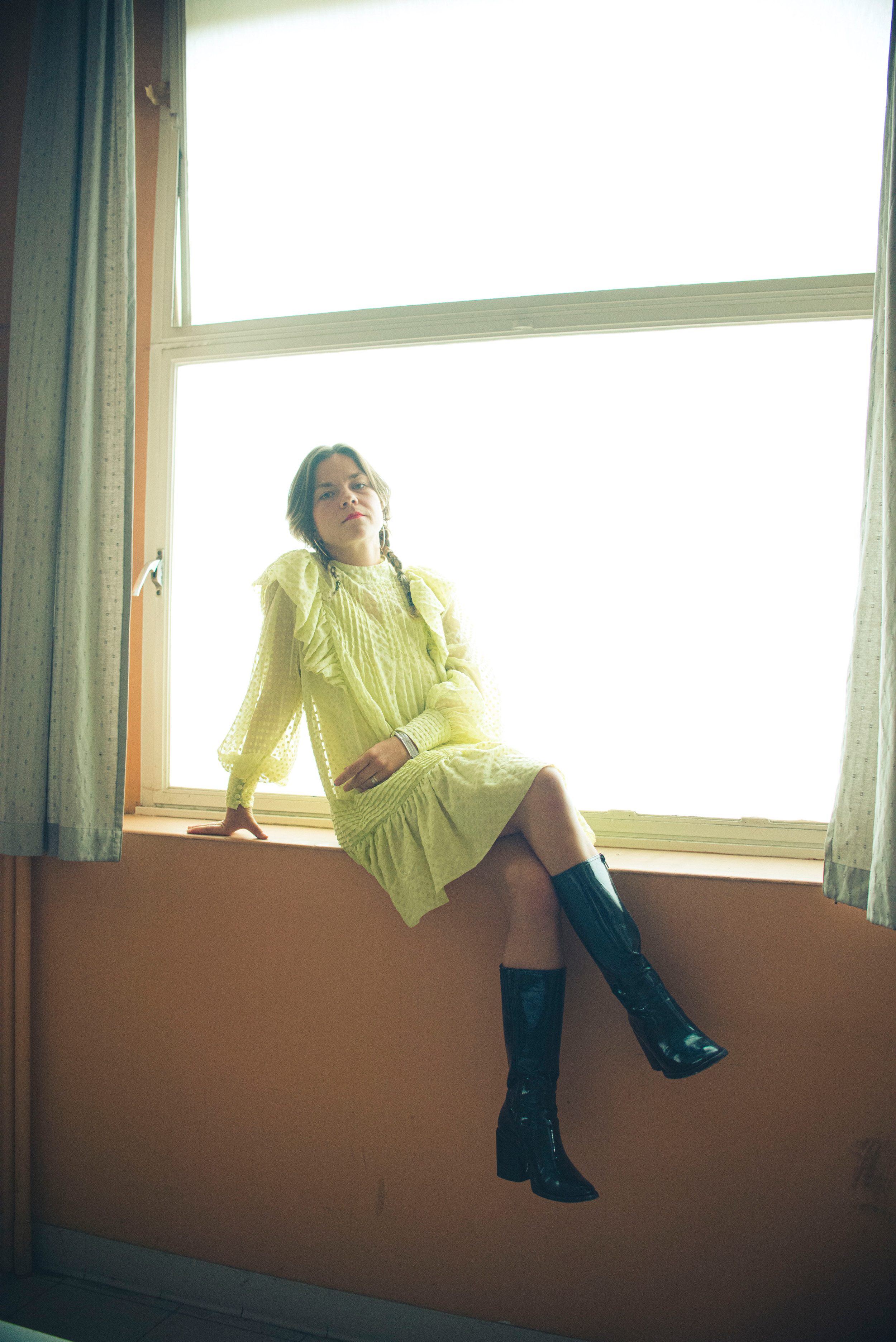
For this performance I work with the producer of the album who does the live sound, a light designer and a fashion designer who made a dress for the show. They are all wonderful people who know what they’re doing and whom I trust. This way the performance almost becomes a Gesamtkunstwerk. I think that is great. I love the fact that it becomes a shared story.
Sometimes, science and art converge in unexpected ways. Do you conduct “experiments” or make use of scientific insights when you're making music?
I’m definitely not making use of scientific insights. Phew, I get tired only by the thought of it.
I guess I’m constantly conducting experiments, but more in the sense of playing around, trying things and trying out different combinations. I think the approach of my work can be similar to how I imagine a biologist approaching his or her subject.
In the book Annihilation by Jeff Vandermeer there is a passage which I relate to. The protagonist (a biologist) regularly walks to an empty lot where a puddle has become a pond over time. She sits there and observes different species. By doing that she becomes one with the environment and the ego becomes trivial, she blends in with this transitional environment and forgets the world around her.
How does the way you make music reflect the way you live your life? Can we learn lessons about life by understanding music on a deeper level?
This quote of producer Rick Rubin says it all: The real practise of the artist is a way of being in the world.
For me music has a therapeutic effect. My life and my work are intertwined. That doesn’t mean I’m constantly working, not at all, for me going to the funfair with my family is as important as making music. Sometimes even more important. There is no hierarchy.
There are a lot of different aspects in life I try to be mindful about and therefore also in music, like staying amazed and being open for things that cross your path and giving space to coincidence. I practise being patient and being grateful. I also try to not take myself too seriously. I have this obsession with time and sometimes I make myself come late to learn to let it go.
Another big thing that I’m trying to erase is the idea of right and wrong. Every choice is a right choice. Some things that didn’t work out are just drafts for things that will work out later.
The idea that only hard work is good work I find total craziness. What matters to me is when you do things with care and patience. For example, taking the time to answer these questions is a part of my artistic practise but it’s also a reflection on life. I give them the time they need.
Do you feel as though writing or performing a piece of music is inherently different from something like making a great cup of coffee? What do you express through music that you couldn't or wouldn't in more 'mundane' tasks?
In my view, writing or performing a piece of music is not very different from tasks like making a cup of coffee or having a conversation. We all have the ability to be creative and make creative choices in our daily lives.
For example, choosing what to wear or how to make a cup of coffee can be just as creative as making music, depending on the approach we take. Do you make it with care? Do you take the time for it? Are you in the moment? Or are you just doing it as fast as possible? Something as simple as writing an email can become a little piece of art!
When I’m performing I’m sharing a part of myself with the audience, which can be very intimate. The act of listening to music has the potential to become a shared experience that can be both cathartic and transformative, creating a sense of unity and understanding that is hard for me to find elsewhere.
In the end, it's not the task itself that determines its creative potential, but rather the approach we take to it. By approaching even the most mundane tasks with care and intention, they can become meaningful experiences.