Published
Part 2
Sound, song, and rhythm are all around us, from animal noises to the waves of the ocean. What, if any, are some of the most moving experiences you’ve had with these non-human-made sounds? In how far would you describe them as “musical”?
Dave: That’s a lovely question, and one that makes me realize my definition of “musical” contains an element of organization. So, while I wouldn’t call a lot of the sounds in nature, or daily life, necessarily musical on their own, they often only need the slightest bit of organization to become musical.
I remember riding a city bus when I was a student. When you got on, you’d drop coins in a box that would mechanically sort them as they fell through various, increasingly smaller slots inside. It was rhythmic as hell, and I’d be sort of hypnotized by it, but there wasn’t a pattern. You couldn’t tap your foot to it. But it was almost music.
Another example that comes to mind is that I grew up on the edge of the woods and the sound of crickets was constant at night. I would lie awake and listen to how there was movement inside it, like murmurations in a flock of birds. Again, it’s not a repeating pattern, but it hits the heart like music.
We are increasingly playing with unusual time signatures and phrasings in the band these days and these coins and crickets often come to mind. How can you organize something natural without losing its organic quality? How far can your stretch and warp a pattern of beats or notes before it becomes too chaotic for the genre you’re in?
From very deep/high/loud/quiet sounds to very long/short/simple/complex compositions - are there extremes in music you feel drawn to and what response do they elicit?
Dave: I’m a hardcore listener to experimental music, particularly where very long drone compositions are concerned. It gives me something that’s difficult to describe.
Every so often I will drive someone to the airport, or on a road trip, and they’ll see what I have in my truck to listen to and just be horrified. “How do you not fall asleep at the wheel listening to this?” is a question I’ve gotten more than a few times. To me, those long, resonant, hyper-nuanced compositions give me the vigilant, ambiguous energy I was referring to earlier. If I’m going to fall asleep at the wheel, it’s going to be to the Beatles. But Éliane Radigue or Andrew Chalk have probably saved my life.
There’s a scene in film I saw a few years ago where a couple of idiots are listening to a new “minimalist” composition on an expensive stereo system and discussing its merits before realizing the record isn’t playing at all and they are just hearing the refrigerator in the next room.
I sound a little like one of those guys, I know, but I swear I’m being sincere.
From symphonies and traditional verse/chorus-songs to linear techno tracks and free jazz, there are myriads ways to structure a piece of music. Which approaches work best for you – and why?
Dave: Omen plays with folk and roots genres, so we didn’t concern ourselves so much with the concept of verses and choruses as much as we probably would have if it had been a straight alt rock album.
A lot of the roots and folk music we were pulling in as influences doesn’t have traditional choruses, so when we’d be working on a song and realize it didn’t have one, either—or that we didn’t know what to call a chorus and what to call a verse--we felt like we were synthesizing those genres in an interesting way without being calculated about it.
But on the album we’re writing now, most of the songs are longer, with more expansive bridges, with more spacious intros and outros, and we’re realizing we’re probably swinging into prog rock territory. These expeditions into genre aren’t planned as much as we’re just trying to follow some kind of collective energy and every now and then we all look up and realize “Ah, we’re over here now.”
Could you describe your creative process on the basis of one of your pieces, live performances or albums that’s particularly dear to you, please?
Dave: A song on the album that stretched us, while also showing us how we best collaborate is the song “Roaring Spring.”
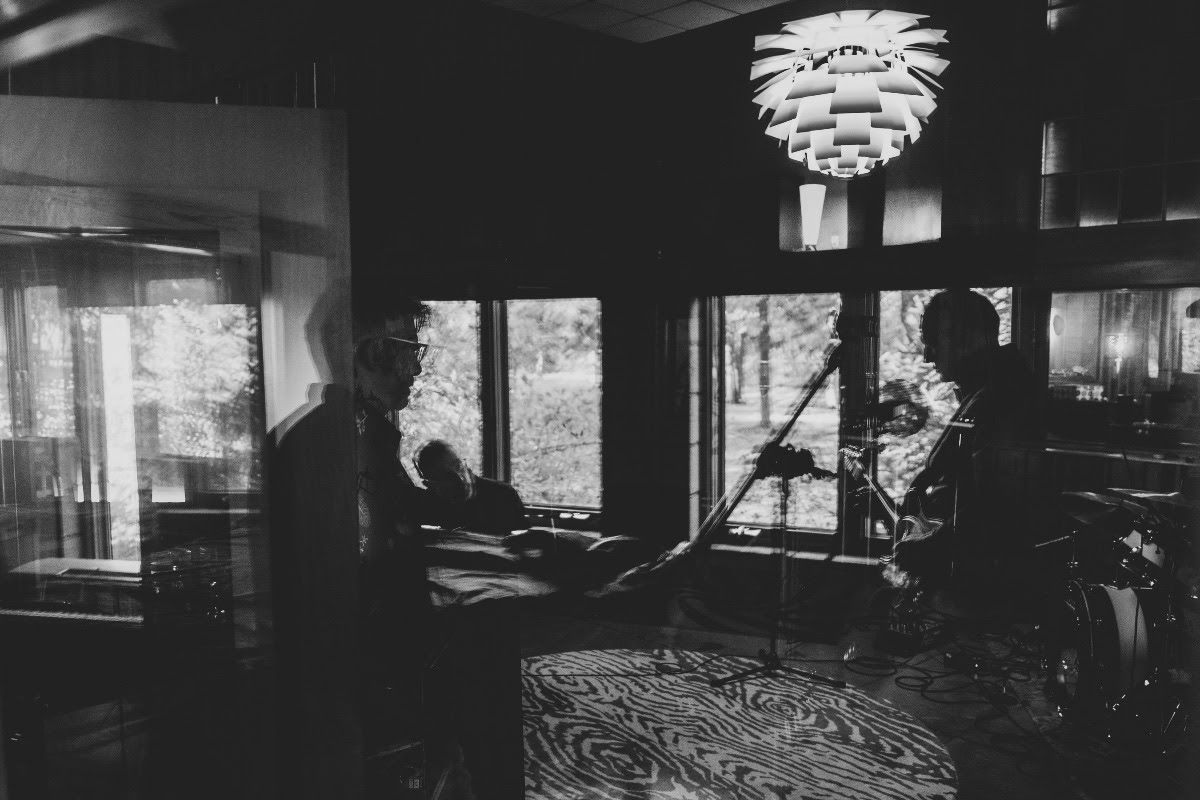
We weren’t in the same room when that song was born. We live in three different cities and come together as often as we can to write music at a farmhouse out in the Ohio woods near where Jer and I grew up. We’re usually there together, but one trip Tom couldn’t make it. Instead, he had sent us five unusual percussion rhythms to play with. Jerry had his acoustic and we were wrapping up a long day of work when we decided to play one of Tom’s rhythms just to see if we could get our heads into it.
Jer started playing some progressions that had a real rootsy tang to them and I just started singing, and from the point of view of the really furious character. I’d been doing a deep dive into Ralph Peer’s work in Tennessee recording for Victor Records and what came out of those sessions, but a lot of those musicians were pretty rural people and apparently it wasn’t always possible to locate some of them in the months and years after those sessions. So, I suddenly had this voice in my head of a man who’d recorded with Peer, and who went home feeling a bit commodified in the process.
The more we played, the more strange Jerry’s chords got. We were bending notes, sliding all around, and all to this odd rhythm of Tom’s. When we finally stopped and sent a recording of what we were doing for Tom to hear, he called us immediately, already inside it. We all knew what it was and how it should work. It’s pretty galvanizing when that happens; there’s communication going on that isn’t verbalized, but it’s so clear. Let’s call it synchronized intuition.
Writing that song gave us a lot of joy, angry as that character is. He’s one more ghost on a record that turned out to be full of them.
Sometimes, science and art converge in unexpected ways. Do you conduct “experiments” or make use of scientific insights when you’re making music?
Dave: I’m trying to think if there’s anything on Omen that can properly be called scientific. I don’t think so, not in the sense you mean. There’s a lot of curation of sounds in what we do, and pushing things in the mix close to the point of oversaturation or overstimulation. But that’s just about excitement, not science.
I wish we were more scientific. That sounds like a good ambition.
How does the way you make music reflect the way you live your life? Can we learn lessons about life by understanding music on a deeper level?
Dave: You can be ethical and thoughtful in any endeavor, so that’s the first thing that comes to mind. Craftsmanship is a choice and a value; Rigor is a choice and a value. But, beyond that, my gut is saying “stop there” because I think you’d have to make music for a long time to answer that question more personally in an honest way.
I will say we work until there’s no filler in the music, until everything is intentional and considered. And when the path forward is unclear on a song, and we’ve tried everything we want to try, we acknowledge that and move on.
Sometimes an unresolved song will come back around months or years later and that’s stellar, but sometimes unresolved songs go away forever and, in its own way, that’s stellar, too.
Do you feel as though writing or performing a piece of music is inherently different from something like making a great cup of coffee? What do you express through music that you couldn’t or wouldn’t in more “mundane” tasks?
Jerry: Maybe not coffee, but I’d say maybe a meal. You can use traditional ingredients in unusual ways. Or the reverse. You can push the boundaries of what’s expected. You can dress it up with extra production. But when you’re finished, does it taste good? Is it something you’d eat again? Or is it too bland, or too adventurous? Are there interesting notes or flavors you’d like to experience again? Is it too run off the mill? Or too finicky?
I like to think we shoot for music that is unusual, interesting, attractive yet mysterious enough to make you wonder a little bit. And keep you coming back.
Dave: I understand that question as teasing apart craftsmanship from creative intuition. I don’t know how to have my intuition fully firing in day-to-day tasks very much anymore, except in learning new things, which I try to do as much as I can.
One can certainly innovate in daily tasks, and that can be soulful, as can becoming expert at a more mundane activity. But I think what making music gives me that tasks can’t is a sense that I’m receiving, or participating in, something inexplicable. I’m listening to a space and filling it intuitively (and emotionally, if it’s going well).
As someone who’s never once made coffee in my life, and hasn’t had any incentive to get great at it, I think if I tried making you a cup by intuiting how, you probably wouldn’t drink it. And I would never want to write music primarily through a sense of craftsmanship.
You can tell when a band you love starts doing that. Isn’t that the beginning of the end?
Every time I listen to “Albedo 0.39” by Vangelis, I choke up. But the lyrics are made up of nothing but numbers and values. Do you, too, have a song or piece of music that affects you in a way that you can’t explain?
Dave: Here’s my theory about “Albedo 0.39”: Those numbers and values are delivered with such gentle intelligence it’s hard not to try to imagine a context for them in which that voice isn’t meant to be a reassuring one. It doesn’t sound like an android’s voice. It sounds like a human being worthy of whatever responsibility he’s been given, which is not my experience of a lot of adult life, so I’m with you in finding it moving.
For me, the piece that comes first to mind in terms of evoking an inexplicable reaction in me is Joe Jackson’s “Steppin’ Out.”
I am fucking terrified of that song and I couldn’t begin to tell you why. It produces in me a real, primal anxiety. Within the first five measures, my body is fully in flight mode. Same with Gary Wright’s “Dream Weaver.”
Amazing song, but the first minute is absolutely shit-my-pants terrifying to me. Why? WHY?
If you could make a wish for the future – what are developments in music you would like to see and hear?
Dave: I take the spirit of the question to be about music itself and not how it’s distributed or how musicians are renumerated--the wishes there are obvious.
But purely in terms of music, what comes to mind first is that I’d really love to see musicians collaborating more across lines of genre, but not in some watered-down middle ground. Remember that fantastic Loretta Lynn album Van Lear Rose?
It was absolutely a Loretta Lynn album in every way, but Jack White opened up the doors around her in terms of how it was produced and let in some elements that offered mutual respect and a shock of recontextualization. Suddenly a line between Lynn’s music and White’s music that might have been faint or unclear to their separate audiences, was now bright and straight.
I loved that album so much, more than any other Loretta Lynn album or any other Jack White album. What if Thom Yorke produced a José James album? Or Aldous Harding collaborated with John Adams? Etc. Etc. Even the misfires would be music we’d be lucky to have.