Published
Part 2
Over the course of your development, what have been your most important instruments and tools and how have they shaped your perspective on music?
Wooden flute first, as I did not have access to a saxophone right at the beginning. I was trying to play along with The Shape Of Jazz To Come, Codona 2 or Ayler’s Live at Hilversum with my recorder, and I was happy if I managed to catch one or two right notes.
Then of course the alto saxophone. 10 years of hard work for me, many daily hours of practice, many months if not years of street and subway playing in Berlin. And believe it or not, the saxophone is still my big love. I can’t really sing, but through my alto (and now also baritone) I am not ashamed to sing. Sometimes it becomes a nice multi-note, other times just an energetic growl. And I love the pure and shiny notes, projected directly from the heart and soul!
Then of course the early 4track cassette machines, the Tascam 4track tape machine, and the collection of instruments in the former cow stable studio of our family friend which I had access to and I which I all used for the early collages. Then the first turntables (DUAL) which I hated cause they were heavy & constantly in auto stop mode. And finally then the first DJ turntables, firstly in the beginning Omnitronic, then finally the Techniks 1210 MKII. Also the first heavy hardware samplers, and finally now my current sampler, which is basically a compact voltage controlled analog modular set-up I compiled. In between I had a love/hate relationship with computers and different softwares, finally I made my peace with them, as I use them in my own specific way and not on stage.
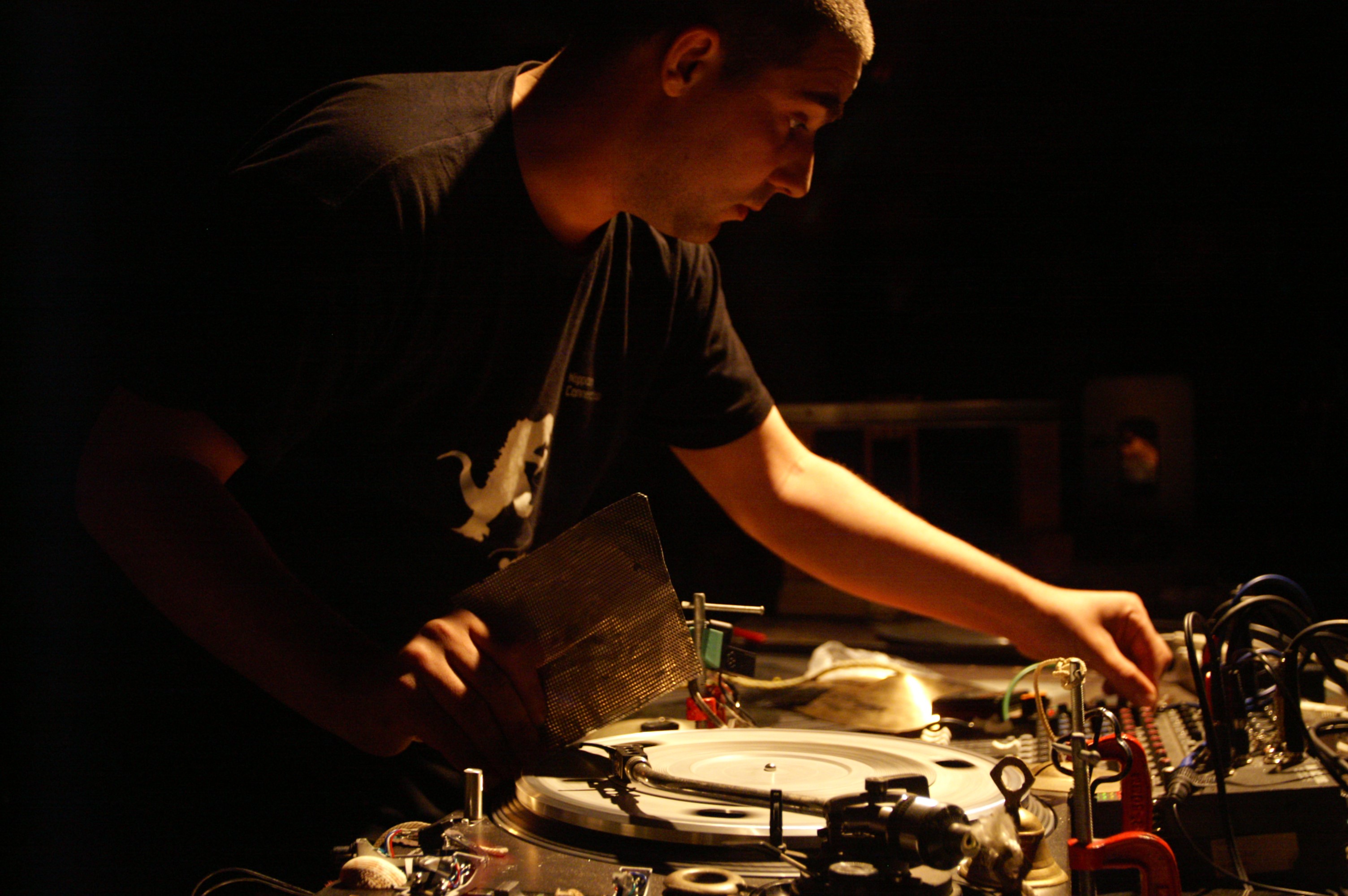
When it comes to turntables, for many years I did not even own a professional DJ turntable. Turntables were my second love after the saxophone. It is such a beautiful hands on and direct instrument, which you have to touch very gently sometimes. But with a good solid machine like the 1210 you can also go totally wild. The turntable will never let me down, and again it is like the act of love making for me, from the most tender to the most wild ecstatic moment. I am just in love with the sound, the warmth, the crispness, and the responsiveness, …
Of course it is a long long process, like in any relation and with any instrument. The instrument needs attention, understanding and many hours of devotion to learn and master the problems and challenges, … With the saxophone I will express myself by playing melodies, tones, it is my link to the ancestors and the history. With the turntables I am in the NOW and in the FUTURE. I can play in any exprimental style. It is the most versatile and adaptable instrument I have ever looked upon.
I also love percussion and traditional instruments from Non-European folk musics. I collect bamboo flutes, percussion instruments, and sound making objects. I use them for installations, and recently I have started building my own soundmakers and instruments again which I use for my compositions.
I am really bored by the usual sound effects and tricks which I hear everywhere. This is both in contemporary composed music and of course also in contemporary improvisation. Extended tricks which everyone copies from everyone, and very easily they degrade to nothing than being sound effects, endlessly recombined. I am not interested in this often flat trickstering. I want to hear the unique sound, the personal, individual and honest sound. I want to hear one note and know who it is, like with Don Cherry, Albert Ayler, Ornette Coleman, John Coltrane, Harry Partch, Paul Lovens, Christian Lillinger, …
I have done nothing else in my whole musical life than looking for my own individual tone, and I am slowly finding it. That’s exactly why I am building my own sound makers and instruments, like the Rotating Surfaces back in the day, or now many percussion instruments and acoustic objects, …
Back in the day when Don asked me to sit in for the first time with him after the set he came up to me and stated that he liked my tone, that he could identify my own individual sound, that this means a lot and that I should always trust this. That playing fast does not matter, that it would just happen by itself and that I should keep playing long notes.
What a wise man he was. I still practice long notes, and I always focus on the tone, no matter what instrument or music I play.
What, would you say, are the key ideas behind your approach to music and what motivates you to create?
It is an inner urge which motivates me to create. I cannot explain it, I cannot help it, I have to do it. It’s an inner voice which tell me to do so!
Some key ideas are “community and sharing“, sharing what I love so much with other musicians and finally the audience. And absolute freedom and openness, complete independence from the market and capitalist system of promoters, labels, etc. It is not easy but I try to do my best.
Of course I have to pay the rent and survive. But I never compromise my music. I’d rather go back to playing in the subway to earn my living before I’d have to compromise on my ideas. Luckily I am in a position now that some people do appreciate what I do and they give me opportunities to perform and realize my visions. But who knows how long that lasts.
There is no recipe, system or style I follow. I believe in the openness and curiosity I was taught by Don Cherry. This same openness leads to different musics and collaborations. And these encounters with musicians allow me to travel worldwide and allow me to share my thoughts and ideas with other musicians and communities.
I also believe that almost everything had been said in music, or has been done already, even in Ancient or Medieval times, that we just perform variations. That’s why I use samplers and turntables and I de- and reconstruct existing sounds into something else, into a new context.
With my acoustic playing it is slightly different and less direct. But at the end of the day I also just re-mix my favorite phrases and melodies, like I constantly re-construct and re-assemble them.
Paul Simon said “the way that I listen to my own records is not for the chords or the lyrics - my first impression is of the overall sound.” What's your own take on that and how would you define your personal sound?
I almost never pay attention to lyrics. And I don’t worry about chords and harmony too much either. I have to actually force myself to listen to lyrics, and I cannot quote song texts, … I listen mostly to instrumental and abstract music, or African music where I cannot understand what they're singing. Then lyrics become totally abstract, like voice / lyrics / language become melody / rhythm / sound or timbre to me.
What I always listen to first is the “unique personal“ sound of a musician. If I cannot find a personal sound / voice, I will not be interested to spend more time on it. And secondly I listen and look for surprise, something novel I have never heard before. Maybe it comes from those days when I got hooked and found the music of Don Cherry, back then almost every album of his vast discography was different and exciting for me.
Maybe that’s why I still look for surprise, even though they have become far more rare. And mostly I find them in traditional music from Africa and Asia nowadays. There is still so much to discover in tribal and ritualistic music, it is so many times amazing and exciting!
Sound, song, and rhythm are all around us, from animal noises to the waves of the ocean. What, if any, are some of the most moving experiences you've had with these non-human-made sounds? In how far would you describe them as “musical”?
When I heard the Australian group Machine for Making Sense on the Austrian radio, they were using field recordings and they opened my ears and mind. It was amazing to understand that any sound around us can be used as music, you only need to consciously compose it into a piece. Or just declare it music. Of course John Cage was also an important forerunner of this ideas and very important for me and my further development as an artist.
Later I found out many others had already used noises, soundscapes or non-musical sounds, like Erik Satie, the Futurists, Edgar Varese, and so on. And of course the whole Musique Concrète movement in France and later worldwide. But I was initiated through Machine For Making Sense and Rik Rue and Jim Denley who were recording and using environmental sounds in their music. Inspired by them I took my Walkman and started recording our entire farm life, my mother milking the cows or the rhythmic repetition of her knitting machine, my father hammering in the wood workshop, a strong rain storm, the neighbor's dog, …
I used all these sounds and combined them with African drum loops & other rhythmic samples in my first tape collage piece which I performed live around 1987 or 1988 and which was called “che“. I performed this piece when I was around 15 years old at a family friend's Summer festival. My parents weren’t aware that I had been recording them and composing for weeks and were completely speechless and touched.
My father was close to tears when he realized how I secretly recorded and re-contextualized their working sounds and when they realized how much rhythm and beauty was hidden in their daily work routines at the farm, … In Africa people know this. Women are pounding cassava in sync or in polyrhythms and they sing along, like this daily work becomes much easier and a big joy, the joy of music. Work becomes music, and music no longer feels like work either. Today there many people doing so-called field recordings, but only rarely do I hear new and interesting approaches. Recorders are cheap and so are the results mostly.
But there are exceptions. Just recently I heard a young musician from Vienna, Stefan Vogelsinger. He performed a beautiful, pure and unique set with an eight track digital recorder. He played back field recordings and chose in real time which sections he wanted to use. All this he combined with several simple piezo contact mics which were amplifying his chair, and a few objects he had attached.
He was running the piezos through the mic pre-amps of the recorder, and so the field recorder was source/player/mixer and pre-amp in one. He turned the field recorder into his own and very unique instrument, he really knew what he was doing and he sounded absolutely fresh, individual and amazing! I never heard anyone play like him before!
From very deep/high/loud/quiet sounds to very long/short/simple/complex compositions - are there extremes in music you feel drawn to and what response do they elicit?
Oh, extremes are always good, I find. From silent to loud, noise versus melody, or from a fragile solo to a loud tutti burst out, … It’s probably because I come from collage, and collage means constantly juxtaposing opposing and not fitting elements. For some it might seem like too many extremes, but to me it is simply contrast.
Same with musical styles I am involved in. I love melodic Free Jazz, one day slow moving extreme walls and layers of noise, another day super fast and dynamic cross-cut music with a strong rhythmical element, yet another day slow and dark drone music, or crisp electro-acoustic improv, again next day purely acoustic music with classical contemporary character, then ambient, industrial, …. I love contrast. If I would have to play always the same style of music, I would get totally bored and worn out, it would make me feel sick!
Again, this links me directly to Don Cherry, the many faces of, with the ears wise open!! The only condition I have, it has to be innovative and experimental. It can even be successful, but I hate when things are done entirely for commercial expectation and not for an inner need or urge!