Published
Part 2
Could you describe your creative process on the basis of a piece, live performance or album that's particularly dear to you, please?
I would say, it is actually my debut mini album, Notes on Listening which is particularly important to me, as it represents the culmination of years of experimentation and exploration. The album was built around natural elements, silence, and focus that I have found from moving to the countryside. It is a blend of neo-morning electronica, kosmische, and foley recordings.
But there were three key techniques that really helped shape the album: aleatoric music, minimalism, and fundamental waveforms.
Aleatoric music is all about chance and unpredictability in the composition process. I mean, who doesn't love a good surprise? Didn’t John Cage say that by removing the composer's ego from the equation, the music can more accurately reflect the chaos and unpredictability of the world around us.
In Japan, there is a form of music called "gagaku," which includes improvisation and indeterminate elements. In gagaku, the musicians follow a conductor who gives signals and cues, but the music is not fully predetermined. Similarly, in Chinese traditional music, there is a concept called "luogu," which involves improvisation and the use of chance elements such as tossing sticks to determine the structure and content of the music. It's like rolling the dice and seeing what happens - you never know what you might come up with!
In addition to the minimalist phasing pulses of Steve Reich and the hypnotic arpeggios of Laurie Spiegel, I have also drawn inspiration from the repetitive and meditative sounds of Korean traditional music, particularly the mesmerizing sound of the “gayageum”. The way in which the gayageum player delicately plucks the strings with precision and care to create a steady and unchanging rhythm is truly mesmerizing.
Furthermore, the Middle Eastern maqam system has also influenced my approach to minimalism, particularly in the use of subtle variations in pitch and melody to create a sense of movement and progression. The microtonal intervals and intricate melodic structures of maqam music have provided a rich source of inspiration for my own compositions.
And let's not forget about the cyclical and rhythmic patterns of Indian classical music, particularly the use of the tabla and other percussion instruments to create an entrancing groove. The way in which these rhythms evolve and develop over time is a testament to the power of repetition and subtle variation in creating a sense of momentum in music.
I know you have only asked for one example, but all these influences have had a huge impact on my work, allowing me to explore the transformative effect that even small changes can have on a piece.
Lastly, on fundamental waveforms! Where you start with a basic waveform and manipulate it through synthesis techniques, repeating patterns, and subtraction. It's like building a sonic lasagna, layer by layer, until you've created something that feels right to you.
All in all, these techniques allowed me to create music that is unpredictable, and richly textured. Notes on Listening is a way to process my anxiety, and my research findings on electronic music –– nostalgic yet forward-thinking, and a reflection of my own perspective.
Listening can be both a solitary and a communal activity. Likewise, creating music can be private or collaborative. Can you talk about your preferences in this regard and how these constellations influence creative results?
I think it's important to approach both listening and creating with an open and receptive mind, regardless of whether you're doing it alone or with others. When we take the time to really listen, we can discover new layers of meaning and nuance in the sounds around us, and that can be a powerful source.
As for collaboration, I find that working with others can be incredibly enriching, both creatively and personally. When we share our ideas and perspectives, we can create something that's truly unique and reflective of our collective vision.
Of course, there's also something to be said for working alone, where you have complete control over the creative process and can really dig deep into your own inner sphere. But I think that no matter how we approach it, the key is to be fully present in the moment and open to the possibilities of what can be created.
How do your work and your creativity relate to the world and what is the role of music in society?
… without music, I'd be a complete mess! Whenever I'm feeling anxious or overwhelmed, I turn to my trusty playlists to help me get through it. But seriously, I truly believe that music has a crucial role to play in society. It has the power to bring people together, to inspire and to heal.
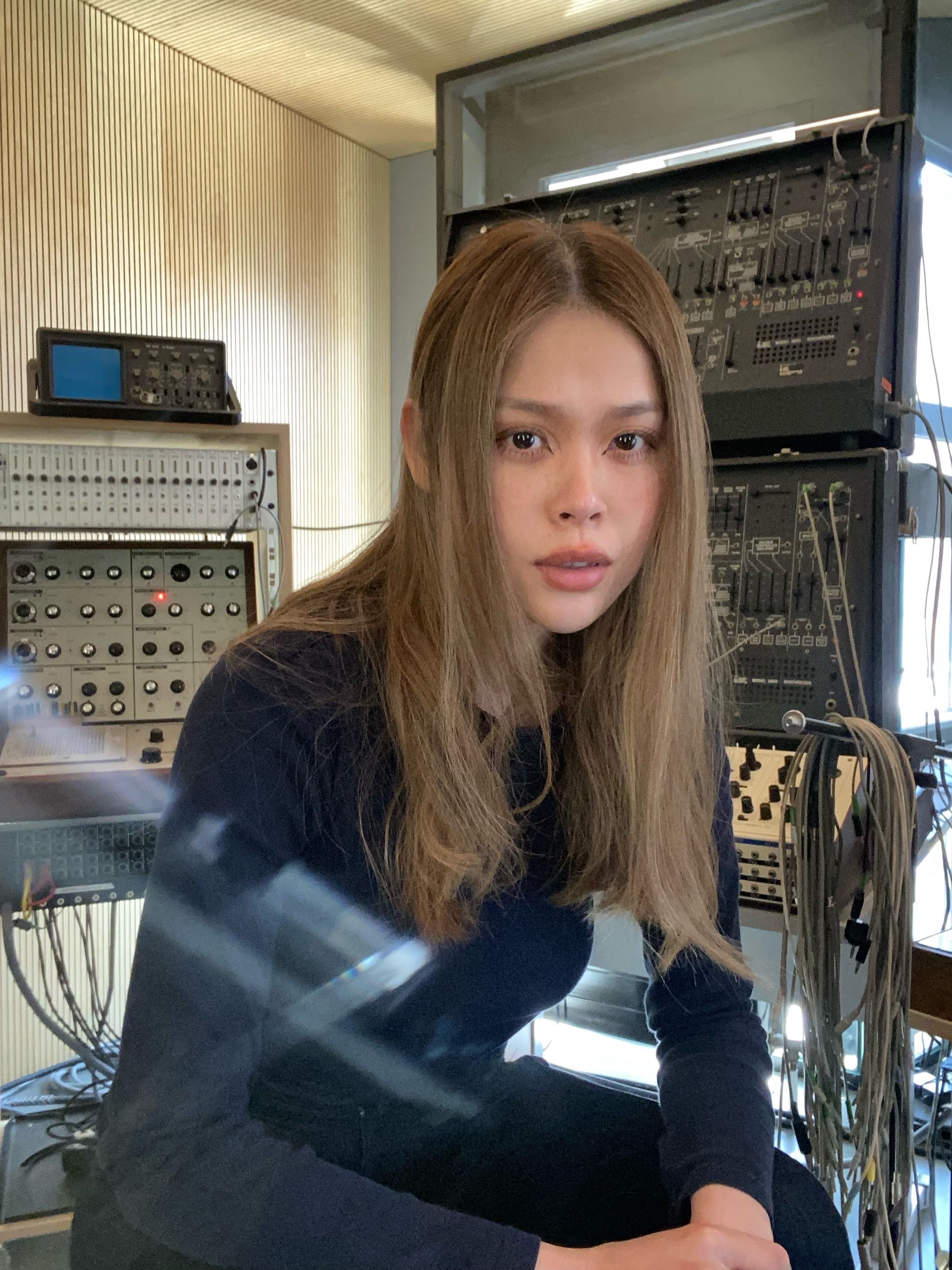
My work is all about exploring our relationship with the natural world, and seeking to transmute the wondrous of our surroundings into auditory form. Whether it's through a distorted drone in F on the Serge System or a rhythmic beat on the EMS VCS3, or just the recording of a glass of water being filled, I hope to create something that connects with people on a deeper level and makes them feel something.
If we can use music to bridge divides and foster greater understanding and empathy between people, well, that's even better! Regardless of our differences.
Art can be a way of dealing with the big topics in life: Life, loss, death, love, pain, and many more. In which way and on which occasions has music – both your own or that of others - contributed to your understanding of these questions?
I couldn't agree more. Music has been an especially important tool for me in understanding these topics, it can be incredibly healing and cathartic. In fact, music has been a way for me to connect with some of the most important people in my life.
My auntie who has introduced me to Gameboy and Super Mario, as well as Teresa Teng's music, was a major influence on me. She struggled with bipolar disorder and severe depression, and unfortunately, mental health was not a widely accepted topic in China at that time. My grandparents would make unfair excuses for her behavior, I could see that she was suffering. Tragically, she ended up taking her own life while I was studying in the UK, leaving me a letter stating that she didn’t want me to be upset.
Track 5 on my album, "Petrichor," is dedicated to her specifically –– It has a melody that always reminds me of her and her favorite smell, which was the inspiration for the track's title. Creating this piece of music was a way for me to process my grief and to find solace in her memory.
How do you see the connection between music and science and what can these two fields reveal about each other?
Both fields are essentially two sides of the same coin, both about figuring out how the world works and what makes it tick. When it comes to music, we're exploring the properties of sound, how it travels through space, how different frequencies interact with each other, and how we perceive it as human beans. But guess what? These are all things that scientists study too!
The study of acoustics, in particular, is all about understanding the physical properties of sound and how it interacts with the environment around us. And when we start diving deeper into the science of music, we can even get into some pretty complex mathematical principles like harmonics, resonance, and frequency analysis.
Trying to think whether music has certainly inspired scientific discovery and innovation … I guess it is less common but there have been instances where music has played a role in scientific breakthroughs.
Take binaural beats, for example …These are like auditory illusions that happen when two slightly different frequencies are played in each ear. They were first described by a German physicist named Heinrich Wilhelm Dove way back in 1839. Since then, binaural beats have been used in neuroscience research to study how our brains process sound. Who knew that listening to music could teach us so much about our brains?
Similarly, the study of acoustics and sound waves, which is closely related to music, has led to numerous scientific discoveries and technological innovations, such as the development of ultrasound imaging and the creation of new materials with unique acoustic properties.
But the connection goes both ways. Because, just as science can help us understand the nature of music, music can also help us communicate scientific concepts and ideas. TBH scientific concepts can be pretty complex and hard to wrap our heads around. But when you put those ideas into a musical context, suddenly they become a lot more accessible and easy to understand.
Creativity can reach many different corners of our lives. Do you feel as though writing or performing a piece of music is inherently different from something like making a great cup of coffee? What do you express through music that you couldn't or wouldn't in more 'mundane' tasks?
Creativity is like a ninja - it can sneak up on you and strike at any moment, no matter what you are doing.
Making coffee might not seem like the most creative task, but it requires a certain level of artistry, knowledge, and patience to get that perfect balance of flavor and aroma … Same for doing washing up or mopping the floor, is not easy to clean the dishes spotless without leaving any marks or to mop the floor without destroying its natural texture.
When it comes to music, there's just something special about the way it can tap into our emotions and take us to a different place. I mean, have you ever listened to a song that just gave you goosebumps or made you feel like you were flying through space? Or that it makes your tension headache disappear into thin air?
For me, it is a way to express the unexplainable stuff that just can't be put into words.
Music is vibration in the air, captured by our ear drums. From your perspective as a creator and listener, do you have an explanation how it is able to transmit such diverse and potentially deep messages?
As I mentioned earlier, music is a powerful tool, and we have to use it ethically … It's a force that can make us feel everything without even saying a word. It's all about the different elements that make up the sound, like melody, harmony, rhythm, and timbre.
For instance, minor keys and dissonant harmonies can create a feeling of sadness, while major keys and consonant harmonies can make us feel like we're on top of the world. And don't even get me started on the power of a good beat - it can make us want to dance, run a marathon …
But it's not just about the sounds we hear. It also has the power to connect us to the natural world and the universe at large. By using sounds like bird calls, wind chimes, and water sounds, we can tap into the rhythms and patterns of the world around us and find a sense of clarity and serenity.
Almost like a universal language that speaks to all of us, no matter where we come from or what language we speak. It's a powerful tool that can help us communicate complex emotions and ideas in a way that words sometimes can't.