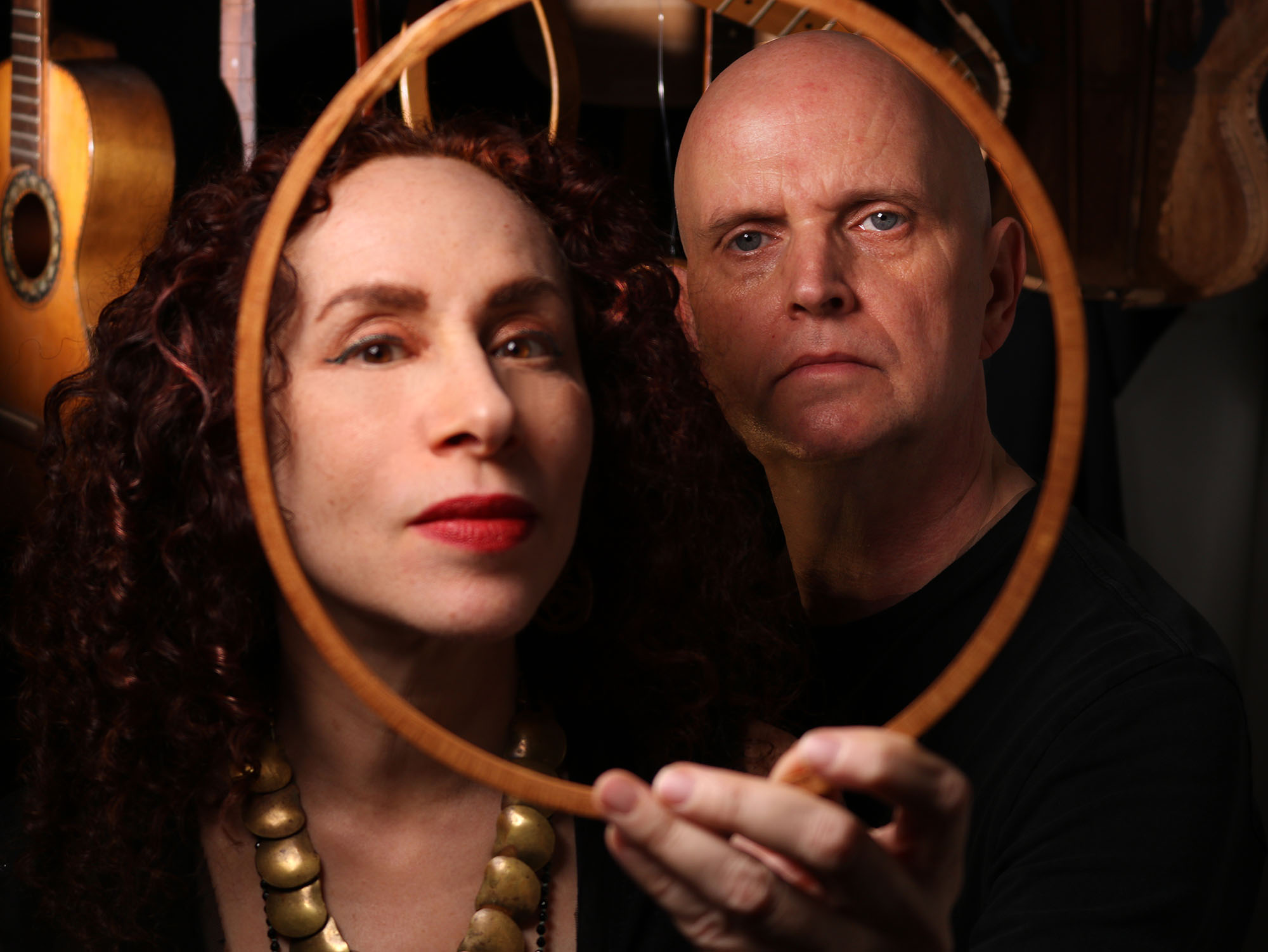
Published
Part 2
Are you acting out parts of your personality in your music which you couldn't or wouldn't in your daily life? If so, which are these? What, would you say, are the key ideas behind your approach to music?
Tom: I don't think so – but I would not walk around singing or talking in rhyme in my daily life – so there is that artifice. I think the elements of collaboration and experimentation are the key methods and approach.
Cheryl: Truly – I think if we didn’t share so many perspectives, we wouldn’t be able to collaborate, and that also lends us the ability to experiment.
If anything, I think our music amplifies elements that exist within us.
If music is a language, what can we communicate with it? How do you deal with misunderstandings?
Cheryl: Part of the process of creating any artform is coming to terms with the fact that not all works can connect with all people. If someone connects to something in a way that wasn’t intended – well, no one can control that.
Tom: I think misunderstandings are inevitable. It is all in the mind of the viewer and listener and to a certain extent perception is reality for them.
I think emotions are obviously communicated musically. I think the lyrics and titles are far more likely the source of any misunderstandings. Since you can't live forever, and the work stands without you – I don’t see how you can avoid interpretations that are not exactly in sync with your intention.
Making music, in the beginning, is often playful and about discovery. How do you retain a sense of playfulness and how do you still draw surprises from tools, approaches and musical forms you may be very familiar with?
Tom: Changing instruments and compositional methods while working with a partner and collaborator helps to keep things fresh, playfully, and experimental.
Cheryl: This is very true for our new album. I was a bit sad at first to see Tom shift so far away from bass and guitar – but I loved the elements he created without them, and it was fresh and inspiring to see how I could contribute given a new palette of sounds.
Sound, song, and rhythm are all around us, from animal noises to the waves of the ocean. What, if any, are some of the most moving experiences you've had with these non-human-made sounds? In how far would you describe them as “musical”?
Tom: Fire sirens, car horns and train sounds have always fascinated me. Bird songs and calls, the squirrels and their wild vocal noises and shouts – sounds belonging to both natural and urban environments are very interesting.
Cheryl and I spend part of every day listening to animals. For years there was a car alarm in our neighbourhood that sounded like the beginning of “Purple Haze.” The sound of heavy equipment dredging the river near my house when I was a child still comes into my mind many years later – mechanical rhythms have always interested me. The sound of the washing machine or a drill.
If they are organized into a structure any of these sounds could obviously be part of a musical experience.
Cheryl: You forgot to mention the dishwasher – we both start tapping to its rhythm! It’s even better when the dishes aren’t loaded quite right, and things clang around …
The train line near our house sounds really mournful late at night – it’s one of the most singular sounds – and it’s got this fantastic doppler shift that’s hard to ignore.
There seems to be an increasing trend to capture music in algorithms, and data. But already at the time of Plato, arithmetic, geometry, and music were considered closely connected. How do you see that connection yourself. What aspects of music do you feel can be captured through numbers, and which can not?
Tom: Probably all of it can be recorded or captured or described with complex math. If the resolution and depth of the capture is great enough maybe numerical representation will be indistinguishable from the original. I don't know.
Cheryl: The connection feels like it must be innate … It seems like resolution is becoming more and more complex and should be ever-expanding …? I don’t know either!
How does the way you make music reflect the way you live your life? Can we learn lessons about life by understanding music on a deeper level?
Tom: I hope so. If listening to music made and performed by other people does not give you a deeper understanding of the lives, minds, and experiences of others – I don't know what could.
Music is as powerful as art, books, films, plays and lectures. Learning from the thoughts, experiences and observations of others while potentially tapping your feet. What could be a better way to develop a deeper understanding of music and life at the same time.
Cheryl: We may be biased, but we’ve often discussed how other art forms can’t capture emotion as well as music. Perhaps moving images come close … but even silent films usually had sound to accompany them – piano scores were sent along with films early on.
We can surround us with sound every second of the day. The great pianist Glenn Gould even considered this the ultimate delight. How do you see that yourself and what importance does silence hold?
Tom: I almost never have music on as background sound. I like quiet. When I want to listen to music i try to give it as much attention as I would a film or book. I would not read while listening to music.
The Glenn Gould quote is interesting. I would consider listening when I can fully enjoy and give attention to the music a delight as well. But I would not want to hear music all the time.
Cheryl: Absolutely. I actually find it difficult to be in situations where silence is not a choice! The phrase “hear myself think” often occurs to me. Sonic space is needed to experience, then respond to the world.
Being actually forced to hear other people’s choice of music can be one of the most aggravating experiences … you’d think we wouldn’t have to endure that so often now because so many options exist for such wonderful quality in-ear listening …!
Do you feel as though writing or performing a piece of music is inherently different from something like making a great cup of coffee? What do you express through music that you couldn't or wouldn't in more 'mundane' tasks?
Tom: Although I appreciate making a great cup of coffee – I don't think it has potential lasting power of an artistic creation.
Ideas and emotion are what I would hope to express – along with an interesting groove and structure - that would be far beyond the possibilities any cup of coffee I've ever had. Hopefully.
Cheryl: Well, I’m mostly a tea drinker, but I can appreciate the value of a great cup of coffee! No matter how special the tea or coffee – hopefully in music we can express something unique?
However, if we shift to chocolate – all bets are off! I’ve experienced some utterly amazing creations in chocolate – maybe there isn’t so much of a difference!
If you could make a wish for the future – what are developments in music you would like to see and hear?
Tom: If and/or when the UAP or UFO or whatever they are called at that time start communicating – I hope it is with music.
Cheryl: One of our most favorite recent discoveries is that the immediate areas surrounding cave paintings have fantastic acoustics. Logically, they were likely early dance clubs – or at least music venues!
For the future, I would wish for a development to ensure viruses – microbes of any kind actually – cannot ever again prevent people from gathering to enjoy music. It’s obviously an ancient and deeply rooted need.