Published
Part 2
Sound, song, and rhythm are all around us, from animal noises to the waves of the ocean. What, if any, are some of the most moving experiences you've had with these non-human-made sounds? In how far would you describe them as “musical”?
Natural sounds (or natural events, even visual ones, that I find absolutely musical, such as for example the marvellous iridescent shapes that flocks of birds create in the sky, which I consider absolutely exciting and moving) are for me the true essence of music.
Yes it can say non-artificial or non-manipulated music, pure music, which is characterized by regularity-irregularity, symmetry-asymmetry, harmony-inharmony, it can contain everything and nothing, it does not particularly express romantic, ethical, sweet, violent, ugly, beautiful feelings, but somehow it can express all this and more, infinite variety and contrasts. I think it's the most neutral and innocent music. It expresses a force and meaning in its real nature. In short, it is real music that comes closest to an idea of freedom in today's music and therefore is a great source of inspiration for me.
When you are in certain places, you can hear a wonderful combination of natural sounds, such as rain in a forest, thunders, sea waves, birds singing, etc. Each of these events could be a unique, unrepeatable and moving experience. It could be a source of inspiration and part of composition at various levels, from musique concrète and sampled to extended techniques that can reproduce and imitate these sounds in various ways.
From very deep/high/loud/quiet sounds to very long/short/simple/complex compositions - are there extremes in music you feel drawn to and what response do they elicit?
In the past, aphoristic compositions, made by a few dilated sounds or very articulated, dense and concentrated sounds in a very short time, were my passion. I tried to condense musical thought even in a few seconds, fascinated by many compositions by Kurtag (who in my opinion is an unparalleled master in managing very short musical tempos and in concentrating very powerful ideas in a small space).
I have also worked a lot with musical theatre in the exploration of short musical forms and I have also written works for ensembles (for Patricia Kopatchinskaja and Camerata Bern) where I even tried to compress a “violin concerto” into 4 minutes. It's a fascinating challenge to deal with the small forms and you can learn a lot about the control and balance of musical form in general especially when you then decide to create much larger, more complex and large-scale works.
In the last 10 years, I have tackled the writing of no less than 10 large concertos for soloist and orchestra and found myself dealing with a rather large form with a remarkable duration ranging from 30 to 40 minutes. In both cases (shorter or larger form) the prevailing feature in my writing was (and still is) the absolute variety and very sharp contrasts, obviously proportionate and balanced on the basis of the length of the pieces. I must say that the contrast applied to multiple parameters is now my compositional rule, especially in my last recent compositions, with a more abstract language.
When you manage abstract material, you have to create strong contrasts to determine a variety and a continuous surprise in the listener. The level of attention in the psycho-perception of listening is based on this principle and dictates very specific rules that must be respected when writing new music.
What fascinates me the most is always having a sense of absolute freedom in what I write but then slowly I build the "rules" that the material itself suggests to me to adopt, so that the music works. This is one of the mysteries of the creative process which cannot be explained but is fully experienced when you are manipulating any sound material.
From symphonies and traditional verse/chorus-songs to linear techno tracks and free jazz, there are myriads ways to structure a piece of music. Which approaches work best for you – and why?
As I said in other answers, currently my research is based on pure and abstract sound, freed from any semantic association.
The example of authors such as Ligeti, Xenakis, Boulez, Stockhausen and many others, led me to reflect a lot on my motivation to make music. I'm not interested in pastiches, quotations, or more or less clear references to one style or another, to one genre or another. Clearly today we are all connected and we are influenced (even unknowingly) by all the musical phenomena that are around. But music for me must be a pristine area, a kind of oasis, something that defines itself because it simply exists as a physical phenomenon, rather than a signifier. This is now my prevailing address in what I am writing.
I spoke of a point on an unconscious level that defines a musical idea, well, for me the ideal point is like a seed, or a cell that self-regenerates and proliferates on itself. I just want to let this almost spontaneous process go in its freest possible direction.
Could you describe your creative process on the basis of one of your pieces, live performances or albums that's particularly dear to you, please?
My latest album Woven Lights is certainly the most representative first album of my career, a record that I hold dear because it contains the first experiments of a radical change in my musical conception.
The Violin Concerto contained on this disc is a work from 2015 and then we have "Chaconne", a piece for electric violin and electronics from 2021. In fact, since 2015 I have started to change my creative perspective by focusing on sound, colours and properties of bright sounds that for me naturally determine many poetic and expressive contents, also highlighting a new idea of melody.
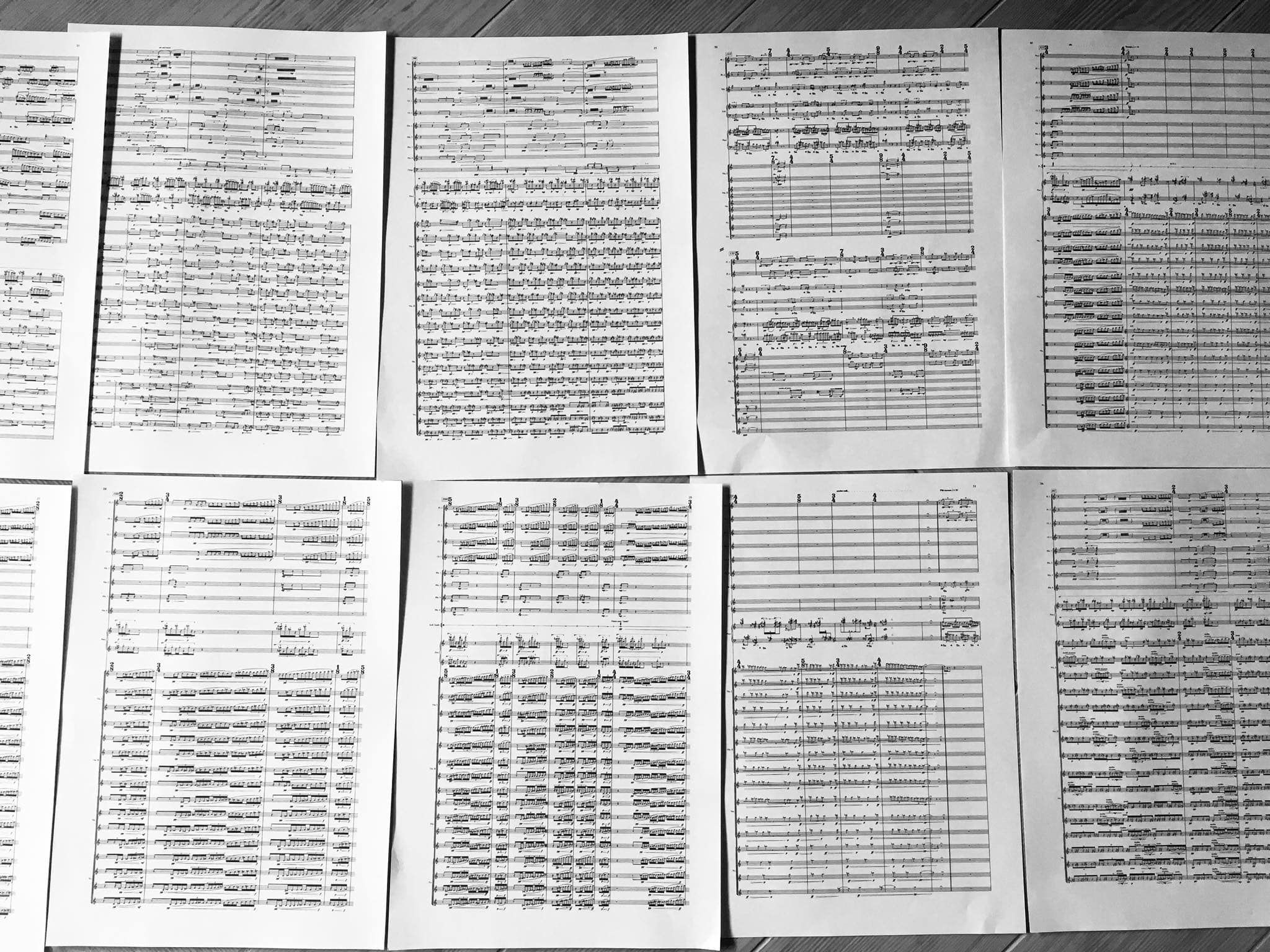
The form of my pieces has had a constant characteristic over the last 10 years: each work is mainly conceived in a single movement, without clear subdivisions and separations but a variety, without solution of continuity, of excited developments and suspended moments. This allows me to think of the form of a piece as a single living organism composed of various parts and contrasting episodes, which are always connected and interdependent.
This happens especially with large-scale pieces such as those contained in this album.
Sometimes, science and art converge in unexpected ways. Do you conduct “experiments” or make use of scientific insights when you're making music?
Absolutely yes. As I said before, in recent years I have become passionate and interested in astronomy which also includes phenomena related to physics and chemistry.
This world apparently far from music (as we are normally used to thinking and listening to it) actually has a very strong relationship with the world of sounds. I draw a lot of inspiration from these scientific processes to imagine the evolution, proliferation and transformation of sounds and in general of all musical parameters.
In my Piano Concerto (2017-18) I represent a sound vision of a large black hole through a sense of gravitation achieved thanks to a particular rotation of the sound between the instruments in the orchestra.
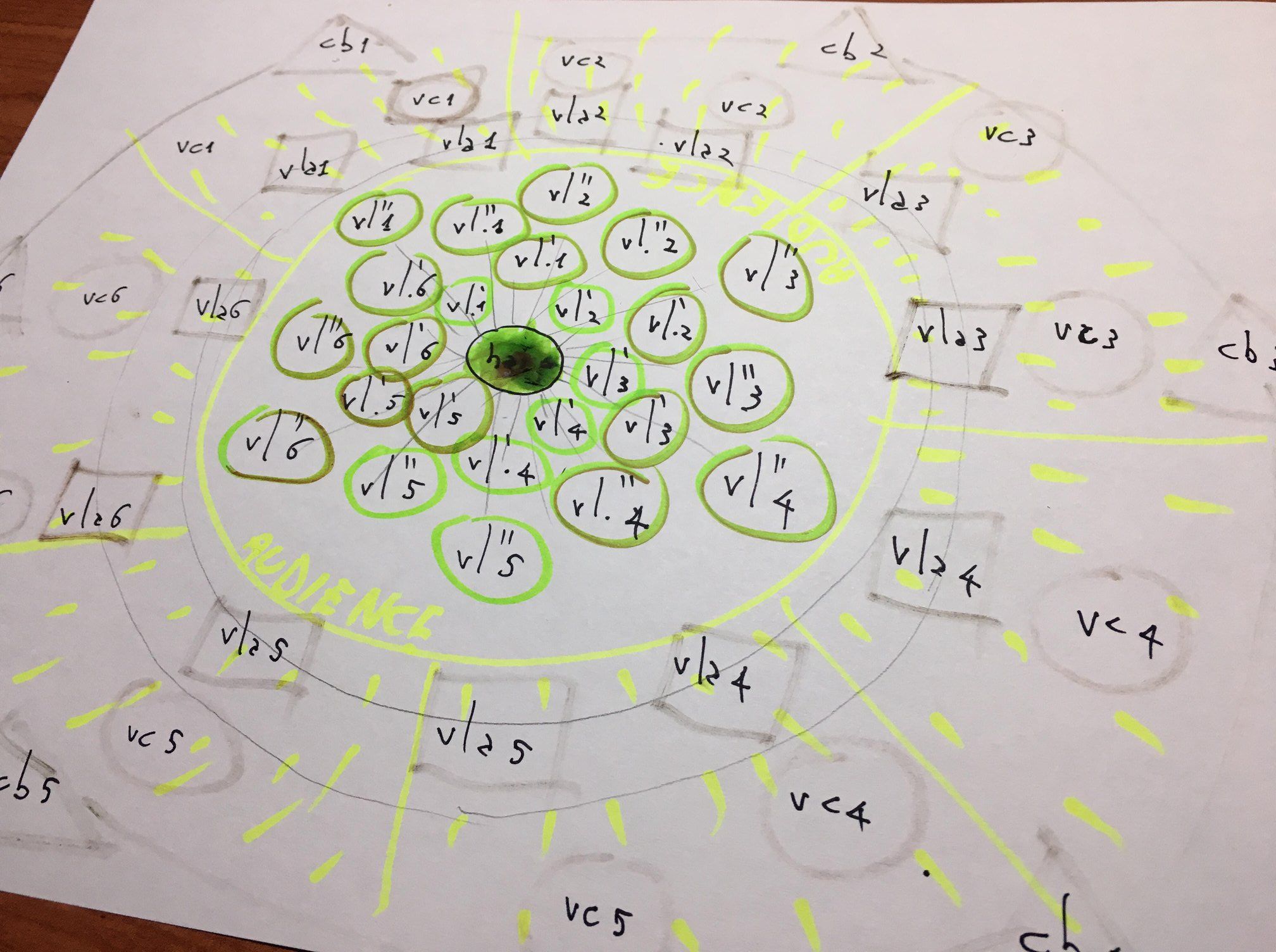
In the case of the Drops concert (2019) for harp and strings, I describe the phenomenon of concentric waves that propagate and break each other on the water surface caused by the fall of sound drops. Here too the spatialization and the particular arrangement of the instruments in a concentric form underline the spatial importance of my music.
I'm also writing piano studies where I look for natural harmonics on strings, with a reference to quantum theory. In the work I've just finished, dedicated to the Ensemble Intercontemporain, I have an idea of "seeds of light" that reproduce each other, somehow recalling string theory.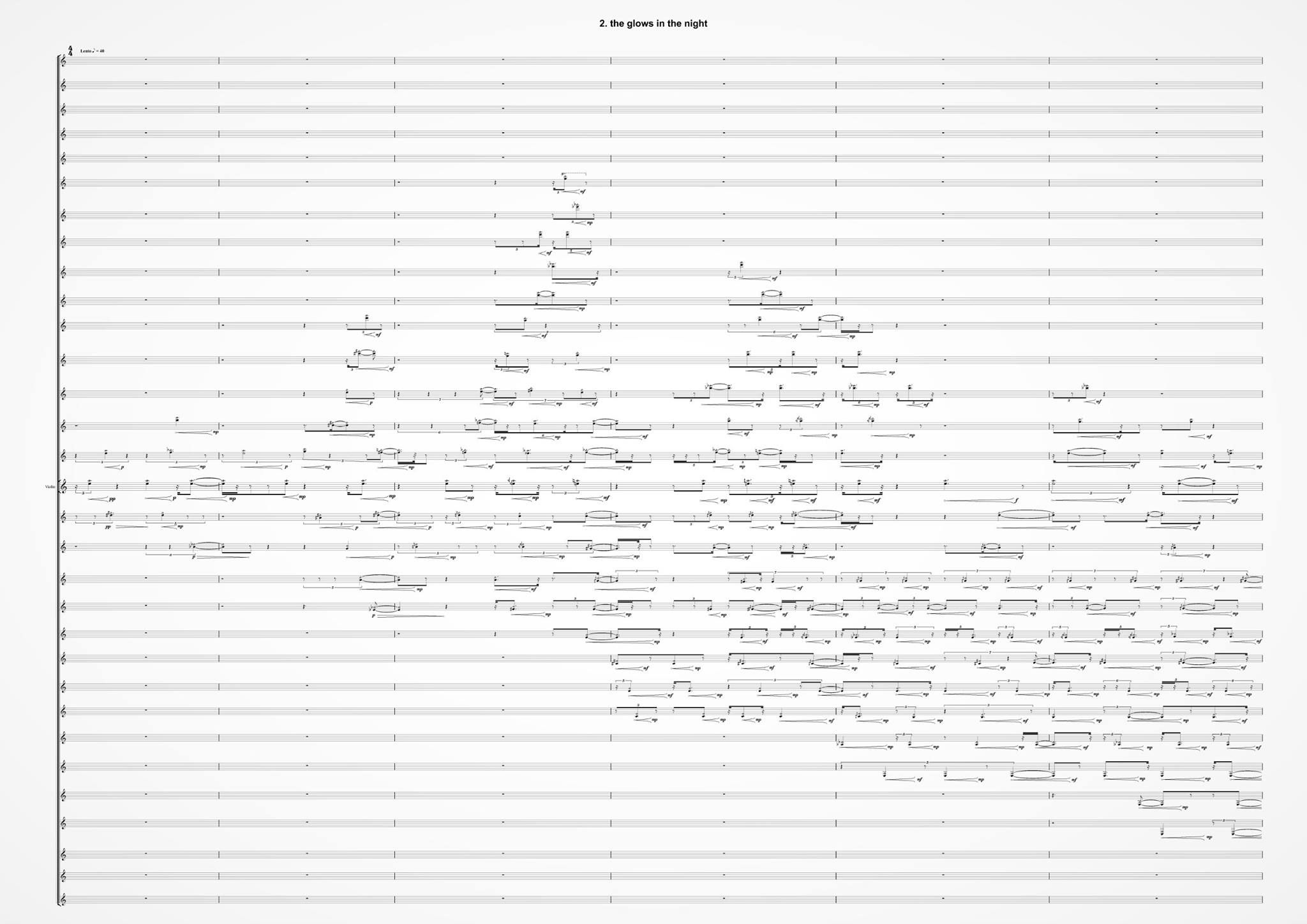
How does the way you make music reflect the way you live your life? Can we learn lessons about life by understanding music on a deeper level?
A very interesting question. Apparently, my life has no influence on my creative process and vice versa. That is, I don't think that events that have marked and still mark my life can influence my increasingly abstract work. But I have to say that probably on an unconscious level there are strong relationships and connections, as is normal.
My life is made of music and in the end, there is no experience in my life that I consider to be non-musical. The sound envelops my breath and my character and it determines how I behave, it regulates and balances my mood and all the emotions I experience, for better or for worse. So, there is osmosis, even if implicit. A relationship with myself that guides my steps and makes me more mature and balanced.
I feel that all this belongs to an underground, subconscious level and I can never make explicit a relationship between an event in my life and a musical work that I am writing at the same time. My music is like a silent scream of my feeling, which orders itself and forges itself, comes to life and shapes itself in favour of the music itself.
Deep down I don't write for commissions, to achieve success, I don't even write for myself but I write exclusively for music.
Do you feel as though writing or performing a piece of music is inherently different from something like making a great cup of coffee? What do you express through music that you couldn't or wouldn't in more 'mundane' tasks?
Being a very private and shy person who takes care of every detail in a more intimate sphere, I think that our every gesture, our every moment of the day has a deep meaning, a ritual, something that makes us feel good and takes care of us, something that consoles us from so many work and personal disappointments.
This is why I think preparing a good cup of coffee at the end of the day, going shopping, doing gym exercises, driving, preparing a good lunch for yourself or to share with someone, talking with friends, taking a walk in nature, etc. all this and much more, is always an intimate gesture of love that I would compare to my care in finding expressions through sounds, to writing music slowly that has characterized my work gradually, every day.
When you are used to making music, creating it and writing it, this ritual is transferred to everything that concerns our daily life, in all the relationships we have with others at every level. You don't even notice this, you do it with great spontaneity and naturalness. How to give yourself to life and to others.
When I teach at the conservatory I always tell my students: composition is like cooking done with great care and love. It is necessary to choose, to dose the ingredients in the best possible way to obtain refined, delicate and unique flavours, to have care and passion so that they can be distinctly felt one by one - but at the same time they can amalgamate in a single new and unrepeatable flavour.
Every time I listen to "Albedo 0.39" by Vangelis, I choke up. But the lyrics are made up of nothing but numbers and values. Do you, too, have a song or piece of music that affects you in a way that you can't explain?
I have many pieces that I love and that I listen to over and over again, as if it were a physiological need, like the need to breathe. In my case, it is not only a need connected to my emotions but also to an intellectual pleasure and from which I always learn something. I could listen to a piece hundreds of times and be surprised like the first time or I could always rediscover new details that I had never noticed before.
I have very particular care also for what concerns the things I listen to as if I had written them myself. I never listen at random and I do a lot of cleaning and ordering in my playlist. In particular, in recent years I have only been able to listen to a certain type of contemporary music which I naturally feel akin to my being and my feelings, which leads me to deep reflections on the meaning of everything, on life and on what we are and what we feel.
I love in particular a piece that is "Atmosphere" by Ligeti. I believe that this work is the synthesis and essence of a human feeling connected to the infinite and the eternal, themes that are very dear to me.
The parallel and otherworldly dimension of this work leads me to deepen my search for my sound connected to a very personal emotional dimension as if it were a secret that I carry within me and that I will never reveal to anyone.
If you could make a wish for the future – what are developments in music you would like to see and hear?
This is the more complex question. In reality, the musical world (in purely artistic terms), so multifaceted, so varied, represents a "tangle" of different voices of which I am only a thin thread.
I like all of this, I like this freedom that we have achieved (at least in the field of art as opposed to the much more serious problems at various levels that are multiplying in the world and which I don't want to talk about at all). In this multitude of voices, I like to think that no one is similar to another (even slightly) and that we really need each voice and allow everyone to express themselves as they wish, to give maximum freedom to creativity which is the only thing it saves us from everything else.
What I don't accept in the artistic and musical world is that there is not enough equity and meritocracy and that the same opportunities are not given to deserving artists to obtain the necessary visibility and attention. Maybe I'm not talking about success but I'm talking about the possibility of fully sharing one's work at high levels, in prestigious places; I'm talking about the right opportunities that every artist, unjustly underestimated, has the right to have, regardless of gender, ethnicity, religion, or other factors.
Instead, there are only a few "chosen" artists (also for reasons that do not strictly concern the artistic value) who are given many great opportunities by powerful people, important artistic institutions, theatres, orchestras, etc. There are not only them in the world. The same opportunities and attention must also be given to others, to other voices, and to those who have not yet had the opportunity to emerge for what they deserve.
Marketing is a hellish machine and very often pursues the surface of things, the logic of certain mysterious and sometimes perverse mechanisms ... it's a very long issue that makes me sad.
But in the end, I want to be optimistic: I firmly believe in a healthy sharing of our individual message through art, what makes us unique and unrepeatable and all deserving of opportunities (some more, some less) that will eventually come, if you have something important to say thanks to your own voice and unique personality. I trust that a lot.