Published
Name: Bella Wakame
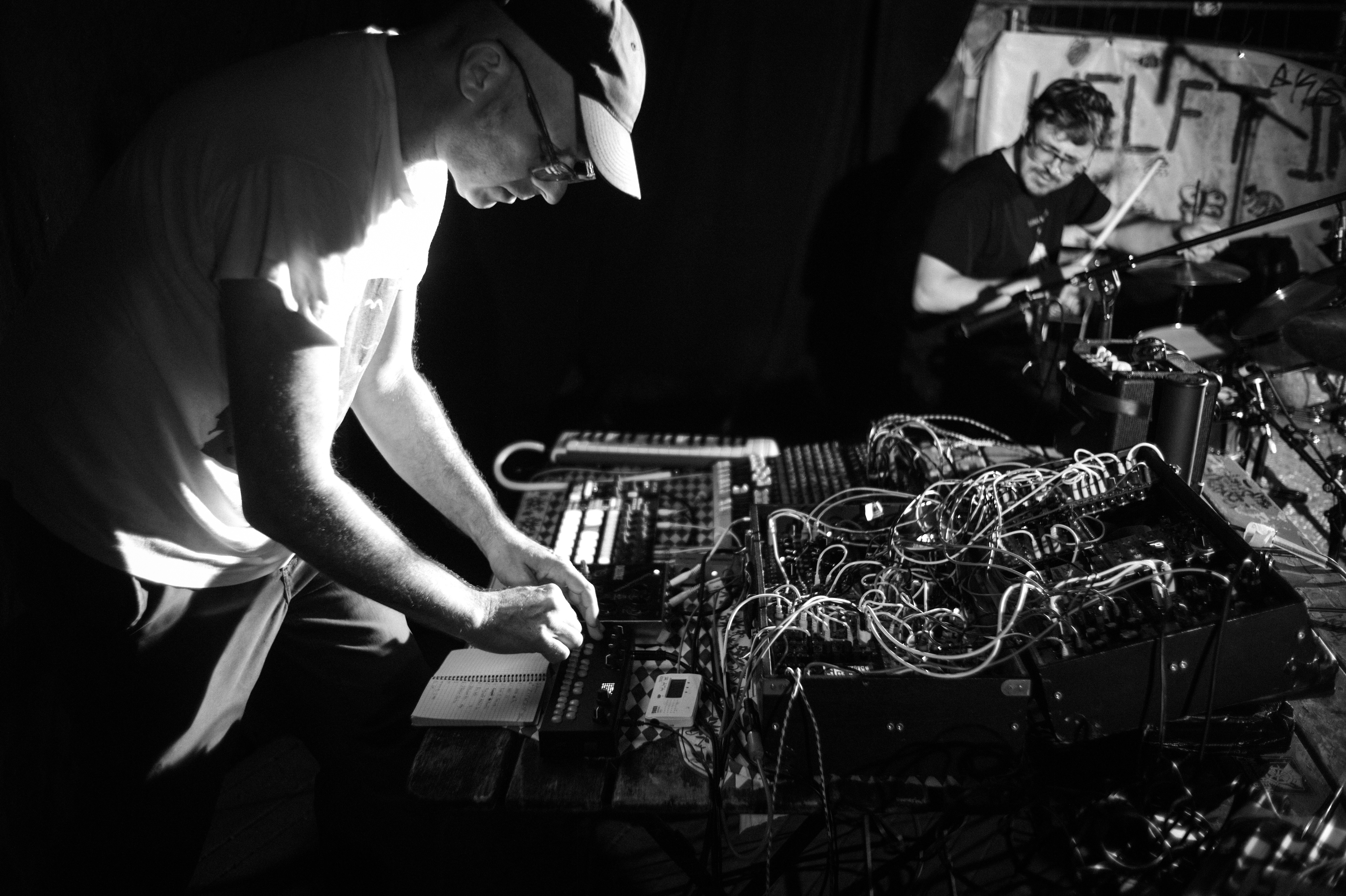
Members: Andi Haberl (drums, sensory percussion), Florian Zimmer (modular synthesizer)
Interviewee: Florian Zimmer
Nationality: German
Current release: Bella Wakame's eponymous sophomore album is out via Umor-Rex.
Recommendation for Berlin, Germany: Hamburger Bahnhof is always worth a visit.
Shoutouts: Morphine Raum, KM28 , Donau 115, Silent Green, 90mil, km28, Schokoladen not for modular synth but for providing a space to play.
[Read our Andi Haberl interview]
If you enjoyed this Bella Wakame interview and would like to know more about the band, visit them on Instagram, and Soundcloud.
Many artists have told me that they're in discovery mode when working with the modular. What are some of the things you recently discovered while working with your own set-up?
I made the Moog Subharmonicon sing like a swarm of birds
There are artists who can realize their ideas best with a traditional – or modified – piano interface, others with a keyboard and a mouse, yet others by turning knobs or touching screens. What's your preferred and most intuitive/natural way of making music and why?
There is not necessarily THE instrument with which I always start working on a piece but it’s best to start with an instrument I can put my hands on. Could be a sampler, drum machine or the modular.
The rest mostly builds on that.
What did your first modular look like? Tell me about the first pieces you produced and performed on it, please.
The first ‘semi’ module I got my hands on was a blue Arp 2600 lent to me by the kind folks of the band Fenster. I had no idea how to get it to work, and quickly found out that there was no intuitive approach to the instrument if you knew nothing about its signal flow. But at least I managed to squeeze out a few sounds, and I was immediately fascinated.
The most important step happened after we had finished the first album with Driftmachine and then decided that we wanted to perform with modular synths.
A big challenge (besides me getting to learn how to treat the machines) was to get to racks in sync and to choose the modules to create the sound that we wanted to achieve.
There is a worldwide community around modular synthesizers. How would you describe your involvement with it and its role for your creative development especially in the early days of your modular journey?
I wouldn’t say that I’m part of a modular community but I do profit from all the folks who produce tutorials and share their knowledge on modules (thank you!!!).
This helps me a lot upfront concerning deciding on buying a new instrument.
Modular synthesizers allow for the most diverse and personal set-ups. What were some of the most surprising/inspiring configurations or ways of playing the modular that you've seen?
The shows of Frank Bretschneider, Jan Jelinek or Andrew Pekler, are always inspiring to listen. I hope I get to see Suzanne Ciani perform one day.
But I don’t have a clear idea about their set ups in detail as there’s too much going on.
[Read our Frank Bretschneider interview]
[Read our Jan Jelinek interview]
[Read our Suzanne Ciani interview]
Can you take me through the evolution of your modular system up to your current set-up? What are aspects you consider when buying a new module?
I rarely buy new modules as I’m still surprised what I can do with the modules that I already own. If I do, then it’s either pragmatic concerning signal flow or it has to support keeping discovery mode going.
But of course a new instrument / module is always good/inspiring in order to start working on new music. Lately it was a Xylophon and Philicorda.
The evolution of my set up is mostly defined by the moment I started playing it with Driftmachine.
Since then I had additions / changes due to the other bands (Saroos, TVII SON) I’m working with. The actual rack can be seen here.
Portability has been one of the main drivers for music production over the past years. What importance does mobility have for you when it comes to production – and what strategies for making the modular portable have you developed?
Portabiliy is essential, because I have to carry the modular to shows, and studios.
Therefore I have a case with four rows of modules, with most of my modules patched already plus a suitcase with a Mackie mixer and all them cables. All together tied on a trolley.
Modulars suggest a more immediate relationship with sound. In how far does this hold true from your point of view and what has working with them taught you about sound in general?
When there’s an interesting sound, beat etc. then I’m intrigued by it and it gets me started - no matter how it got generated.
In which way does the modular influence musical results and what kind of compositions does it encourage / foster?
For me, the modular system always includes the invitation to unexpectedly wander off in a completely different direction.
Describe the creative process for your current release, please.
Andi and me knew each other already before and already played together. And since Andi is an incredibly talented musician / improviser with a wide open radar and always curious about new sounds, we got together quite quickly.
Cooked lots of food, searched sounds to feed his sensory percussion and just kept meeting up, playing and feeling comfortable and trying to perform live as soon as possible and then develop the pieces live. It was a new experience for me because before it was studio work and developing the songs first and then preparing to play live.
We recorded a lot in our studios and once with Tadklimp in a studio, but we ended up in front of the computer ‘building’ the songs, which in the end felt very unsatisfying as the recordings didn't reflect the energy and excitement of the live shows.
Jan Jelinek suggested that we should record our concerts and then get on with it. So we did this at Donau 115 and Silent Green and it was a ‘relief’ to work on the tracks as we had almost all the arrangements ready, and a lot of the sounds from the modular system. What Andi did with drums, sensors etc would not have been created like this in the studio.
We could also see that the songs were good for live performance, but not strong enough for a record. To work on the music from that point was a lot of fun and we immediately had a lot of ideas to add to the tracks, which were eventually mixed by our dear friend Tadklimp, who we've both worked with on other recordings.
Many modular set-ups still do not support saving patches or quickly switching between them. What possible benefits or inspiring consequences does this quite severe limitation have for your own music and creative practise?
Sometimes it would be nice if you could save a patch and/or the settings on the module itself. But on the other hand, it's also part of the game and I don't really feel limited by that.
I've set up everything in my studio in a way that I'm always ready to record immediately. I tried to roughly write down settings and it's quite nice to flick through these notebooks, even if I sometimes don't understand the notes anymore ;-)
In principle, it's about knowing your instrument, understanding the signal paths and accordingly everything is possible, from harsh sounds to organ-like arpeggios and velvet percussions.
I am under the impression that choosing the modular is not just a musical decision, but somehow extends into other parts of one's life as well. Can you reflect on this a little bit?
In the beginning it was - to me - a challenge to dive into manuals, books to generally understand how the signal flow works. I was very fortunate that Andreas Gerth (my partner in Driftmachine) is a true gear- / techhead and he helped me to get into the basics.
But when I managed to rehearse and understand the basics it immediately made me want take the computer off the stage for future live performances. The modular brought me into improvising. I couldn't really improvise and also didn’t feel comfortable doing so with my previous setup (Ableton, Efx).
Now there's a basic setup, from where I can take turns and see where it takes me (us). But also it's possible for me to return to the starting point, and I'm very happy that I can do that and that it feels good to do so.
From that point of view I'd say I've found my instrument with the modular, especially because I never learnt to play an instrument.
For you personally, is the goal to become as proficient and fluent on the modular as others might get at the piano – or to keep discovery mode on forever?
It's an instrument that I have to work on constantly. When I come back from a holiday, I often find myself wondering how it all works and it takes me a little while to get back on track.
It's a constant challenge to achieve both: improving the signal flow and keeping the discovery mode going forever A goal in life I want to achieve, not just in music.