Published
Part 1
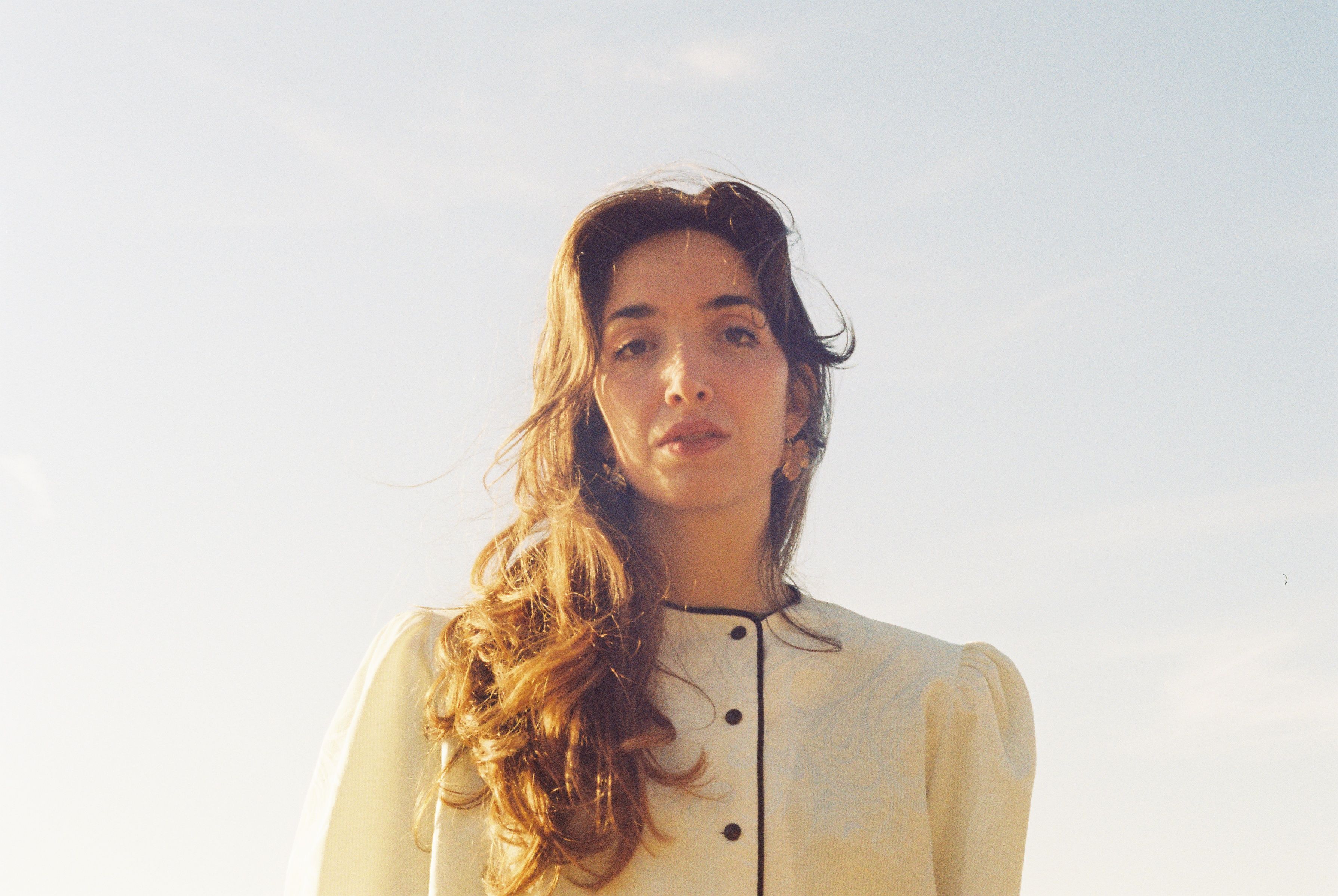
Name: Francesca Gaza
Nationality: German-Italian
Occupation: Pianist, composer, vocalist
Current release: Francesca Gaza's new album Crown Shyness is out August 21st 2026 via New Amsterdam.
If you enjoyed this Francesca Gaza interview and would like to know more about her music, visit her official homepage. She is also on Instagram.
As of today, what kind of materials, ideas, and technologies are particularly stimulating for you?
Getting to see the working process of other composers or performers — on a very normal day in their life — is one of the most fascinating things for me personally. How they build their own canon, and then go to places from it, whether through books, conversations, or interviews.
I've been reading Le passage des frontières by Kaija Saariaho, a collection of her thoughts and essays and exchanges on compostion, her life and reflections on all of the above, and it's been so inspiring to get a peek into one of the most inspiring contemporary composers, for me.
Ideas and canons from the past are another huge point of interest that I keep coming back to. In the world of contemporary composition, the significance and use of tradition is often debated and discussed. Igor Stravinsky, a composer I go back to a lot, shaped this debate with his statement: "A true tradition is not the relic of a past that is irretrievably gone, but a living force that animates and informs the present." Those words have personally inspired me deeply, and led me to reflect on how we engage with the legacy of the past and use it in our own music.
Another book I've adored is Stravinsky's Poetics of Music — a lecture he gave to young students at Harvard, offering a glimpse into his thinking at that moment on composition, canon, past and future.
I love how a Baroque counterpoint étude can have such a profound effect on music from today. I love getting to the core of it, then twisting and turning it around (in a very ‘incorrect’ way), and finding a personal touch in it too.
Another huge stimulation for me is literature and poetry — T.S. Eliot's Four Quartets, or E.E. Cummings, whose poetry led me to write the third piece on the album, "spring is like a perhaps hand," around his words.
Many people perceive classical music and contemporary composition as having high barriers of entrance, both for listeners and musicians. What have your own experiences been in this regard?
When I turn it around, what I keep coming back to is that it's also about listeners and musicians who never get exposed to contemporary composition in a "normalized" way — and that absence is what builds the threshold in the first place.
There's something liberating in growing up, by complete chance, around people who love all kinds of music — for whom going to see the newest opera production is as natural as catching Verdi's Traviata, or checking out the most DIY high school band with amazing ideas or listening to pop, song, folk music in a natural or intuitive setting. If that happens, the threshold becomes basically invisible.
Of course there's the problem of affordability, which is why I think it's wonderful that in most cities I've lived in, entrance for under 30 was free or very cheap. I often think about the fact that I know a lot of non-musician friends who I know would really love a particular contemporary composer, but they just never get exposed to them because no bridge exists between their interest and that music.
I do believe a lot of this comes down to chance, but I think it would be wonderful to build an audience-artist relationship based more on curiosity and taking a leap, rather than always returning to the known. How to do that is something I think about a lot, but I haven't found an answer yet.
Where do most of your inspirations to create come from – rather from internal impulses or external ones? Which current social / political / ecological or other developments make you feel like you need to respond as an artist?
For me, both inner and outer impulses are present. Internal impulses are ever-present, especially if I give myself time to think — to go for walks, look at the sea, run in forests, or walk through very crowded, busy streets with many people, listening to my favorite new album.
Outer topics preoccupy me a great deal. Unfortunately, most social and political developments create a kind of worry-state that I sometimes struggle to put into music, because it's so concrete. Whereas I feel music has this incredible power to give meaning — and I often feel I can only access that power if I don't try to describe something directly. That's something strictly personal, of course; I admire those who can do it, and manage it well.
There is one very strong social and political impulse underlying this album. I've been watching friend groups and social circles fracture over the last years because of political disagreements that get flattened into black or white, good or bad — if you disagree, you're not my friend. That frightens me very much. I think two things can be true at the same time, and we absolutely need to hold space for both inside of us. Making it normal again to agree to disagree — with friends and family — to sit with that discomfort, to learn, study, research.
In the age of social media and self-proclaimed expertise on every topic, it's easy to forget that we might think we know something, but an article we read, a conversation with a friend, the experience of someone close to us who lived through something firsthand — these things can and should affect our opinion. We have to let them.
The question of allowing a kind of co-existence between apparently distant truths within us is represented, in a way, in the ensemble I chose, and in the distant principles and genres I love bringing into the same piece — not like a patchwork, but like a breathing ecosystem. That social and political question is woven very much into this music. Both "Ritual / Cascate" and "Be a Lamp, a Lamp, a Lamp" carried that world for me throughout the composition process.
To sum it up, my music is often seeded with a lot of non-musical material too: co-existence, making space for multiple truths at once, loneliness within an increasingly polarized society, being multicultural (which is very much a part of who I am), the art of love, the awareness that the words we choose and how we speak carry far more weight than just the moment they leave our mouths, trying to musically describe how I feel when friends share their deepest worries and most beautiful feelings with me, loving early music deeply, admiring pop artists, being devoted to jazz and its history of improvisation, loving contemporary music as well, reading Girl, Woman, Other by Bernardine Evaristo and finding it work its way into the musical architecture without ever being directly quoted — and all of the above, entwined.
Tell me a bit about the sounds & creative directions, artists & communities, as well as the colleagues & creative hotspots of your current hometown, please. How do they influence your music?
What a beautiful question. I feel like the places one lives in strongly shape one's influences and output, in either a direct or a more veiled way.
Basel, where I've lived for seven years now, has been a city of deep transformation for me — first because of my studies there, but also because the scene is incredibly dense, diverse, and active compared to the tiny size of the city. There's so much history and art here, especially from composers of the 19th and 20th centuries who passed through and were commissioned by the city's inhabitants and patrons — all beautifully archived in foundations, museums, and documentation centers. The Paul Sacher Foundation, in the heart of the city, holds commissions to Bartók, Stravinsky, Saariaho, Ligeti, even visual works and writings by Picasso.
Because of its position, the city borders France and Germany — you can walk across without noticing, until suddenly the language changes and you realize everything around you is written differently. But everything sits so close together, in proximity and in melting into one another. That reflects a real multiculturalism, a multicultural oasis with tiny satellites of subculture constantly making things happen. It feels like the first place I've lived where someone has an idea and it actually happens — and happens beautifully.
There's so much love and respect for art here, and so much appetite for it from the people who live in it, or who just pass through. That absolutely influences me: having an ambitious idea, like holding together a large ensemble that spans different styles and musicians, became possible because of that air of possibility, that atmosphere of love for it.
There are three main schools here that attract world-class students — classical, jazz, and early music. The early music scene has had an enormous impact on me. You walk from one campus to the next and suddenly see people carrying strange, gigantic or microscopically small instruments, tailored to their era but resonating in the now.
What I admire about that scene is that, because there's often a lack of sources or recordings of ancient music, the musicians have to research so much more than I was ever exposed to — looking at paintings to see how instruments were held, how musicians stood in groups, what writers of the time said about different tuning systems and what they meant, the disputes they had with the church, and so on. Going into that kind of detail and history really opened my head, and it's stayed with me in what I like to do.
Florence is a parallel home that I've kept for many years — the influence of its architecture and art is always in front of my eyes. I hold it close to me, the way architectural monuments in Italy are built over centuries, through generations of artists commissioned over many years, eventually creating one gigantic piece of art. That richness of detail is something I try to strive for in my own music — the tiny quirks, embellishments, colors, small shapes, lights and shadows that make a visual piece of art so appealing to me are always present in my mind when writing.
The love of detail, I guess, translated into one sentence.
Composing has always had an interesting relationship between honouring its roots and exploring the unknown. What does the balance between these two poles look like in your music?
Another beautiful question. Balance is exactly the right word.
I believe it's humbling, important, and nurturing to study and love the past — to borrow its methods, analyze them, and at the same time observe what happens when you plant that borrowed method in the now. It's like the seed of a plant: it still carries its original information, but if you plant it in new soil, it will change too. It's a natural process, one that I believe ensures the love and continuity of a tradition.
I don't think you need to make sure people hear what you've studied — I don't believe in the necessity of that obviousness. It can be loud at times and quiet at others, within one's own process; whether it comes through or not doesn't really matter to the result, but it matters to me during the process.
I started a few pieces on the album with a counterpoint exercise — "Be a Lamp, a Lamp, a Lamp" and "spring is like a perhaps hand" — because I felt stuck. Basically nothing is left of that exercise in the final piece; it transformed, took on a new shape, and went somewhere else entirely. But it matters to me how I got there.