Published
Part 1
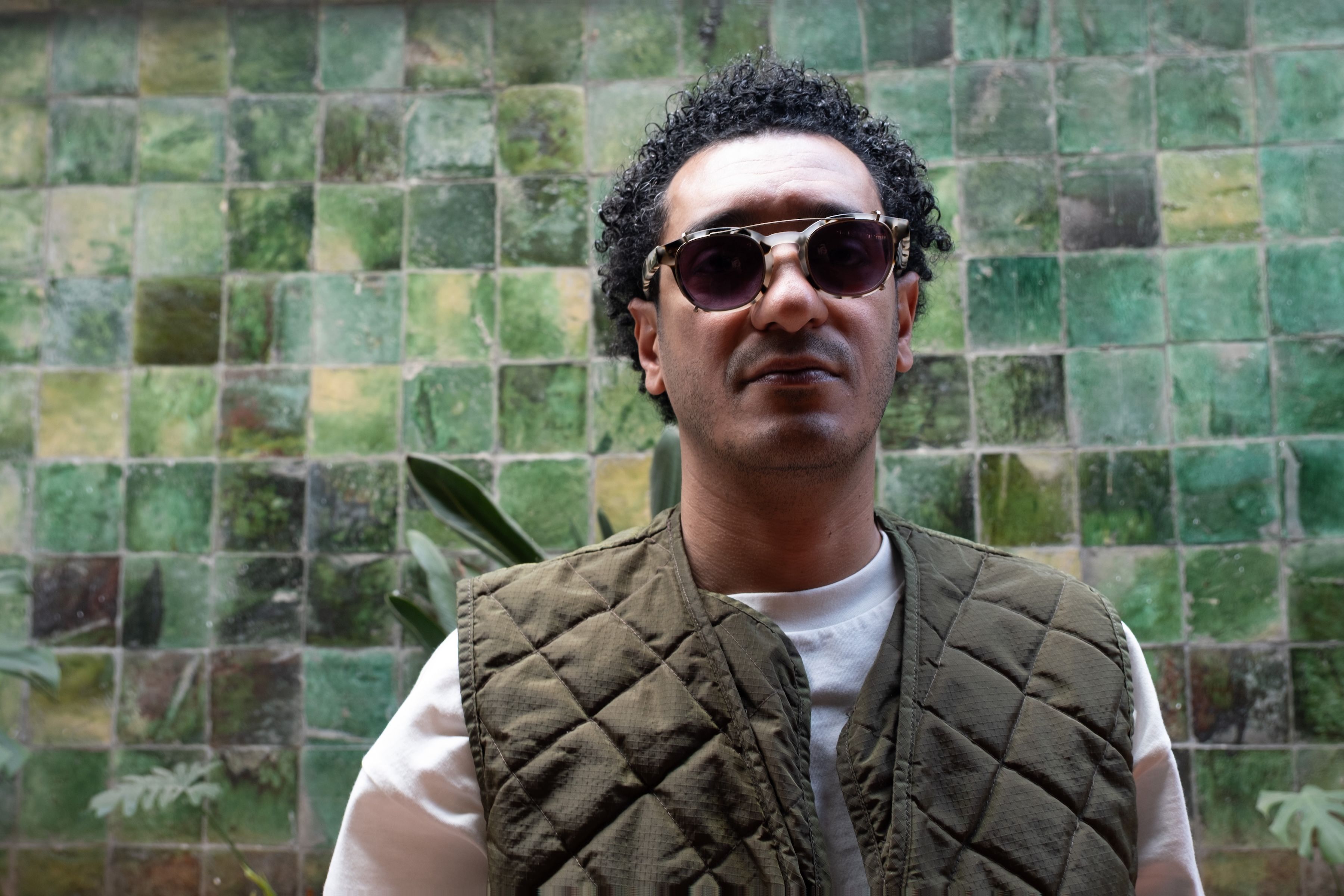
Name: Guedra Guedra
Nationality: Moroccan
Occupation: DJ, producer
Current release: Guedra Guedra's new album MUTANT is out via Smugglers Way.
If you enjoyed this Guedra Guedra interview and would like to stay up to date with his music, visit him on Instagram, Facebook, and Soundcloud.
For a deeper dive, read our earlier Guedra Guedra interview. As an extension of this interview, do check out his recommendations on albums he loved for their sound.
When I listen to music, I see shapes, objects and colours. What happens in your body when you're listening? Do you listen with your eyes open or closed?
When I listen to music, it’s not just about hearing. It’s a full-body experience. My entire body becomes alert and responsive. I feel the bass deep in my chest, the high frequencies tingle at the back of my neck, and the rhythms travel through my legs. It’s a multisensory state, almost like a trance.
I often close my eyes while listening, not out of habit, but because it allows me to access the inner architecture of the sound. With my eyes shut, I can visualize the spatial dimension of the music. I see textures, shifting landscapes, sometimes even faces or buried memories rising to the surface.
Sound becomes a living environment I can move through.
How do listening with headphones and listening through a stereo system change your experience of sound and music?
Listening with headphones is like stepping into an intimate sonic bubble, a kind of self-portrait made of sound. It isolates you from the external world and brings every detail to the forefront. You’re immersed in a microcosm where subtle breaths, ambient textures, micro-reverberations, and hidden layers become perceptible. It’s an introspective experience, one that allows you to focus on the minutiae of a piece, almost like sound microscopy.
For me, headphone listening is deeply personal, it collapses space and amplifies time, sharpening your awareness of every shift and gesture in the music.
On the other hand, listening through a stereo system reconnects me to physical space. It’s about how sound fills a room, how it interacts with the architecture, how it bounces off surfaces and takes on new shapes depending on where you stand. The sound becomes part of the environment, not just something you hear but something that shares space with you.
The stereo field builds a sonic landscape, atmospheres, textures, ambiances, all of which shape your perception of the music. Even environmental noise, like the hum of a fridge or the echo of footsteps, can blend into the experience and alter your emotional reception of the piece.
In my artistic practice, I use both approaches. Headphones allow me to fine-tune the composition, to sculpt the tiniest sonic details with precision. The stereo system, in contrast, helps me understand how the music breathes in space, how it interacts with listeners in a real environment.
One is for analytical depth, the other for spatial projection. Together, they complete my understanding of sound as both an intimate and collective phenomenon.
Do you experience strong emotional responses towards certain sounds? If so, what kind of sounds are these and do you have an explanation about the reasons for these responses?
Yes, but I would say it’s not so much specific sounds that trigger intense emotions for me, it’s the way listening itself unfolds.
Listening, for me, is a deeply philosophical and transformative act. It reshapes our relationship to the world, to space, to time, and to our own memory. It’s not just the sounds themselves that move me, but their invisible charge: their history, their texture, their spatial presence, their fleeting nature.
I’m fascinated by the semantics of sound, its plasticity, and its suggestive power. Some of the simplest sounds, like the wind brushing against a metal surface, or a distant, barely audible choir, can open sensory gateways, awaken buried imaginaries, or resurface memories I didn’t even know I had. These are sounds that, on the surface, say nothing, and yet contain everything.
There can be sounds which feel highly irritating to us and then there are others we could gladly listen to for hours. Do you have examples for either one or both of these?
Yes, absolutely. For me, the most powerful sounds are often those that happen without intention, the ones born from the world itself, not engineered for us.
I could listen for hours to the spontaneous hum of life: a conversation drifting through an open window, the distant voices of neighbors, or the way birds modulate their rhythm with the changing light of day. These are not sounds designed to be beautiful, but they resonate with truth, and in that, they become profound.
On the other hand, I sometimes find the overproduced, hyper-compressed soundscapes of modern commercial spaces quite exhausting, they leave no room for breath, no space for the imagination. It’s not the volume that disturbs me, but the lack of nuance, the erasure of silence.
I believe that the most moving sonic experiences come from what I call “deep listening to the ordinary,” when we hear not just the sound itself, but the environment that gives birth to it. In those moments, irritation transforms into curiosity, and noise becomes music.
Are there everyday places, spaces, or devices which intrigue you by the way they sound? Which are these?
Yes, there are many everyday spaces that intrigue me because of their musicality.
For example, I love listening to transitional spaces, like a train station or a busy pedestrian street, especially when people are walking. What fascinates me is how the rhythms of footsteps develop, intersect, and then break apart to form new rhythmic patterns each time. It feels like an improvised composition in real time, where each person becomes an unconscious instrument.
I also have a deep appreciation for the sound of an analog clock. The steady ticking, almost hypnotic, keeps a constant rhythm and creates a sense of stability within the sonic chaos of daily life. It reminds me of a natural metronome, a background pulse that holds space for the surrounding silence.
The sound of a train is another powerful example. It carries a mechanical, regular rhythm that instantly evokes movement. It makes me think of a music software metronome marking a starting point, but here, it's the clatter of the rails that takes that role.
What fascinates me is that despite its steady beat, every variation in terrain or track produces a slightly different sound. There is a pulse, but also subtle shifts that reflect changes in speed, direction, or environment. It’s like a living composition, constantly evolving.
Have you ever been in spaces with extreme sonic characteristics, such as anechoic chambers or caves? What was the experience like?
Yes, I’ve had the chance to explore several spaces with extreme sonic characteristics, and these experiences have deeply shaped my perception of sound and performance.
One of the most memorable moments happened over ten years ago, thanks to the OneBeat program organized by Found Sound Nation. I had the opportunity to present a sound performance at Arcosanti, a unique site in Arizona designed by the Italian-American architect Paolo Soleri.
Arcosanti is an experimental utopian town based on the principles of “arcology” (a fusion of architecture and ecology), created to minimize the use of natural resources while encouraging human interaction. Built in raw concrete in the middle of the desert, the place has a very distinctive acoustic quality. My performance was built in direct dialogue with the architecture: the vaulted resonances, natural delays, and frequencies amplified by the building’s curves.
Performing in such an environment feels like collaborating with the space itself, where each sound gesture becomes an echo, a reflection, a suspended dialogue.
More recently, I also had the opportunity to create an improvised performance inside a natural cave, in the Fes region of Morocco, as part of an artistic research project called SAKHRA, specifically in Moulay Bouchta.
With just my phone, a megaphone, and a few recordings, I interacted with the raw acoustics of the cave: a mix of irregular echoes, long reverberations, and frequencies shifting with the geometry of the space. It was a deeply physical, almost shamanic experience, where even the smallest sound seemed to float, transform, and return charged with new energy. In that context, silence carried as much weight as sound itself.
These two experiences have been a profound source of inspiration. They taught me how architecture, and even the geology of a place, can become instruments in their own right. In these settings, you don’t just perform a piece, you compose with the space, you let the environment speak through sound. It completely changes the way one improvises, feels, and communicates.
What are among your favourite spaces to record and play your music?
Some of my favorite places to record are those full of life, markets, streets, cafés, ceremonies, anywhere you can feel human presence.
I’m drawn to environments where sound is alive, layered, and unpredictable. That’s where I find the most interesting textures, rhythms, and emotional depth. I believe that recording in such spaces brings something organic and real into the music, something you can’t recreate in a silent studio.
When it comes to performing, I love to experiment in all kinds of places, clubs, outdoor festivals, cultural spaces, even unconventional venues like caves or rooftops. What excites me is seeing how people respond to the music in different settings. Their energy teaches me something new about my own tracks, about what resonates and what surprises.
Every space becomes a kind of laboratory, and every audience interaction helps me grow as an artist.
Do music and sound feel “material” to you? Does working with sound feel like you're sculpting or shaping something?
Yes, absolutely. For me, sound is a living, breathing material. I don’t just compose, I sculpt. I carve it, stretch it, fragment it, like a ceramicist shaping clay or a speculative archaeologist brushing dust off forgotten relics. Working with sound feels like working with memory: layered, fragile, full of tension and silence. Every gesture becomes a form, every edit a contour of time.
This vision comes especially from my practice with field recordings. I’ve recorded in the souks of Marrakech, during rituals in Taroudant, and through the streets of Casablanca, capturing voices, echoes, machines, birds, the breath of the city itself. These recordings are not just data to me. They are shards of lived experience.
In my track “Four Lambs,” from my album Mutant, I used a Hamadcha ritual I recorded years ago. It was saturated, unstable, imperfect. But I didn’t want to clean it, I wanted to let the instability speak. Like placing a broken fragment of pottery at the center of a sculpture, it holds the memory of something ancient, still vibrating.
When I work in the studio, even with digital tools like Ableton Live, convolution reverbs or granular synthesis, I treat them like physical tools, as if I were in a workshop, shaping resonance with my hands. I listen not only with my ears, but with my whole body. I loop sounds for hours, walking around the studio, letting them breathe in the space, letting them guide the process.
It’s not just design. It’s embodiment.