Published
Name: Hybrid Protokol
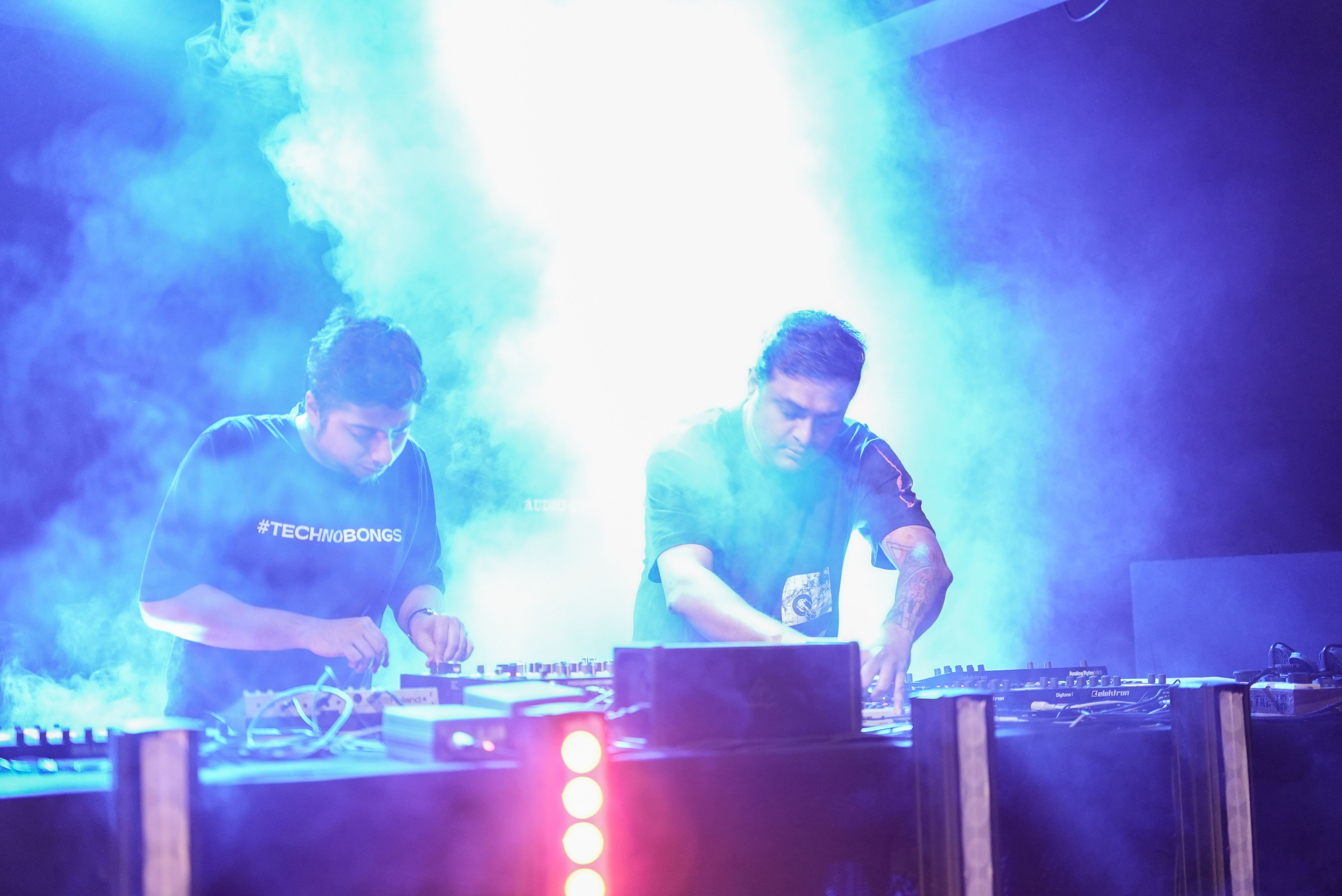
Members: Soumajit Ghosh, Aneesh Basu
Nationality: Indian
Current release: Hybrid Protokol are among the artists included on compilation Indian TechXpress 2, compiled by Alexander Robotnick, out via Hot Elephant. Other artists on the release include Pawas, 5volts, Farhan Rehman, and Noni-Mouse.
Recommendation for Kolkata, India: Both of us prefer the Countryside rather than the hustle and bustle of the city i.e. Kolkata. But the one thing we can recommend visiting in Kolkata is Park Street, which is the hub of all your Nightlife and electronic music Culture. The Area hosts a lot of NightClubs promoting Electronic Dance Music and Live Music Culture.
Topic that we're passionate about but rarely get to talk about: Aneesh likes to Fly Kites. He has deep passion towards Severe Weather and Thunderstorms. He also has a Lifelong Dream of travelling to Texas, USA and chasing a Tornado. LOL!!!!
Soumajit has a strong passion for stargazing and identifying the stars/planets in our universe. He often interacts with STELLARIUM observing the night sky … although several times, due to the light pollution/air pollution in the city, it gets hindered. 🙁 !!!
He also has a lifelong dream in observing the Aurora and a quirky dream of observing a Great White Shark up close!!!
[Read our Alexander Robotnick interview]
[Read our Farhan Rehman interview]
[Read our 5volts interview]
If you enjoyed this Hybrid Protokol interview and would like to stay up to date with the duo and their music, visit their official homepage. They are also on Instagram, Facebook, Soundcloud, and bandcamp.
What were some of the musical experiences which planted a seed for your interest in electronic music?
At the tender age of 7, Aneesh's father bought him an album of Kraftwerk’s The Man Machine.
He established an uncanny relation to the music of that album and used to listen to the same on loop.
At that time, he didn’t know what that music was, but later during his university days, when he discovered that it was “electronic music,” there was no looking back.
Soumajit, who from his very young age was introduced to North Indian Classical Music, remembers several years later about Giorgio Moroder and Kraftwerk as 2 legendary artists, which he had come across during his school days while practicing school drills.
Around the year 1998, he again was introduced to synthesizer heavy music which was released by The Chemical Brothers' “Hey Boy Hey Girl,” which planted the seed for exploring the possibilities of creating music using synthesizers.
Most genres of music make use of electronic production means. What does the term “electronic music” mean today, would you say?
Well, almost all music today is produced with electronic and digital means. But that doesn't mean all music is electronic music.
Electronic music is mostly defined by the sound of the synthesizer. And it’s the usage and style of that particular synthesizer which defines a genre. For example a TB303’s filter cutoff modulation invented acid house to techno to 90s trance.
They are contrary to popular or commercial or film music. Rather a culture of their own having their own Audience and Industry. That to us is what differentiates everyday radio music from electronic music.
Disco, house, techno, drum n bass, IDM and many other genres were about a lot more than just music. For you personally, is electronic music (still) a way of life – and if so, in which way?
Like we said in the previous answer, electronic music along with its numerous genres, is a way of life. Each has it own culture and so does the market and the industry as a whole.
Just like an individual gets influenced by rock music, he or she can get influenced by disco, house, techno, drum n bass and What NOT!!!!
What role does community play for your interest in production and getting better as a producer?
Community plays a big role in shaping an artist’s career and their music. Being out there at the venue, at the festival, at a residency, mingling with other artists definitely inspires artists to give more, sharing knowledge with each other, rising to the top as an artist and also a producer and thereby setting an example to many.
It also fosters visibility and leads to a healthy life as opposed to sitting inside a closed room studio and only making tracks for yourself or putting out content on social media.
What are examples for artists, performances, and releases that really inspired you recently and possibly gave you the feeling of having experienced something fresh and new?
There’s a new genre called New Wave Trance which is coming up in the market. It fuses acid house, techno and 90’s trance. Key players in this field and also whom we are listening to are artists like Abdul Raeva (Estonia) and DJ Spray (Ireland).
We are getting deeply inspired listening to this new sound.
Also artists like Kangding Ray, Atom™ are also helping us shape our influences and they are quite visible in our new and future productions.
[Read our Atom™ interview]
What kind of musical/sonic materials, and ideas are particularly stimulating for your own work right now?
Acid basslines and acid-like synthlines are definitely some of the key elements in our songwriting approach now.
These have always been there. But right now, having a track with a slow buildup and breakdown is becoming a defining characteristic of our sound.
Where do most of your inspirations to create come from – rather from internal impulses or external ones? Which current social / political / ecological or other developments make you feel like you need to respond as an artist?
To be very honest, our sound mostly comes from the impulses of the synths that we are using for our music. Either for playing LIVE or in the studio. Even though most music genres have a political history like techno or trance, we do not diverge into that.
Our motto is simple. PLUR - Peace, Love, Unity, Respect. The key elements of electronic dance music.
Tell me a bit about the sounds and creative directions, artists and communities, as well as the colleagues and creative hotspots of your current hometown, please. How do they influence your music?
Our musical influences are mainly electronic music from the UK.
Our hometown, ie Kolkata, India doesn’t factor much into our music making influences - although the roots of Indian Classical Music are very much there in most of our tracks, as both Aneesh and Soumajit have training in Hindustani Classical Music.
We try to be very pure with our musical tastes, influences and preferences. And it is with this purity, that, in 2022, we collaborated with a local musician from Kolkata who indulged in Bangla Folk Music.
With that musician we made a vocal track which fused UK techno with Bangla Folk.
Today, electronic music has an interesting relationship between honouring its roots and exploring the unknown. What does the balance between these two poles look like in your music?
Like we said in our earlier answer, we keep our influences and roots to the core and are open to blend these with other genres like Bangla Folk Music.
“Rasta Night” with Soumyajit Majumdar, made in 2022 is a testament of that. The track was released on Sony Music India. That made us one of the few Electronic Acts in India to have released music on Sony Music India.
What were some of the recent tools you bought, used, or saw/read about which changed your perspective about production, performing, and making music?
We recently invested in the Elektron Syntakt and the Elektron Digitone II. And we are also exploring a Vsti Synth called Diva made by a company called Uhe.
The sounds/nature/character of the synths are definitely giving us a fresh perspective on our current artistry. The music we used to make 5 years back is much more refined and has evolved now in 2025 as we write this.
How do you see the role of sampling in electronic music today?
Sampling was, is, and will be a big part of electronic music production.
We use a lot of sampling in our tracks, too. Like dialogues from films, parts/loops from other songs, etc.
What are some of the most recent innovations in sound design for you - and what are currently personal limits to realising the sounds you have in your mind?
Using EQ or Multiband boosts to notch up frequencies and harmonics, thereby bringing that acid-esque sound to the fore - a key element in our music.
And as said earlier, we like to spend hours and hours with our synths, toying with their sounds and characters and then you come up with that happy accident which defines who we are.
For example, in 2017 we made a track called “Prosthan”.
We were one day generating a test tone (a sine wave @ 440hz) on our Sampler. Adding some fx and glitches on that, we came up with the track.
"প্রস্থান (We're not alone)” was released digitally via an Independent Indian Music Label and Culture IP - Nrtya Music - and distributed by Horus, UK.
In as far as it is applicable to your work, how would you describe the interaction between your music and DJing/DJ culture and clubs?
We portray ourselves as performers playing electronic music LIVE on the gear that we carry. As opposed to a DJ set, where you are mostly mixing and playing produced tracks - produced by yourself or other artists.
Also with the rise of Instagram, DJing and electronic music have become a FARCE.
For artists, it’s more about dancing and throwing hands in the air rather than focusing on the actual work. Which is operating the CDJs and showcasing your skills on them. Also it’s now more about how you look or dress. Like a fashion statement. LOL.
First, look at Underworld:
And then look at this clip with Sara Landry LOL!!!!
This is what is WRONG Right Now. LOL!!!!
How, would you say are your live performances and your recording projects connected at the moment? How do they mutually influence and feed off each other?
Generally we jam as live musicians with our gear when we are making a new track or coming up with a new pattern on the instruments. That jam then gets structured and rehearsed for live performance.
Besides live gigs, in our studio - we record that live performance into our DAW (Cubase in this case) and that is when that track gets into production and then released. Final mixing of the track happens on Pro Tools.
Our Track “Diaspora” on Alexander Robotnick’s Indian TechXpress 2 came into being in that way only.
Even if AI will not entirely replace human composition, it looks set to have a significant impact on it. What does the terms composing/producing mean in the era of AI, do you feel?
AI should not control us. Rather we should be controlling AI. It’s like petting an animal. As simple as that.
AI lacks human touch. Anyone can understand music which is made by human playing as opposed to a few keywords or prompts.
Also, when it comes to live gigs, it’s us humans representing the stage and not AI. Although watching an AI Live is equivalent to watching FAKE Instagram DJs. LOL!!!!