Published
Name: Butcher Brown
Members: Marcus Tennishu (vocals, trumpet, saxophone), Corey Fonville (drums), Devonne Harrison (keys), Andrew Randazzo (bass), Morgan Burrs (guitar)
Nationality: American
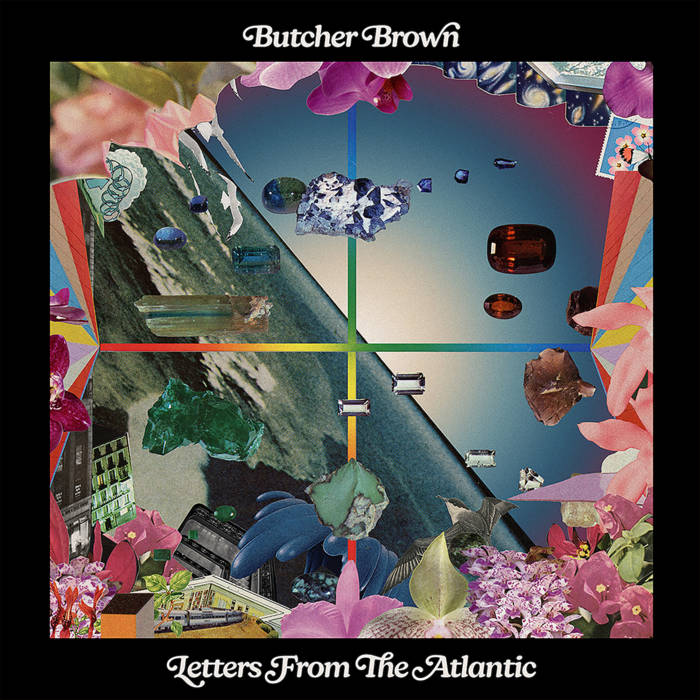
Release: Butcher Brown's new album Letters from the Atlantic is out via Concord Jazz.
Review by: Tobias Fischer interviewing himself
This interview review is part of 15 Questions's project of finding new, more engaging formats for the review format.
For a deeper dive, read our Butcher Brown interview, and our conversation with the band about improvisation.
Every Butcher Brown album so far has opened with an overture, a short piece announcing the start of the experience. Typically, these were short uptempo pieces seemingly intended to raise your pulse. Letters from the Atlantic, however, begins with the remote cries of seagulls and supernaturally lush synth chords - a beach scene in late Summer. And when the beats finally kick in, they still have this dreamy, fantasy-like quality to them. What do you make of this reduction in tempo, which feels slightly out of character compared to the previous releases?
Well, once you're past the “seagulls,” which is the actual name of the track, the album is by no means a pure downbeat affair. Conversely, it's extremely diverse and filled with as many uplifting and danceable compositions as it is with warm, simmering ones.
More importantly, I think it's to signal that this is not just an album, but a safe space.
A safe space from what?
I know that Letters from the Atlantic was planned as a sonic journey, taking you through different spots and moods, inviting a multitude of associations, images and memories. Those seagulls, for example, which you're heard right at the very beginning, are from a field recording the group captured at Virginia Beach. But really, it's not so much about a specific place, as it is about triggering the emotions associated with a set of sonic references.
That said, to me, it offers the same kind of refuge as clubs did in the 80s and 90s: it's a place where you can be who you want to be, and like what you want to like, without your taste being subjected to scrutiny. Some pieces here may be too smooth, sweet or too sultry for some – but that's on them, not on you.
The album has a truly all-embracing stylistic reach – going from soul to funk, from disco to house, and from r'n'b to drum 'n' bass, while shooting streams of shimmering jazz licks, a ferocious walking bass, woozy dub echoes and irresistible improvisations on trumpet, Rhodes and synth through this delicious melange.
All of these ingredients relate to each other in a very natural way. Yet, no one's judging.
Don't you feel as though this hence and forth between faster and slower songs and as many genres as they can get their hands on, works to the detriment of the flow? I can understand that it's a great tool to hold the audience's attention. But at the same time, one of the things that I loved so much about Live at Vagabond is that it achieves the same while remaining firmly within one space. It just really sucks you in and the slower songs serve to draw you in a little more, before the group pick up the pace again.
There's no comparing those two projects.
Especially in terms of the production, Vagabond was extremely unpolished – it's one of those records about which many older listeners will claim that “they don't make 'em like that anymore.”
Letters from the Atlantic is the exact opposite, it's refined and elegant, the basses really envelope you, every note on the Rhodes is pearly and pure, the drums are in this super palatable pocket between dryness and snappiness that I could write novel-length poems about.
I think the feeling that Butcher Brown were going for in terms of the sequencing is not one of a playlist but of tuning into traditional terrestrial radio: The selection is intended to keep up a certain ambiance, but every song also speaks for itself. It's not random, it's surprising. And it's surprising to the point that you really can't predict what the next piece will be like!
Again, despite its suggestive title, this is not a concept album as such. Prior to the release, the band have stated that they wanted the record to feel “like you’re floating on a trip up and down the coast” and the decisive word in there is “floating.” Didn't you feel like you were being transported here?
I guess so. And maybe you're right: Once you let go of expectations, the pieces really fall into place. I think I would just have loved to see a little more development for Butcher Brown – the idea of leaving your comfort zone.
The thing is, to me, when played in the background, the record has a slickness to it that can feel like it's a mere mood piece. But when you focus your attention on it, this impression changes and you go from the surface to the deeper levels of the music. It's no longer a radio station and more like flicking through the pages of a photo album filled with polaroids of precious moments.
I would argue that memories – which are a key theme here – and music both bypass words and go straight to your emotions. Development is beside the point. What matters is the profoundness of the experience.
And besides, even if the music doesn't ask any obviously challenging questions, I would imagine the band certainly did while making it.
Like what?
What can we be as a band? How far can we take our sound?
It's almost as if every new tune here could have been the beginning of an entire album in its own right. Some of them sound like musicians playing in a room, the horn section glowing. Others are house productions which could have been arranged and finished by one person in their bedroom studio.
The fact that they can close the project with “Infant Eyes,” which sounds like it was taken from a 90s Ninja-Tune sampler is quite remarkable.
And if I didn't know better, I would have mistaken “Something new about you” for a lost Prince original …
… agreed, Marcus Tennishu is absolutely amazing on that one.
Coming to think of it, perhaps the album does have a concept after all: Rather than boxing music in, we can also allow it to mirror life, with all of its ups and down, its hopes and broken promises, the love and the laughter, the tears and the all the little tragedies that occasionally bring us down but help us grow.
It's not a letter, but a series of postcards. Are you going to complain no one wrote a ten-page essay on them – or are you going to be grateful someone thought of you and sent you something heartfelt and beautiful?