Published
Part 1
Name: Jeff Snyder
Nationality: American
Occupation: Composer, sound artist, sound designer, instrument designer, educator, producer
Current Release: Jeff Snyder's Loom is out via Carrier.
If you enjoyed this Jeff Snyder interview and would like to know more about his work and music, visit his official homepage. He is also on Instagram, and twitter.
For a deeper dive, read our earlier Jeff Snyder interview.
Already as a little kid, I was drawn to all aspects of electronic/electric music but I've never quite been able to put a finger on why this is. What's your own relationship to electronic sounds, rhythms, productions like – what, if any, are fundamental differences with “acoustic“ music and tools?
I also was drawn to electronic sounds very early on. I was born in 1978 so I grew up with 80s video games. The first music I ever composed myself was when I was a kid using a Commodore64 program called Music Maker from 1982, and those chiptunes sounds still hold a lot of emotional power for me.
I've always been attracted to the sounds electronics can make that acoustic instruments can't; there is something otherworldly about those eerie tones and the superhuman execution that is possible with electronics. That effect can come from something as simple as the unnatural sudden choked cutoff of a sampled cymbal, or as complicated as some cross-modulated fm noise patch.
I grew up with electronic music but have, for a few years now, been somewhat disappointed with many releases – from conversations with producers, many appear to feel the same. How do you see that yourself and where do you see fruitful developments or fields of exploration?
It's hard for me to say how I feel about the scene because I don't keep up as well as I'd like to. Much of what I listen to when I sit down to listen to music these days is either classic 1960s country music or really out-there experimental stuff, and the electronic dance music I know deeply tends to be the things that were released in my teens and 20s. (Due to all the country listening, YouTube's algorithm believes me to be an elderly divorced Christian man).
I feel like I know every detail of those early Warp records, Bjork's first three albums, Skinny Puppy's Too Dark Park, etc. There are only a few very recent dance music releases that I know personally as well as those, but that's me having my head in the sand and not paying enough attention.
I was excited about the beginnings of the dubstep genre with Skream and Kode9, since it really tapped into that pounding energy of the 1979-ish Roots Radics sound, but brostep stuff is a bummer to me. I love what EPROM is doing with those genre signifiers, though.
Flying Lotus keeps blowing me away with his records - I love everything he does. Helena Hauff was a revelation to me, I really dig how heavy she can make something with very sparse materials. The Soft Pink Truth, Drew Daniel's from Matmos's solo project, is consistently surprising and delightful.
[Read our Matmos interview]
Jlin's music is the newest thing that I feel like I've internalized the way I know the records I grew up with, her stuff just rewards repeated listening so much.
One thing that makes me very excited is how incredible some of the straight pop music that has absorbed influences from the dance music scenes has become. Beyonce's records are super experimental and brilliant, and Charlie XCX brings those creative hyperpop production styles from people like A.G. Cook to the mainstream.
As usual, there are lots of people scurrying around in the shadows making awesome things, but I think right now there is a lot in the mainstream that's also extremely interesting. It's maybe just that the middle ground, higher profile dance music stuff is a bit boring at this particular time.
Late producer SOPHIE said: “You have the possibility with electronic music to generate any texture, and any sound. So why would any musician want to limit themselves?” What's your take on that and the relevance of limitations in your set-up and process?
Yeah, this is the promise and the curse of electronic music. "Any sound you can imagine" can either be freeing or paralyzing. Part of my believes that it's energizing that the limitations of acoustic instruments are really removed when working with electronics. Another part of me needs limitations to compose - and when you sit down to write a piece for violin, you know where the edges of that possible soundworld are, and you know you can't write a note lower than G below middle C.
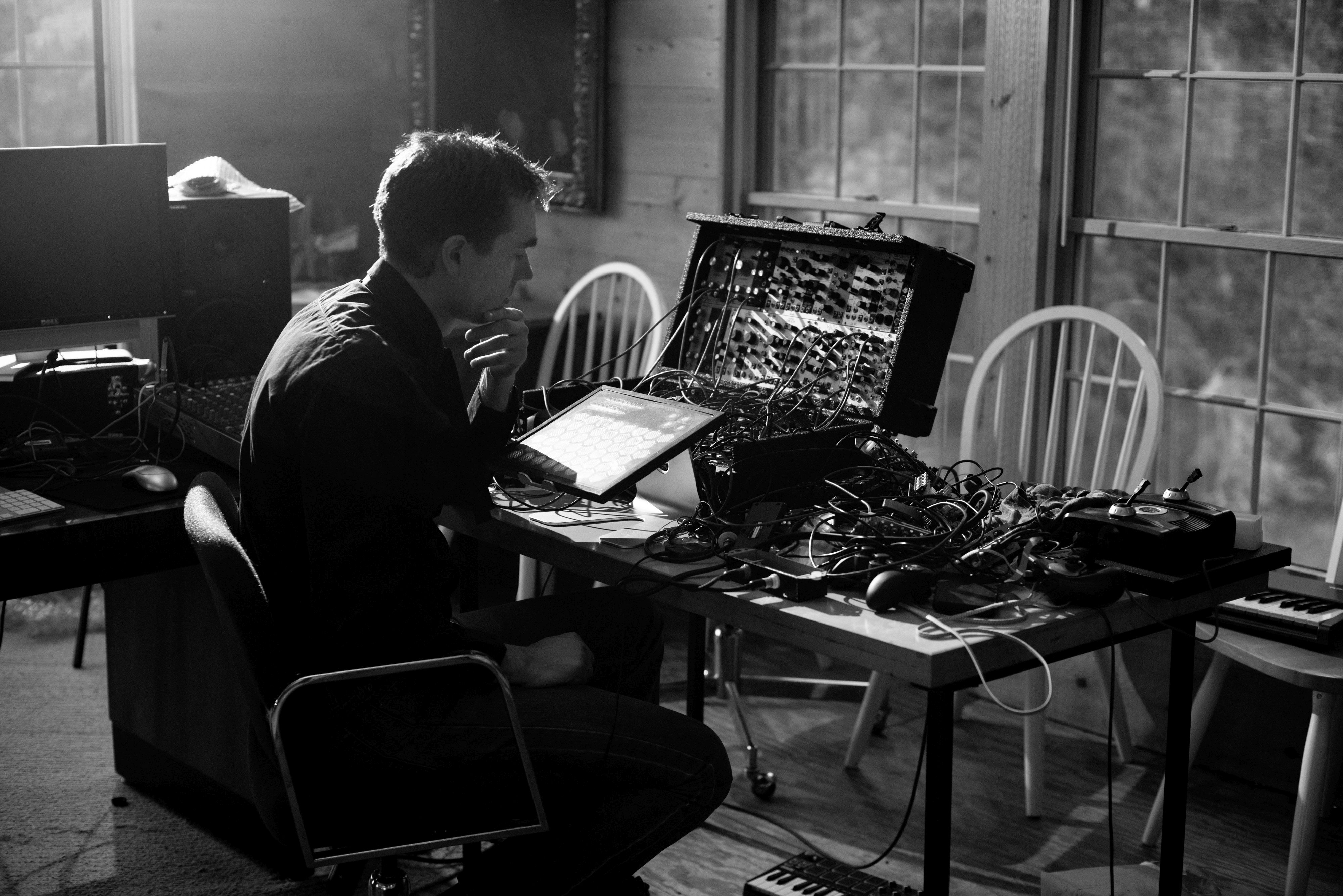
I build my own instruments, often to get around constraints or open up new possibilities - if existing instruments did what I wanted, then I wouldn't need to build my new ones. But a lot of the instruments I build are focused on methods of interaction rather than "new sounds".
Most of the drums on Loom are from a Eurorack module I built that digitally emulates some classic drum machine circuits, and allows for manipulation of drum samples. The difference in how those drums ended up sounding is mostly in the fact that the control of certain parameters is easily modulated in realtime while I'm improvising, so there are a lot of things like toms that pitch shift around while they are ringing (that's what creates the "sonar"-like sounds in the title track).
Another sound that makes a lot of appearances on the album is a module I built that runs a simulation of a vibrating string - it's a method called physical modeling. The implementation of the model is informed by recent research improving the realism of the synthesis by modeling elements like an object touching the string at a harmonic node, or a buzzing bridge. The feedback sounds on the first and last track of the album are that model, being fed back into itself and manipulated live. I like that it feels almost acoustic but somehow still simulated; there's an uncanny valley aspect to it.
In general, on this album I focused on using modules and plugins that I had written as a form of creative constraints, but also I had created those modules and plugins to expand my capabilities in the first place. I have a confused relationship with this idea.
Jean-Michel Jarre maintained that, despite the advances in virtual technology, we are still "analogue animals made out of blood and bones who need buttons and knobs to touch.” Would you say this is the prime motivation for your interest in hardware – or are there other reasons?
Definitely. I love the "offline", compositional activity of doing production in the box and moving around little automation curves precisely, but I also really love making live music and I feel like electronic instruments have so much expressive potential when you create hardware that is tactile and relates to your body more directly.
I like making plugins too, but get much more excited about making physical instruments. I've also felt more and more strongly about the need for instruments as opposed to controllers for electronic performance. I've always been a little sad that because the Manta doesn't have a sound, you can't really tell when it's the Manta on a record. So a goal for my newer instruments is to have something of an identifiable sound to them, so that you could hear it on a record and say "Oh, that's the so-and-so!".
I think the Electrosteel achieves that goal, when I recently heard the first track that includes a session player playing Electrosteel behind a singer-songwriter, it's indisputable that there is no other instrument that could make that sound. I suppose that the Manta/MantaMate combo does have a "sound" that's created by the interaction paradigm.
Listen to the bassline on my electro-country alter ego Owen Lake's song "Will You Miss Me When I'm Gone" (which also uses the Manta/MantaMate combo), and then the bassline on The Plasmic Crystal, and you'll see something idiomatic about how the note sliding feels - it's clearly TB-303 influenced but also obviously not a TB-303.
For some, music equals sound, to others they are two distinct things. What is the relation between music and sound for you? Are there rules to working with sound, similar to working with harmony, for example?
For me they are basically the same thing - a lot of my experimental music would probably seem like it's only sound to some people. My album Sunspots is a dual LP, and the second record is just two 18 minute drones, one on each side. But they are very interesting drones!
Your question about "rules for working with sound" is something I'm not sure I've thought about before, which surprises me as a person who teaches electronic music for a living. There are definitely principles for mixing and engineering, techniques for getting what you are aiming for. Still, I'm not sure there are rules for sound design. I'm also not sure there are rules for harmony. There is some descriptive and prescriptive theory for the harmonic techniques of Western classical music - but I think people often overstate that theory as being "rules". Much of what we think of as harmonic theory is just trying to understand why something that composers do happens to work.
On that subject, I really love to listen to the music made in the late Renaissance as it transitioned to the Baroque period in Europe. Harmonically, concert music was undergoing a gradual change from modal writing to tonal writing, and there is something very tasty about the push and pull when the composers start using those tonal materials and cadences but don't know what they are yet. Really, there are things that sound cool in certain contexts, and different cultures have tried to figure out how to reliably do those cool things they find.
The values of those cultures shape the contexts of the sounds, and therefore what works and what doesn't from their perspectives. In some Hindustani classical traditions, very precise tuning so make perfect, beatless intervals might be desirable to get the intended effect, but in Javanese gamelan music if two notes are tuned to be beatless they are said to be "pleng" which is basically a pejorative meaning boring or flat, because the cultural context and goals of the music are different.
Maybe there are two actual universals: 1. The physics of sound and 2. The biology of the human hearing apparatus and how sounds are perceived. In terms of the physics of sound, you can't get around absolutes like the harmonic series of overtones.
I often think about how serial composition, which was a prescriptive theory, intended to democratize and remove hierarchy from pitch with a new thinking about how pitches can relate to each other. One idea arising from this theory is that of inversional equivalence - an interval going up is the same as the interval going down, a chord is functionally the same as that chord upside down. But the physics of sound disputes this - a minor chord is an upside down major chord, but they sound very different and have very different feels because they align differently with the harmonic series.
I think there ended up being a lot of great serialist music (Stravinsky's late music, for instance), but I don't think it really sonically conveys the anti-fascist message Schoenberg intended. The liberation of dissonance in that music collides with human biology that hears dissonance as an increase in tension, and that's one of the reasons that the mid-20th-century serialist sound mostly survives in our collective consciousness as horror film soundtracks.
It's not that there is a rule against the dissonance that would arise from combining pitches in a certain way, it's just that you need to consider how the harmonies or sounds you make interact with physical realities and with the biology of listeners, as well as cultural memory and values, and then reach for the technique that will get you the result you want.