Published
Name: Jonny Wartel
Nationality: Swedish
Occupation: Saxophonist, clarinetist, improviser, composer
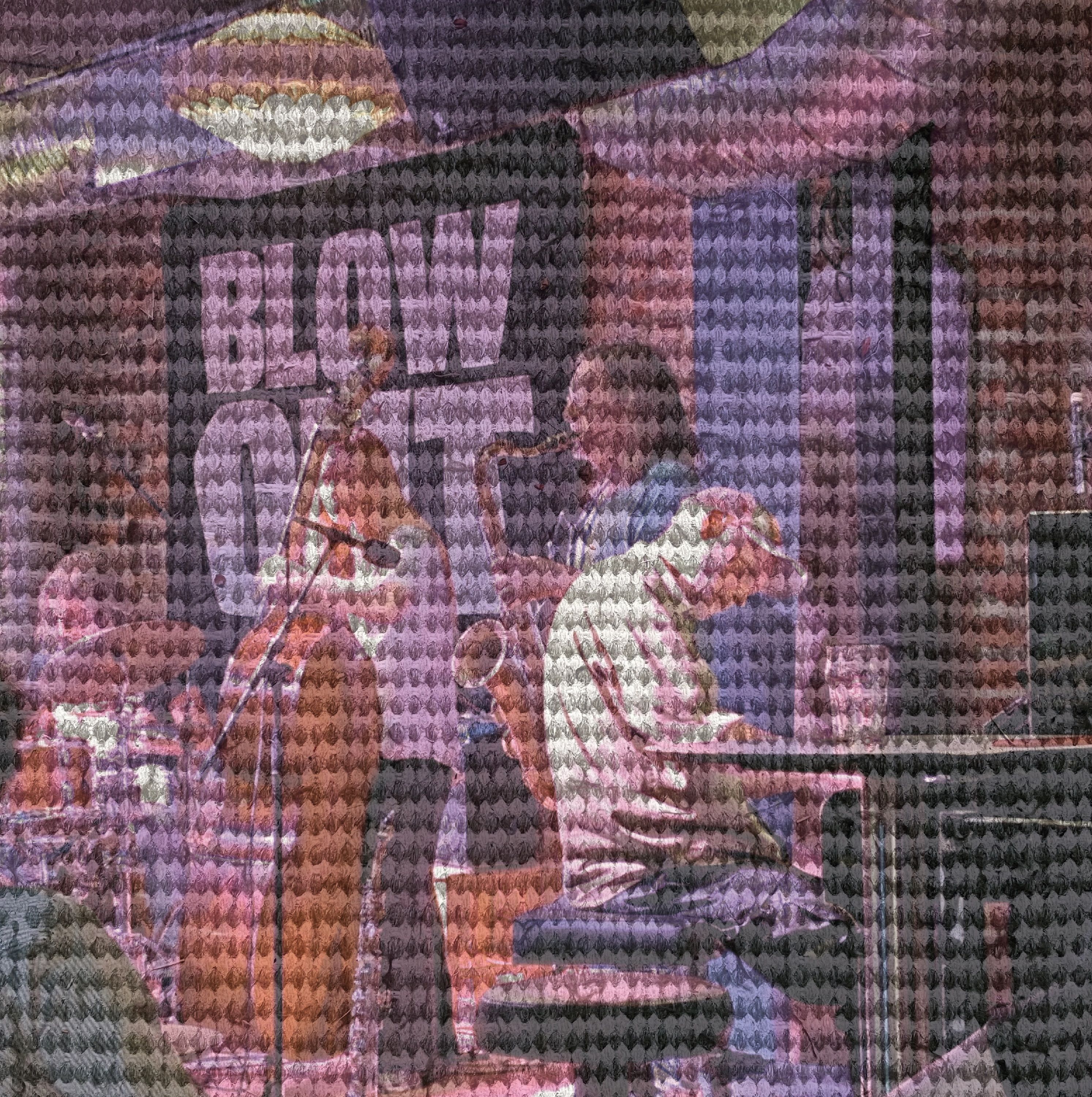
Current release: Jonny Wartel teams up with Mathias Landæus (piano), Georgia Wartel Collins (bass) and Henrik Wartel (drums) for their album Celebrating Live, out via Brotz.
Recommendations: Kandinsky's painting Intersecting Lines, 1923; Paul Auster's novel 4321
[Read our Mathias Landæus interview]
If you enjoyed this Jonny Wartel interview and would like to know more about his music, visit him on Instagram, and Facebook.
When did you first consciously start getting interested in musical improvisation? Which artists, teachers, albums or performances involving prominent use of improvisation captured your imagination in the beginning?
As a small child, I loved experimenting with sounds on the grand piano that both my parents practiced on every day. They never improvised; they stuck to the classical piano repertoire. My mother played a lot of Chopin, while my father preferred Brazilian composers.
Later, when I was a teenager studying classical saxophone, I never played a single note without reading music—not even when practicing scales. I practiced for several hours every day in a room at the local library in the small Swedish town where I lived.
I had a routine: every day I took a midday break and listened to a record—always the same one: Belonging by Keith Jarrett’s European Quartet.
I never really listened to classical music outside of my studies, and I realized that I certainly did not want to become a saxophonist who only played the classical repertoire.
As a promising “good” student, I had three teachers guiding me in classical playing on my alto saxophone. But when I started practicing jazz and improvisation, I never had a teacher. Instead, I connected with other young musicians who were into jazz, and we all listened and learned together.
And then I bought a tenor.
Tell me about your instrument and/or tools, please. What made you seek it out, what makes it “your” instrument, and what are some of the most important aspects of playing it?
I realized that in jazz, your voice is far more individual than in classical saxophone music. I completely changed my embouchure after attending a workshop with the Norwegian saxophonist Erik Balke, the brother of pianist Jon Balke.
The personal sound is the most important tool.
How would you describe your own relationship with your instrument – is it an extension of your self/body, a partner and companion, a creative catalyst, a challenge to be overcome, something else entirely?
I try to maintain a direct connection from my brain—or maybe my spine—without thinking too much about technique and all that. I’m searching for an organic process, and I accept that my technical abilities are what they are.
It’s a bit like language … I’m trying to express my feelings, and that’s not always easy with words (of course, it’s easier in Swedish) but I’m trying to find a sense of flow in every moment using the vocabulary I have.
Sometimes while playing music my technique isn’t strong enough, and I have to find other ways. And sometimes the things I’ve practiced get in the way, and I lose myself by trying too hard.
In fact, I feel physical pain as soon as I try to practice in a structured way. I had enough of that when I was younger.
Derek Bailey defined improvising as the search for material which is endlessly transformable. What kind of materials have turned to be particularly transformable and stimulating for you?
I like chaos. I think it can be very interesting and beautiful when someone plays in a different key than the others—like in “Blasé” by Archie Shepp—or picks up a different tempo, or plays slightly out of tune. Everything, of course, has to be intentional and within the context.
Isn’t everything endlessly transformable? If something isn’t, be aware!
Do you feel as though there are at least elements of composition and improvisation which are entirely unique to each? Based on your own work or maybe performances or recordings by other artists, do you feel that there are results which could only have happened through one of them?
I think that we're subconsciously collecting and restructuring many memories—from compositions, earlier improvisations, or things we heard or felt. In the moment, the memories immediately become a source for a spontaneous framework in my mind, like an ongoing process … always.
In music I believe you always have to improvise within a framework—otherwise, the whole universe becomes your frame and you risk getting lost. As the frameworks arise, whether you like it or not, the freedom in free improvisation lies in the ability to choose your own framework.
You don’t necessarily have to share your framework with others, and you can change it at any time. It can be a very simple framework—like start playing in a single scale, or only in staccato, or even a playful one that you don’t want to share with others: I am Wayne Shorter! The frameworks will trigger your fantasy and creativity and will take you further.
In daily life, the framework shifts with every input you receive—constantly, all the time. For example: imagine leaving one room to get your glasses, thinking you left them on the kitchen table. You need them to write a text like this, and your framework is to act as if you actually know what you’re doing—to be “a good person” with intelligent answers.
But when you enter the kitchen, instead of finding your glasses, you see your phone on the table. You remember you have an important call, pick up your phone, and immediately get lost scrolling Facebook. Then someone calls and asks if you want to go for a walk. Fun— but wait … unexpected complications appear, clouds drifting in … and so on … and so on ... constantly.
You have to improvise in every moment, as the frameworks shift instantly, yet I believe that people, in general, long for rules. Rules relieve us of responsibility—the stricter the rules, the less responsibility we have to take.
There’s a certain suspicion around the word ‘improvisation,’ in music, as if it implies a lack of responsibility. That's a bit strange because in reality, as human beings, we are improvising all the time. We constantly adapt and respond to what happens around us. At the same time, we need to be prepared for anything, which is why it can feel easier to rely on rules or structures.
Mastering a musical structure requires a great deal of effort, of course. But you can follow the rules and improvise within the structure. To improvise without a given structure requires a great deal of mindfulness and perhaps avoiding rules.
When you're improvising, does it actually feel like you're inventing something on the spot – or are you inventively re-arranging patterns from preparations, practise or previous performances? What balance is there between forgetting and remembering in your work?
The hardest challenge is to never pretend. It has to happen in the moment.
You might be working within the same framework as yesterday, but you can’t try to recreate what you did then in a new room, a new environment, with a new audience—it’s a trap.
Are you acting out parts of your personality in your improvisations which you couldn't or wouldn't through other musical approaches? If so, which are these? What, would you say, are the key ideas behind your approach to improvisation?
I play all kinds of music, and I always try to stay within the genre—but in my own way. I try to “fit in,” so to speak, without losing my spontaneous flow. Sometimes that flow is mischievous; sometimes it pushes boundaries.
In fact, I’m always pushing boundaries, but in free improvisation, we can go much further than in a jazz club, where traditional jazz standards serve as the framework or the agreed-upon rules.
In terms of your personal expression and the experience of performance, how does playing solo compare to group improvisations?
I prefer a conversation between musicians through their instruments rather than a solo performance. But at the same time, a solo performance can also be a conversation—with the audience.
In your best improvisations, do you feel a strong sense of personal presence or do you (or your ego) “disappear”?
In my best improvisations, I feel like I’m flying.
In a live situation, decisions between creatives often work without words. From your experience and current projects, what does this process feel like and how does it work?
The group always comes first. Everything I’ve mentioned above we have to do together— in the flow, in the organic process, in the refusal to pretend.
We have to fly together.
And when that happens, no words, eye contact, or gestures are necessary—only deep listening, sensing each other, and feeling the room, including the audience.
Carpe diem.
Stewart Copeland said: “Listening is where the cool stuff comes from. And that listening thing, magically, turns all of your chops into gold.” What do you listen for?
I agree. I especially love listening to Dewey Redman, particularly when he gets hit by a wave of emotion and starts shouting while playing.
Sometimes, even the sound of a single note is enough—like with Charlie Haden.
There can be surprising moments during improvisations – from one of the performers not playing a single note to another shaking up a quiet section with an outburst of noise. Have you been part of similar situations and how did they impact the performance from your point of view?
In a quiet and delicate moment—like the middle of a calm passage in a classical violin solo—suddenly someone’s cellphone rings … that’s a disaster!
But if a phone rings while we’re playing free improvisation, it can become a master trigger for us, instantly changing the direction of the music. That’s wonderful!
I have always been fascinated by the many facets of improvisation but sometimes found it hard to follow them as a listener. Do you have some recommendations for “how to listen” in this regard?
Don’t try to understand or analyse the music. Just let go. It’s a shared journey—between the group, the audience, the room, and the atmosphere.
Everyone has the right to their own interpretation.
In a way, improvisations remind us of the transitory nature of life. When an improvisation ends, is it really gone, just like a cup of coffee? Or does it live on in some form?
Hopefully, it stays in your mind—or the audience’s mind—as a good memory.