Published
Part 1
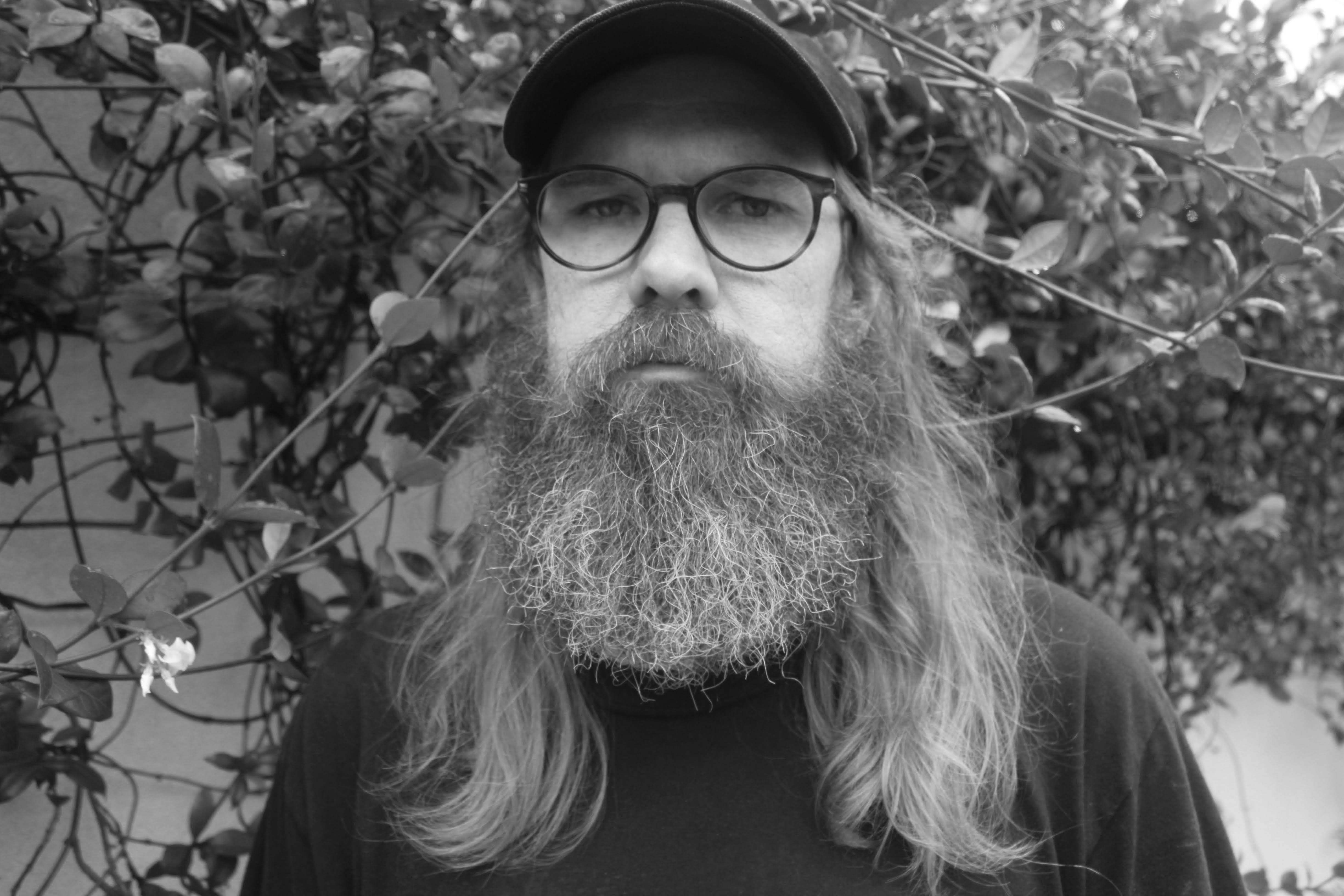
Name: Josh Mason
Nationality: American
Occupation: Composer, producer, guitarist, modular synthesizer player
Current release: Josh Mason's Kicking A Dark Horse is out via greyfade. It is part of the label's FOLIO series which searches for new formats for physical music releases by publishuing full-length editions in a hardcover book filled with complementary essays, notes, thoughts, and poetry.
Recommendation for Florida: I think I would be remiss if I did not direct someone right to the ocean. It stirs my imagination more than almost anything else on this planet.
Shoutouts: Personally, I would frame the future here in relation to education, and with that I would have to make mention of Andrew Fitch who operates Nonlinear Circuits in Perth, W. Australia. NLC consistently pushes the boundaries of what is possible in the analog domain with electronic building blocks and inexpensive jellybean parts. Whether it’s educational schematics, printed PCBs, or community involvement at local kit building workshops, he offers something for everyone’s level of interest and skillset. For my money, all the best stuff isn’t being done for Likes and Follows, but rather by the weirdos in the woodsheds, and especially those who are giving synthesizers back to the people.
If you enjoyed this Josh Mason interview and would like to stay up to date with his music, visit his official homepage. He is also on bandcamp.
Many artists have told me that they’re in discovery mode when working with the modular. What are some of the things you recently discovered while working with your own set-up?
Aside from the value of reverse polarity protection diodes, I’ve found that there is almost always more that can be done with what you may already have in front of you.
That sample and hold can be fed audio and clocked at audio rate; If you clock that divider with white noise you can generate a “crackle” effect; FM an oscillator with looping sample playback and send that oscillator to a phase-locked loop and monitor the comparator out for some very busted “radio” style transmission sounds.
The permutations are seemingly endless, and you don’t always need a dedication module to achieve something you might hear in your head.
There are artists who can realise their ideas best with a traditional – or modified – piano interface, others with a keyboard and a mouse, yet others by turning knobs or touching screens. What’s your preferred and most intuitive/natural way of making music and why?
My preference is certainly tactility, regardless of the instrument. There needs to be a well defined link between physical manipulation—be it a guitar string, or a potentiometer —and a resulting change in frequency, amplitude, etc.
There have been a lot of advancements in music technology with things like gesture-based navigation and haptic feedback for example, but it feels different the way driving a car with an automatic transmission vs. a manual one feels different.
Our entire lives are dominated by screens and at this point in time, and my preference is not to dogpile on that while being creative if I can avoid it.
What did your first modular look like? Tell me about the first pieces you produced and performed on it, please.
I think the notion of “first” is a bit difficult to pin down, due in part to the nature of “modular” architecture. It was assembled slowly and a bit haphazardly, making it tough to say when it was “done” or “ready for use”
Two very important things happened when I began the process: A few Eurorack format modules were loaned to me, which was immensely helpful because the cost of entry to modular synthesizers was (at the time) fairly high, especially if you didn’t know what you were doing.
The second and more important thing was a question that was posed to me: “Would you prefer to generate sounds, or process them?” At the time, I chose processing, because it was familiar enough to me coming from a guitar pedal / sampling / looping paradigm, and I felt like it would ease the learning curve.
It was a tiny system that still relied heavily on external sound generation or sample preparation and manipulation, but it did allow me to experiment with frequency and amplitude modulation, which I had very little context for at that time.
This is one of my very first recorded experiments with my first Eurorack set up (pictured below)
There is a worldwide community around modular synthesizers. How would you describe your involvement with it and its role for your creative development especially in the early days of your modular journey?
The modular synthesizer community has exploded in recent years. When I first started experimenting with it, at least in the Eurorack landscape of the States, there weren’t a whole lot of builders involved. It felt like a breath of fresh air, as it opened up a lot of new ways of thinking for me.
It seems very elementary now, but at the time, the concept of “modulation” or “helping hands” as I thought of it, was revelatory. Suddenly I was able to do things I never could have done with just two hands when it came to interfacing with pedals and samplers, or was just too lazy to learn to do properly with computers.
Comparatively, modular synthesizers are still very lowbrow things, and because of that I was exposed to a lot of fundamental stuff that I would have otherwise glossed over. The systems are so reliant on spatial limitations as well as things like power supplies, so builders are often getting creative when working in those confines, whether that means abusing certain circuitries to do stuff they aren’t meant to, or resurrecting outdated filtering implementations or odd timbre shaping methods.
All of that was fascinating to me, because the rest of the music tech industry around me was seemingly flowing in the opposite direction by trying to make everything cleaner and more accurate. The modular crowd seemed totally content to keep things weird and strange.
Modular synthesizers allow for the most diverse and personal set-ups. What were some of the most surprising/inspiring configurations or ways of playing the modular that you’ve seen?
There is certainly no shortage of strange ways to interface with these things. Capacitive touch keyboards, servo motor drivers, gaming console controller interfaces just to name a few.
There is a wild west angle to the format, in that there aren’t really any standards, and if you can connect it, and it doesn’t start a fire, it’s fair game… though in the case of a couple rather esoteric manufacturers, blowing things up with your synthesizer is not only expected, but encouraged.
One of the more surprising, albeit gimmicky, methods is biometric feedback to control voltage conversion. These devices track tiny changes in electrical current from organic material to stimulate control signals which can be used to modulate any/every parameter of a patch.
I did a tour a few years ago where I leveraged a module like this. My tourmate and I would go plant shopping in each new city we played in, and at the show that night that plant would become the host for those sensors, creating all manner of chaotic signals depending on the type of plant, how much water it had, etc. I then had to react in real time to these very chaotic fluxuations as the set progressed.
Often, when space in the room allowed, I would hand the plant to someone in the crowd mid-set, and as they touched the leaves, they connected themselves to the circuit as well, and it made for a fun way for the audience to interact and be less removed in that type of listening environment.
This biometric feedback methodology was utilitzed to a great extent on a track called “Hermitic Chime” on my Coquina Dose LP. The voicing’s pitch data as well as the voicing’s sustain depth was all sequenced and controlled by a plant (with lots of hands on wrangling to make sure it stayed in the lane I wanted it in).
Can you take me through the evolution of your modular system up to your current set-up? What aspects do you consider when buying a new module?
At this point in time, I’m going on 10+ years of system evolution and forking pathways. My very first experiments focused on processing external signals, but that quickly became cumbersome the more I learned about how all this stuff worked and the more I utilized it live, because that meant hauling around a lot of gear.
Once I started focusing more on doing everything I wanted to do inside the case, I quickly ran into a major pitfall of the ecosystem, which is gear acquisition. I found I “needed” more and more modules, therefore “I’m gonna need a bigger boat” so to speak. Eventually that also became unwieldy in a different way, in that now I had this massive case full of lot of different manufacturers—which might seem fun and novel—but I actually found it to be problematic when it came to things like voltage ranges and thresholds, as there are no real set standards in Eurorack.
One day I was playing guitar and having a conversation with a friend about single-coils vs P90s, and it hit me like a bolt of lightning: this notion of “systemhood” — creating discrete systems that each focused on a single designer’s vision as much as was possible, each curated to achieve specific sounds or goals. Once I started thinking about things that way, everything changed. Suddenly things were getting along and became a bit more predicatible. The music I was writing also became a bit more cohesive and I felt like I took greater steps towards a definition of voice.
A useful (to me) byproduct of this was also the inherent impediments involved in single brand systems. Not everyone makes everything you need, so it forced me to get creative and think “ok well, I don’t have X thing I need, but what is Y thing really actually capable of doing” and furthermore “do i really need to be able to do all this at once?”
This mindset certainly plays a role now more than ever when it comes to making decisions to buy a new module. Especially these days, it’s fairly easy to just go out and buy the exact thing you (think) you need to achieve the end result you have in your head, but I now tend to stop and assess what I have and ask myself “what is the true modular solution here?” which, for me, is inherently more rewarding.
Which modules incisively changed your way of making music – and why?
Without a doubt, all of Scott Jaeger’s Eurorack designs (Industrial Music Electronics, f.k.a. The Harvestman from Seattle, Washington).
One of the first dedicated voices I had as part of my system was a Piston Honda wavetable oscillator. The irony was, initially it was part of the processing set up I had because in addition to being a voice, it also acts as a waveshaper that imparts a very dusty, worn quality that I loved the minute I heard an example of it in practice.
At the time, The Harvestman devices were a bit cost prohibitive, but over the years I ended up running across a lot of it, and once I had my systemhood revelation, that ecosystem really came into focus. All of it works really well together, and it has a certain sound that speaks to me. Some of the earlier designs are also a bit rough around the edges, but I found the quirks in their behavior charming and learned to adapt them for use creatively.
At this point I am now collecting duplicates of most of his designs because I’m terrified that eventually they’ll give up the ghost, or Scott will (god forbid) get hit by a bus and any chance of something being brought back to life is reduced to 0.