Published
Part 1
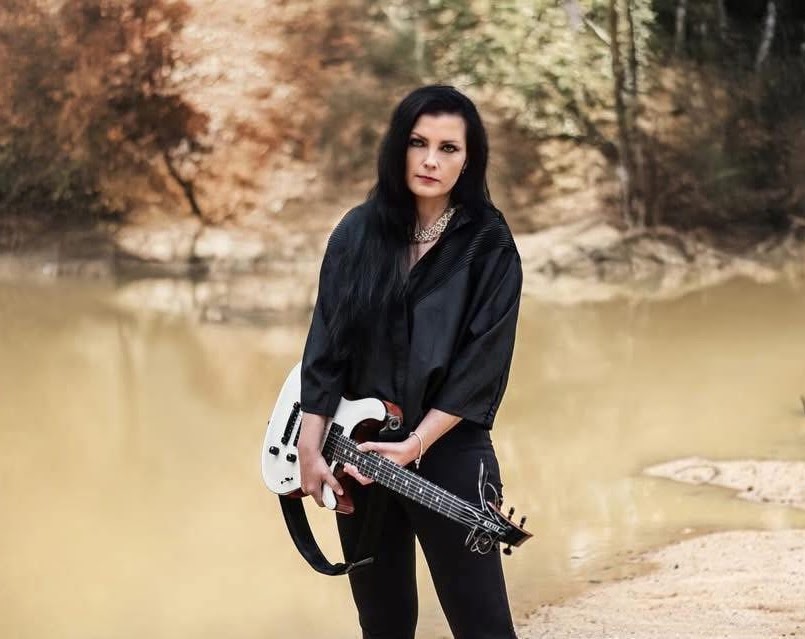
Name: Kamila Csenge
Nationality: Czech
Occupation: Composer, guitarist, improviser
Current release: Kamila Csenge's new album Behind the Universe is out via Fat Banshee.
Recommendations for Prague, Czech Republic: Since I currently live in Prague, I would recommend visiting the historic city center, which is full of beautiful architecture, cultural landmarks, and a unique atmosphere. One of my favorite places is the area around the Charles Bridge and Prague Castle, where you can experience the history and character of the city while enjoying stunning views over Prague.
If you enjoyed this Kamila Csenge interview and would like to know more about her music and upcoming live dates, visit her official homepage. She is also on Instagram, Facebook, and tiktok.
What were some of the musical experiences which planted a seed for your interest in jazz?
I am not from a musical family, so I started pursuing music relatively late. My musical journey began with classical music, which gave me a strong foundation and introduced me to the beauty of melody and harmony.
Later, I discovered jazz, and it opened up a completely new world for me. Listening to artists such as Pat Metheny, Jim Hall, Bill Evans and Al Di Meola was incredibly inspiring.
What attracted me most was the creativity and freedom of jazz—the ability to express yourself in the moment and create something unique through improvisation. That sense of exploration and personal expression is what made me fall in love with jazz.
What does the term jazz mean today, would you say?
Jazz means creativity, connection, and interaction with other musicians.
What I love most is the spontaneity of it—the ability to improvise in the moment and create something unique together. Every performance is different, and no improvisation is ever exactly the same. That sense of freedom, communication, and discovery is what makes jazz so special to me.
As of today, what kind of materials, ideas, and technologies are particularly stimulating for you?
At the moment, I am particularly inspired by ideas that explore the connection between the outer world and our inner experiences. Themes such as personal transformation, courage, the unknown, and our place in the universe continue to stimulate my creativity. These ideas are at the heart of my debut album Behind the Universe.
For example, the composition “Against the Wall” is about the courage it takes to create change. Sometimes, if we want to shift something in the world, we have to push against resistance—even when it feels like everything is standing in our way. The piece captures the struggle, the obstacles, and the inner strength required to keep moving forward.
Even when the path is difficult, change can only happen if we keep going.
Musically, I am inspired by jazz tradition, classical music, contemporary harmony, and artists who are not afraid to explore new directions. I enjoy discovering new sounds and finding ways to combine different influences while maintaining my own musical voice.
Technology is also an important creative tool for me. I compose using Cubase Pro and Finale, and as a guitarist I enjoy exploring sounds with the Neural DSP Quad Cortex. These tools help me turn musical ideas into reality and expand my sonic palette.
At the same time, the most important source of inspiration remains human experience, emotion, imagination, and the connection between people through music.
Where do most of your inspirations to create come from – rather from internal impulses or external ones? Which current social / political / ecological or other developments make you feel like you need to respond as an artist?
The inspiration came from both the external world and my inner feelings. The whole album Behind the Universe was born from a desire to explore what lies beyond—beyond the visible, the known, and the limits of fear and pain. It is a journey past the stars, past time and space, into infinite expanses where the familiar dissolves and the impossible becomes possible.
At the same time, it is also a journey inward. The album reflects not only the vastness and mystery of the universe around us, but also the inner worlds within ourselves—the uncharted spaces where courage, transformation, hope, and hidden strength exist. Each composition represents a different step along this path. Through the music, I wanted to explore the connection between the outer universe and our inner experience, inviting listeners to discover beauty in unexpected places and to reflect on what is greater than us, yet deeply connected to our own hearts.
While I do not usually write music that responds directly to political events, I am influenced by the emotional and social realities of the world we live in. One composition that reflects this is “This World.”
The piece was inspired by the struggles many people face today—the silent battles, loneliness, uncertainty, and emotional burdens that often remain unseen. At the same time, it is a message of compassion and hope. It reminds us that even in difficult times, we can help one another and find strength through connection.
As an artist, I am interested in the human experience behind current events and social changes. Through music, I hope to create a space for reflection and remind people that even in challenging times, there is still beauty, empathy, and the possibility of healing.
Tell me a bit about the sounds & creative directions, artists & communities, as well as the colleagues & creative hotspots of your current hometown, please. How do they influence your music?
I currently live in Prague, which has a vibrant and diverse music scene. The city has a strong jazz tradition, but at the same time it is very open to contemporary influences and cross-genre collaborations. There are many talented musicians, venues, festivals, and creative communities that make Prague an inspiring place to live and work.
I am fortunate to work with outstanding musicians who are also based in Prague, including Kateřina Vacková on double bass and bass guitar and Ivo Hermanovský on drums. They are members of my band and also performed on my debut album Behind the Universe.
Collaborating with them has had a significant influence on my music, as each of them brings their own personality, creativity, and musical perspective to the project.
What role do electronic tools and instruments play for your creative process?
Electronic tools play an important role in my creative process. When I compose, I record my ideas in Cubase Pro and notate the music in Finale. Once the compositions are finished, I prepare the scores and recordings and send them to the musicians. These tools help me organize my ideas and efficiently communicate the music to the ensemble.
As a guitarist, I also enjoy working with effects and exploring different sounds. I have always liked BOSS effects, and my newest piece of gear is the Neural DSP Quad Cortex multi-effects processor. It offers incredible sound quality and flexibility, allowing me to shape and experiment with tones in ways that inspire new musical ideas.
While technology is not the source of creativity itself, it is a valuable tool that helps me bring my musical vision to life.
Thanks to technological advances, collaboration has become a lot easier. What have been some of the most fruitful collaborations for you recently and what approaches to and modes of collaboration currently seem best to you?
The most fruitful collaborations for me recently was the creation of my debut album Behind the Universe.
It was a truly collaborative project involving an outstanding group of musicians and partners: Yamirah Gercke on guitar, Kateřina Vacková on double bass and bass guitar, and Ivo Hermanovský on drums. The album was released through Fat Banshee Records, led by Yamirah Gercke, and in collaboration with the Berlin-based music publishing company Random Noize Musick.
The recording process took place in two different studios. We recorded “The Void,” “Against the Wall,” and “Guardians of the Garden” at Popschutz Studio in Berlin with recording engineer Arne Bergner. The remaining tracks — “This World,” “The Metamorphosis,” “Music Forever,” and “The Point of No Return” — were recorded at SONO Records in the Czech Republic with recording engineer Adam Štola. The album was then mixed and mastered by Adam Karlík.
What made this collaboration especially rewarding was the combination of different musical backgrounds, ideas, and experiences, all working toward a shared artistic vision. Every person involved contributed something unique to the project, helping shape the final sound of the album.
I still believe the most effective collaborations happen when musicians can work together closely, whether in the studio or during rehearsals. The direct exchange of ideas, spontaneous interaction, and creative energy between people remain irreplaceable.
Jazz has always had an interesting relationship between honouring its roots and exploring the unknown. What does the balance between these two poles look like in your music?
Jazz has always evolved by building on tradition while constantly exploring new possibilities. In my own music, I try to maintain that balance by respecting the foundations of jazz—improvisation, interaction, swing, and storytelling—while also bringing in my own musical ideas, experiences, and influences.
I am inspired by great jazz artists such as Pat Metheny, Jim Hall, Jaco Pastorius, and Danilo Perez, but I do not want to simply recreate the past. Through my compositions, I try to explore new musical landscapes and express my own voice.
The album Behind the Universe, for example, combines traditional jazz elements with contemporary harmonies, cinematic atmospheres, and themes that reach beyond everyday reality.
For me, honoring jazz roots does not mean staying in one place. It means understanding where the music comes from and using that foundation as a starting point for exploration. Jazz has always been about creativity, discovery, and pushing boundaries, and I try to carry that spirit into my own work.