

Name: Kefaya
Members: Giuliano Modarelli (guitars), Al MacSween (keyboards), Joost Hendrickx (drums)
Nationalities: Italian (Giuliano Modarelli), British (Al MacSween, Joost Hendrickx)
Interviewee: Giuliano Modarelli
Current Release: Kefaya team up with Afghan singer-songwriter Elaha Soroor for “Our Freedoms Must Be Won,” out via Radio International.
[Read our Elaha Soroor interview]
If you enjoyed this Kefaya interview and would like to know more about the band, their music and upcoming live dates, visit the trio's official homepage. The group are also on Instagram, bandcamp, and Facebook.
Where does the impulse to create something come from for you? What role do politics, personal relationships, poetry or other art forms play?
For us, music rarely begins from one single place. It can start with a poem, a conversation, a political event, an old folk melody, a rhythmic cycle, or simply a feeling that something needs to be said.
With Kefaya, politics is not something we add later to the music. It’s already there in the histories, languages and lived experiences that shape the project.
Elaha’s experience of exile, the poetry of Hazara, Afghan and Iranian writers, and our own experiences of migration, actrivism, identity and witnessing the world around us all become part of the material.
Do you begin with a clear vision, or do you leave space for chance?
There’s always a balance between structure and spontaneity. We often begin with fragments rather than finished ideas: a rhythm, a riff, a melodic phrase, a synth sequence, a poem. From there, we leave a lot of space for improvisation and instinct.
Some of the strongest moments happen when the music moves somewhere none of us planned.
For your latest release, what did you start with? What were the conceptual ideas behind it?
With Our Freedoms Must Be Won, we started with the title and what it represented:
The idea that freedom is never something guaranteed, never something you inherit passively. It has to be fought for, defended, and understood as something collective. It's a collective responsibility which we are all accountable for.
From there, the music naturally began to speak about struggle, exile, borders, human rights, resistance, memory and survival.
Tell me about how the new material developed and took its final form.
The album was written over two intense weeks in the studio.
We came in with fragments: Afghan rhythmic ideas, synth patterns, guitar riffs, poems, melodic cells. Then we built everything through collective improvisation. A lot of the final material came out of long live sessions.
Later the music was shaped, arranged and produced mainly by Al MacSween, and partly myself (Giuliano Modarelli), trying to preserve the rawness of those first takes while giving the album a strong sonic identity.
What makes lyrics powerful for you? What do you look for in language?
Lyrics need to carry truth, but not in an obvious way. We’re not interested in slogans or empty political language. We want lyrics that hold poetry, contradiction, tenderness, anger and complexity at the same time.
On this record, the Farsi texts move between Elaha’s own writing and works by Hazara, Afghan and Iranian poets, which gives the album a strong political and emotional depth.
We also made a conscious decision not to work in English, and that in itself is a political and artistic statement. We live in a world, and especially in a music industry, that often assumes English as the default language through a very anglocentric lens which is not the reality around us. For us, working in Farsi is a way of challenging that and asserting the value, beauty and complexity of other linguistic and cultural realities.
We do provide translations, because communication matters deeply to us, but we also believe not everything needs to be immediately filtered through English in order to be understood, felt, or taken seriously.
Do you like to stay in control of the creative process, or follow where things lead?
Both. A lot of our music is rhythmically very precise, built around odd time signatures, metric shifts and polyrhythms. That structure gives us a framework. But inside that, we want risk. If everything is controlled, the music dies. The unpredictability is part of what keeps it alive.
We are also all strong improvisers (coming from jazz and Indian classical music), but in the case of this album we approached improvisation in a non-hierarchical way, without indulging too much in massive solos, instead exploring a more collective approach, although we still like to create space for that especially in live shows.
How would you describe the creative state? Is there a spiritual side to it?
Definitely. Not in a religious sense, but in the sense of deep concentration and surrender.
A lot of the music on this record works through repetition, trance, groove, tension and release. There are influences from Qawwali, Indian classical music, African trance traditions and psychedelia. When the band locks into something together, it can feel like entering another state, a trance-like but also empowering space.
We hope the audience experiences the music in a similar way.
How important is arrangement and production compared to composition?
Very important. Sometimes a simple melodic idea becomes something completely different through arrangement, sound design, production or rhythm.
On this album, production wasn’t separate from composition, it was part of the writing itself. The analogue synths, distorted guitars, rhythmic textures ... all of that shaped the identity of the songs.
It’s possibly a bit less produced than our previous albums in order to maintain a rawer energy, but the dynamics and overall musical journey are still shaped and enhanced through production.
How do you think about artwork and visuals in relation to the music?
For us, visuals need to carry the same tensions as the music. The music lives between cultures, between analogue and electronic worlds, between intimacy and confrontation. We didn’t want something polished or decorative. We wanted imagery that felt human, textured, and able to hold some of that same emotional weight.
All the photography we’ve used for the artwork (and singles) are by Angela Christofilou, and it comes from real moments of collective action and resistance in the UK, mainly from demonstrations in London streets and around detention centres for migrants.
These are not abstract symbols but lived realities. They speak to struggle, but also to solidarity, and to the power people have when they come together against systems of control.
How do you deal with the emptiness after finishing a record?
There’s always a strange emptiness. You spend years living inside something, then suddenly it belongs to other people.
But that’s also the beautiful part. Once it’s released, the songs stop belonging only to us. They start carrying other people’s stories too and that's exciting!
Have listeners ever surprised you with how they interpreted your music?
All the time. We’ve had migrants, activists, and people who don’t speak a word of Farsi all connect deeply with the music in different ways.
One of the most beautiful things about this collaboration with Elaha is the diversity in the audience, as society in the West often feels divided and categorised. It’s powerful to see a room full of Hazara, Afghan, European, and people from all ages and backgrounds coming together in the same space, something you can’t always say about a typical rock audience.
Sometimes people hear things we didn’t consciously put there, and that can be beautiful. It reminds you that music always becomes bigger than your original intention, and that it is ultimately a subjective journey. We also hope people can feel our message of resistance and solidarity in the music, and feel empowered by it

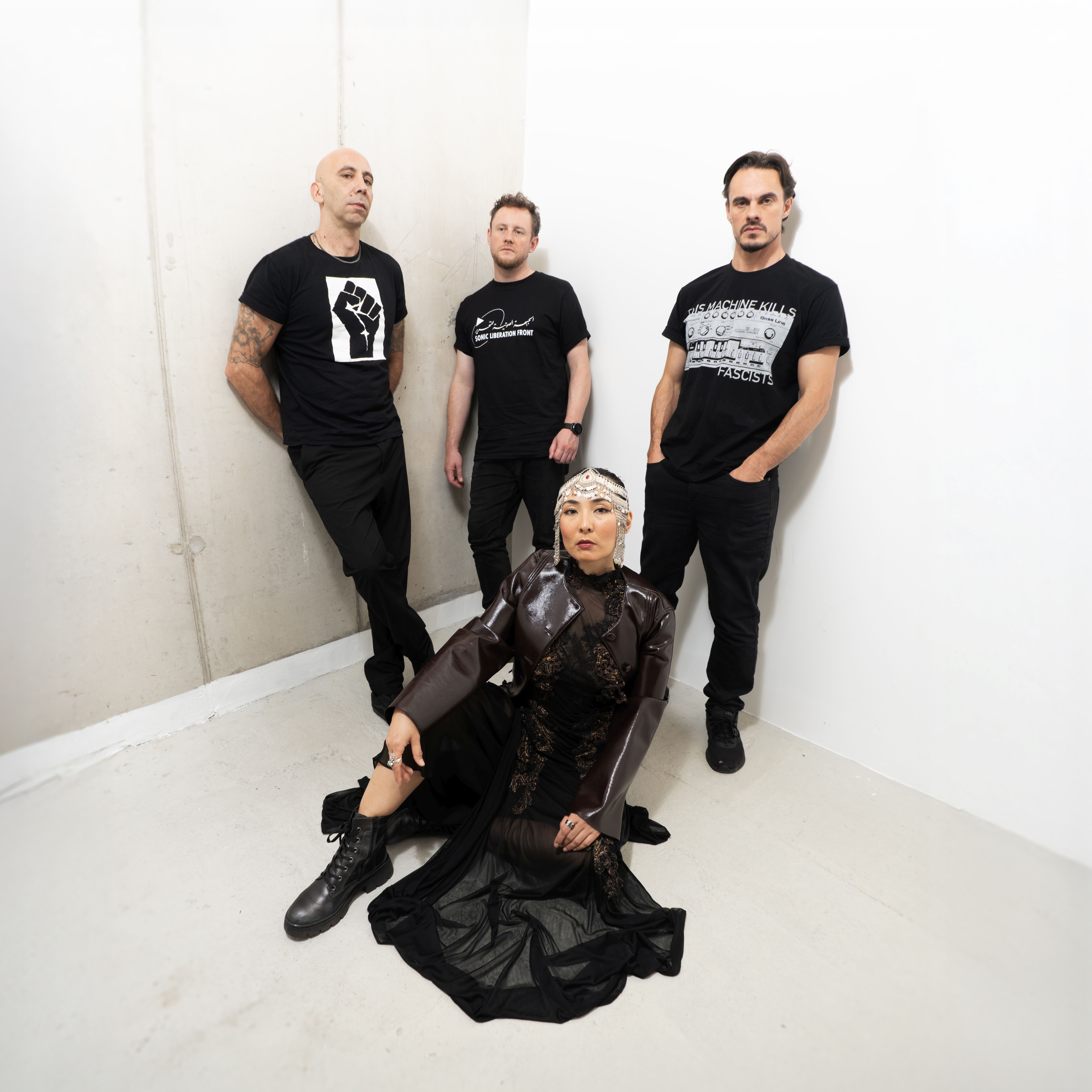 Kefaya and Elaha Soroor Interview Image (c) the artists
“Lyrics need to carry truth. But not in an obvious way.“
Video
