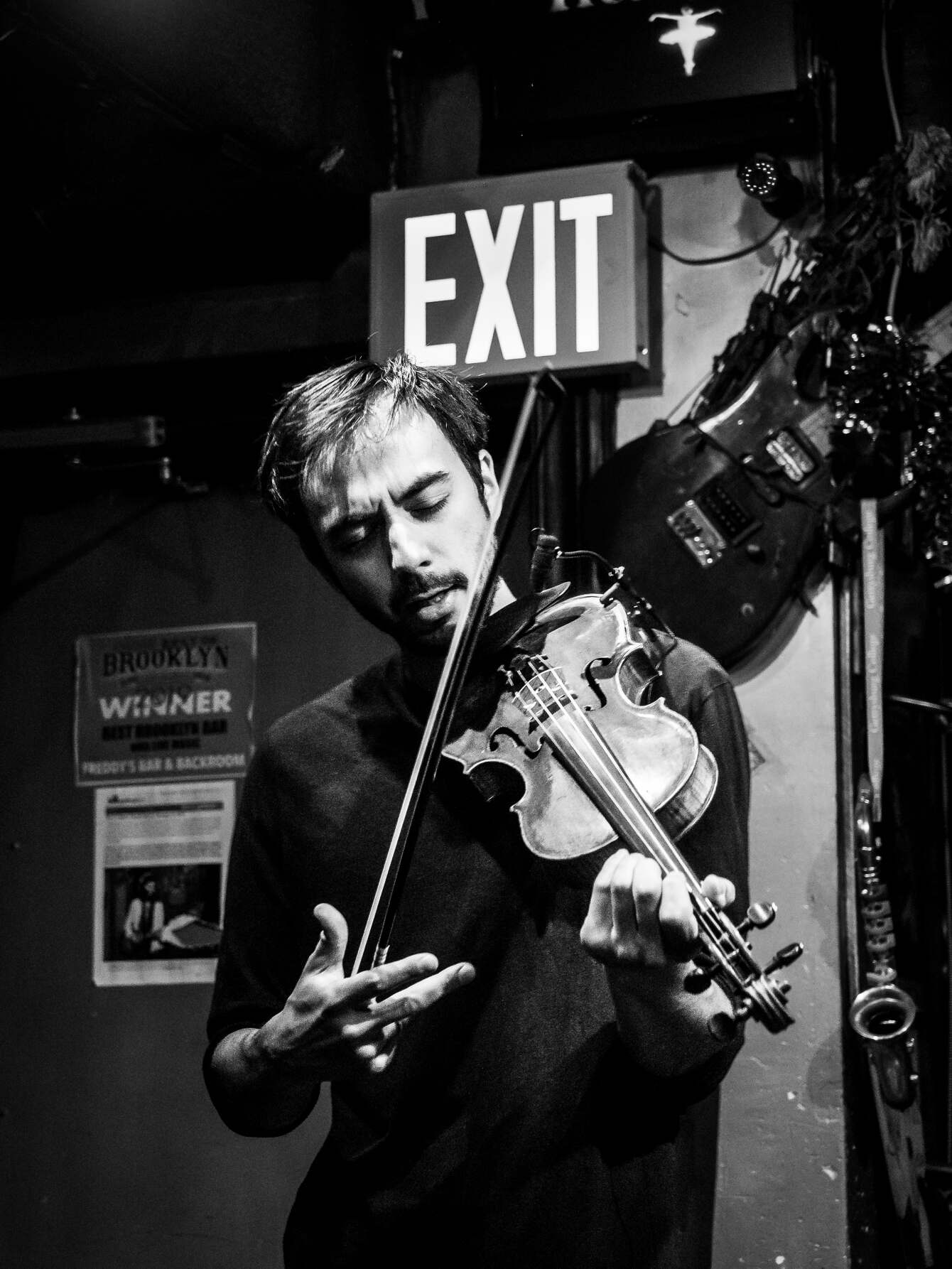
Published
Name: Keir GoGwilt
Nationality: American
Occupation: Composer, violinist, musicologist
Current Release: Keir GoGwilt's new album The Zarabanda Variations is out August 7th 2026 via Carrier.
If you enjoyed this Keir GoGwilt interview and would like to know more about his music and upcoming live dates, visit his official homepage. He is also on Instagram.
As of today, what kind of materials, ideas, and technologies are particularly stimulating for you?
I often find myself inspired by particular histories which I feel connected to by virtue of my musical practice. I grew up studying classical violin, but was always drawn to other traditions including jazz, contemporary improvisation and early music.
Growing up I studied Baroque music, playing dances like the Sarabande, Chaconne, and Folia, very common in works by the likes of Bach, Handel, and Corelli. In the context of classical violin pedagogy, the emphasis in studying these works was necessarily about learning stylistic norms while also attempting to carve out a unique interpretive approach to music that has passed through countless hands over the centuries.
One of the original inspirations for my forthcoming album, The Zarabanda Variations, was recent research detailing the journeys that many Baroque dances like the sarabanda and chacona took across the Atlantic triangle throughout the early period of colonization. Before becoming the Sarabande and Chaconne of courtly European music, these were fast and sensuous dances with syncretic origins in the Americas and Caribbean.
As a composer and improviser, as well as a classically-trained violinist, I wanted to respond musically to the missing historical links in these dances’ journeys from colonial encounter to pillars of the Baroque aesthetic. How could we refigure the Baroque, which is so often represented and performed as a timeless art? I thought to challenge its perceived unity and perfection by layering it against various traditions and genres of music-making that themselves refigure or counter European instruments, harmonies, and forms: mariachi, jazz, free improvisation, various folk idioms.
This involved bringing in the right musicians to create these clashes and collages within the ensemble. I’m grateful to Jonny Allen, Vicente Atria, Mariana Flores Bucio, Miranda Cuckson, Carrie Frey, Alec Goldfarb, Kyle Motl, John Popham, and Wilfrido Terrazas, for bringing their expertise and creativity to this project.
[Read our Vicente Atria interview]
[Read our Alec Goldfarb interview]
The borders between producers, sound artists, and even songwriters are becoming increasingly blurry. What does being a composer mean today, would you say?
I think that a composer is someone who is in the practice of organizing sound to create new constellations of meaning. That can happen through notation, improvisation, editing, recording, collaboration, performance, and curation.
My own compositions for The Zarabanda Variations are finely attuned to the world of the project and the performers involved. For example, my piece, Baroque Concerto, stages a sort of contest between the string quartet component of the ensemble and the improvisers (playing flute, percussion, bass, and guitar).
The heterophony of these approaches allows for the layering of Baroque-inspired textures and pads with the cacophony of a street band. Towards the end of the track, the two elements fuse.
Another track from the Zarabanda album is a song I wrote for the incredible singer, Mariana Flores Bucio. Mariana has a background singing traditional mariachi music, opera, and contemporary music. The song, Humiliation of the Victors, showcases her incredible operatic voice in a kind of futuristic-sounding Baroque aesthetic.
Wilfrido Terrazas also wrote her a song, Plegaria, which showcases her abilities in a more vernacular and jazz idiom. It is one of my favorite tracks on the album.
The poetry tracks on the album involved a very different process of composition. They began with free improvisations by the musicians in dialogue with poet Edgar Garcia’s readings of his poems. For each poetry track we took several takes in which all of us experimented with different sounds, pacing, and kinds of expression to accentuate the rhythms and meanings of Edgar’s poetry. Edgar also took many approaches to his readings.
This collective effort of real-time composition and improvisation was the primary creative and generative part of the work. After the recordings were finished I sat with the various takes and found ways to splice and layer them. This allowed for Edgar’s different voices across the takes to speak to each other.
One of my biggest inspirations for the historical and world-building elements of this album is the composer, Celeste Oram (who is also my partner). All of her work, for example her violin concerto, is always the result of a lot of research, critical and poetic reflection on the material histories through which music sounds the way it does. I’m indebted to her perspective on life and art.
How much potential for something “new” is there still in composition? What could this “new” look like?
There is both nothing new and at the same time there are so many things that remain to be heard and discovered.
One of my recent obsessions is what is sometimes called “just intonation” or “rational tuning.” This is a way of re-organizing pitch space around intervals occurring in the overtone series. The overtone series is the array of pitches which naturally sound above a given fundamental tone. When you bow a violin string, the string vibrates at the dominant pitch, but it also vibrates in integer fractions of the string length: 1/2, 1/3, 1/4, 1/5, etc. The relative strength of these fractional vibrations changes the perceived timbre or color of the sound.
Over the centuries and decades, musicians have used this knowledge to construct and modify musical scales, chords, and compositions. At the moment, so many composers across different genres are working in incredibly different ways to sound different possibilities of just intonation.
Alec Goldfarb and Vicente Atria, both of whom were involved in The Zarabanda Variations, have written some incredible just intonation music. Wilfrido Terrazas’s music also works with “microtonality” (a way of playing between the 12-note equal tempered scale), in a way that is less systematic, but incredibly emotional and visceral, especially when paired with his unique improvisational idiom.
I had the opportunity recently to work with the JACK quartet, who have been both premiering and also writing an enormous amount of just intonation string quartet music. All four of them — Chris Otto, Austin Wulliman, John Pickford Richards, and Jay Campbell — have done a huge amount in honing the languages of just intonation. Chris and Austin also compose — their music was an inspiration for my own compositions for the group.
[Read our Christopher Otto interview]
My own piece for them, “Future Mode 1,” was an attempt to bridge the huge explosion of possibilities for modulation and chord-making with familiar, Baroque bass lines and kinds of ornamentation / melody-playing. I guess, even when exploring the “newest” thing, the past finds ways to re-assert itself.
Where do most of your inspirations to create come from – rather from internal impulses or external ones? Which current social / political / ecological or other developments make you feel like you need to respond as an artist?
Depending on the project, my work can draw from many different inspirations. In recent years I’ve been interested in large-scale works which call upon different musical histories.
Projects like The Zarabanda Variations or my ongoing work with the JACK Quartet set explicit historical coordinates which inevitably have social or political stakes. At the same time, I am careful to connect my musical materials to their context, and to not embed political or ecological messages in them, just because I think these messages are timely or important. I think that music, like poetry, enacts very specific affects and accrues very specific meanings.
As a composer I work within a certain zone of music-making, within a certain common practice, grammar, set of instruments and traditions. These practices and sounds are embedded in and inextricable with certain histories – The Zarabanda Variations for example takes a macro-historical perspective on the ways in which these musical histories accompanied and indexed the violence and humanity-warping currents of colonization.
Other works, like A Treatise on Limited Freedoms for string quartet, are focused on micro-histories of string playing and acoustical research.
It is my impression that adding a conceptual, non-musical dimension to one's work is almost a prerequisite for commissions and grants. How do you view this tendency and how “conceptual” is your own approach to writing?
I think it’s certainly true that there can be pressure to add a conceptual dimension to one’s work in our field, whether it’s in order to appear more rigorous for a grant or job application, or to sell a certain narrative about one’s life and music. I don’t judge anyone who is trying to make a living through their music in as grounded and authentic a way as possible.
In some cases I feel the conceptual focus comes quite naturally for me – I become interested in a particular topic or history and follow that interest in my compositional and performance practice. However, sometimes I find the conceptual connections are made in the middle of a creative process.
For example, I recently received a commission to write a piece for the Bergamot Quartet and harpist Jacqui Kerrod. The Bergamot Quartet plays a set of hardanger fiddles: traditional Norwegian instruments which have four playing strings and five sympathetic strings. It is a beautifully resonant sound, and I myself play a hardanger d’amore – a variation on the traditional hardanger fiddle which has 5 playing strings and 5 sympathetic strings.
[Read our Jacqueline Kerrod interview]
[Read our feature on the hardanger fiddle]
Early in the process it occurred to me that I could do a deep dive into the history of these instruments and the folk repertoire, but I was also conscious of the fact that this was exactly what a composer like Dan Trueman – who initially dreamed up and commissioned the hardanger d’amore – has been doing for most of his career. That’s not to say that I wanted to ignore this history, but rather that I wanted the starting inspiration to come from the sound, resonance, and tuning of the instruments, in perhaps a more abstract way.
I created a composite tuning for the six instruments (hardanger quartet, hardanger d’amore and celtic harp), and let the tuning of these many strings guide the melody and harmonic world of the piece. However, when it came to the form of the piece I was still a little stuck.
One of my daily routines is practicing qigong and taichi. While writing this piece, I have been practicing a particular technique that runs throughout the practice, what is sometimes called “coiling,” or “silk-reeling” in some traditions. It involves a concentrated attention to small, cyclical movements of the body which can move in different directions or at different amplitudes, but are in any case connected to the center and base of the body.
As I was practicing I began to see a guiding analogy between bodily structure and the tuning structure of the six instruments I was writing for. The sensation and practice of coiling began to take a musical shape, both on the level of melody and on the level of overall form.
I’m still in the midst of working on this piece, but the journey with it has felt really rewarding already, insofar as it feels like I am connecting the different practices of my daily life which keep me grounded and engaged.
Composing has always had an interesting relationship between honouring its roots and exploring the unknown. What does the balance between these two poles look like in your music?
I agree that there is a tension between searching for new sounds and maintaining enough of a connection to the familiar. I think the two things are in constant dialogue and balance, and that the interplay between them is what can make composing so exciting. Of course, this balance is different for every composer and every listener. I think it’s important to find that for oneself and to not be too beholden to your imagination of what others want to hear.
Having grown up in New York City during the dawn of the Internet age, I’m not really sure it’s possible to concisely or accurately describe my musical roots or origins. Because of my training and the family I grew up in, becoming a classical violinist always seemed like the clearest pathway to a career in music, but from a very young age I also knew that I wouldn’t be able to stick exclusively to that path.
I’ve likewise taken a circuitous road to becoming a composer, and it’s a title that I like to hold lightly, in large part because I’ve seen the ways in which music is a collective and mediated effort between composers, performers and teachers. It’s something whose happening can be planned but also spontaneous, which requires both diligent practice and also an openness to different skills, sounds and approaches.