Published
Name: Kenji "Jino" Hino
Nationality: Japanese
Occupation: Bassist
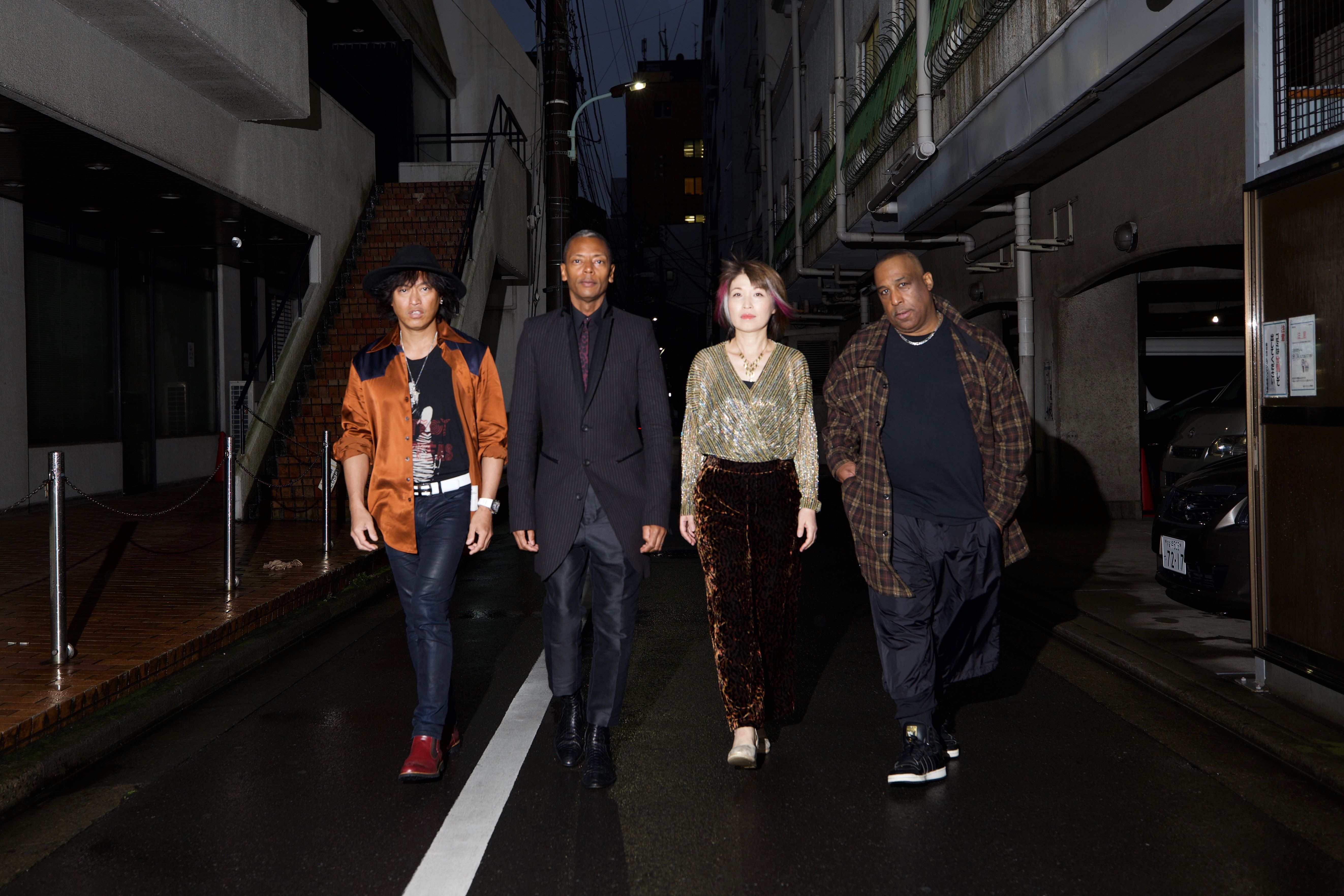
Current release: Kenji "Jino" Hino teams up with Yumiko Ohno (moog), Jeff Mills (electronics), and Gerald Mitchell (keys) again for a new Spiral Deluxe album. The Love Pretender has been announced for release on March 6th 2025 via Axis. Pre-save it for streaming here. Pre-order the album digitally on bandcamp or as a 2x12'' vinyl set on the Axis website.
Recommendation for Japan: Go to live music places. Japan is getting hot, especially the underground scene!
Topic I rarely get to talk about: As human beings on this planet we have responsibilities to live, just like any religion, be good to yourself and to others. You have to eat 3x a day, let your love for food grow, move from junk to vegan food to etc. Explore food. Living in Japan you can’t always eat what you love, so I cook everyday when I’m not on tour. I just love it, cooking foods from AWOL!
[Read our Yumiko Ohno interview]
[Read our Jeff Mills interview]
[Read our Gerald Mitchell interview]
If you enjoyed this Kenji "Jino" Hino interview and would like to know more about his music, visit him on Instagram, and Facebook.
What were some of the musical experiences which planted a seed for your interest in jazz?
Jazz is the ultimate form of music. Listening to Miles Davis influenced me in so many ways. He made me want to be cool, sexy, sad, funky, like I'm exploding. It’s one of the highest forms of art.
Jazz also teaches you to be selfless at times - you can play free, a ballad or you could turn towards the psychedelic, and the spiritual, etc. You can always express yourself right there, right away with someone you just met without any conversations.
Jazz influenced me to listen deeper and play according to the person you're playing with and who might be doing something entirely different from yourself. You can breakdown any jazz standard and play it in any genre and play the same song everyday and it’ll sound different every time depending whom you are playing with … Total freedom is what jazz is … You can express yourself depending on how you feel at that moment.
Jazz taught me to listen more. Listening is the key and it creates an invisible link between yourself and others. I’m just a student of it.
What does the term jazz mean today, would you say?
Total freedom. It’s ageless, colourless, non-racial ….
As of today, what kind of materials, ideas, and technologies are particularly stimulating for you?
Every sound, from bus noises to anything that creates a pulse like a heart beat or windshield wipers to car turn signals …
Where do most of your inspirations to create come from – rather from internal impulses or external ones?
Both!
Sometimes I feel the beats when I’m walking, jogging or running or listening to my own heartbeat or the heartbeats of others.
Which current social / political / ecological or other developments make you feel like you need to respond as an artist?
I don’t have the urge to respond. I do that internally.
Music has become a lot more global, and incorporating elements from other parts of the world or the musical spectrum is commonplace. Do you still think there are city scenes with a distinct, unique sound? How does your local scene influence your work?
I play every day with hundreds of artists and bands on a multitude of recordings, jam sessions and projects to produce or arrange, re-harmonize everywhere anywhere where I live.
I’m based in Tokyo now and can sit in anywhere, everywhere.
What role do electronic tools and instruments play for your creative process?
Instead of getting band members or musicians to play your music, the electronic DAW has enabled us to create our ideas on the fly.
Of course these is a limitation because software won’t respond right away like humans. But with crazy AI technology that’s already changing so fast it’s scary!!
Thanks to technological advances, collaboration has become a lot easier. What have been some of the most fruitful collaborations for you recently and what approaches to and modes of collaboration currently seem best to you?
This week I recorded a city pop artist and my ex student’s new CD. I had a solo gig, and a dance music gig. I always approach it with an open mind and an open heart, regardless of the genre. I relax and play from the heart.
Put on an electronic drum beat and I can sit in and play the pocket, playing fills and speeding up and slowing down etc. Without a non pocket drummer who will just aggravate me and the others. I played with many greats without a drum beat as well, duets, trios without a drummer - that’s where jazz art form shines.
I can make any beat swing harder and make the drum beat sound incredible. For example: You could play a straight beat and I could make that beat sound like it’s swinging. I could make a metronome sound like it’s in a pocket.
Jazz has always had an interesting relationship between honouring its roots and exploring the unknown. What does the balance between these two poles look like in your music?
It’s all good, the 2 poles become 3, 4, 5 … and so on.
My father is jazz trumpeter, he plays jazz in all its incarnations. That’s where I come from. There’s no right or wrong. Do I hear a note or feel a pulse? My finger just leads me down the invisible road without thinking about it. It’s involuntary, I just close my eyes and play for as long as the other person keeps feeding me with inspiring music.
How much potential for something “new” is there still in jazz? What could this “new” look like?
It’s limitless … whatever you're into: that could always develop into something new.
But you have to go back and listen to the 30s, 40s, 50s, and so on … all the way to now. Back in the day, there were no speakers, no bass amps, PA. So I think orchestras and big bands had the most (volume) decibel in sound. Turning up the volume on radio and record players is no comparison to them.
So you could loop a speech by Martin Luther King and playing something on top of that – that's different and new. Or you could create free jazz with beats as we've been doing with Spiral Deluxe with Jeff Mills. He keeps pioneering it and I thank him for that!!
For many artists, life-changing musical experiences take place live. How do you see that yourself?
There have been too many great live experiences to mention. From multi-Grammy artists to underground, non paying gigs to performances at churches to playing traditional Japanese music. I see myself making music with them and feel like there is always room for learning, and for improvements!
How, would you say are your live performances and your recording projects connected at the moment? How do they mutually influence and feed off each other?
It’s all humans playing. But bird sings in key, too, and the woodpecker gives off a pulse and they are all connected.
But if I listen to Stevie Wonder before a gig, his phrases might pop out without consciously thinking of them … music always influences the outcome and every note influences and feeds all others if you give yourself a chance to listen.
Improvisation is obviously an essential element of jazz, but I would assume that just like composition, it is transforming. How do you feel has the role of improvisation changed in jazz?
Improvisation in jazz is the alternative melody, it is composition on the fly. You can play just one note or you could play a lot more, depending on whom you're playing with and how you’re feeling … it could sound chaotic, spiritual, happy, etc.
Jazz is the one element you can take and mix with anything.
What, would you say, are the key ideas behind your approach to improvisation?
Breathing, relaxing, and playing with rhythm is what I tell myself to do everyday. Be in tune with yourself and others around you.
Are there approaches, artists, festivals, labels, spaces or anyone/-thing else out there who you feel deserve a shout out for taking jazz into the future?
The jazz legends have given us the formula. Without them there is no future in jazz.
The Montreux Festival intends to preserve its archive of recordings for future generations. Do you personally feel it's important that everything should remain available forever - or is there something to be said for letting beautiful moments pass and linger in the memories of those that experienced them?
Music is like a time machine! It takes you backwards and forwards in time. Always approach it from the heart and cherish your moments.
Also, just like a great book or, art or movie, the older you get you notice the unnoticed changes. So archiving is key to go back and let the new ones listen.