Published
Name: Yumiko Ohno
Nationality: Japanese
Occupation: Keyboard player, moog basist, composer
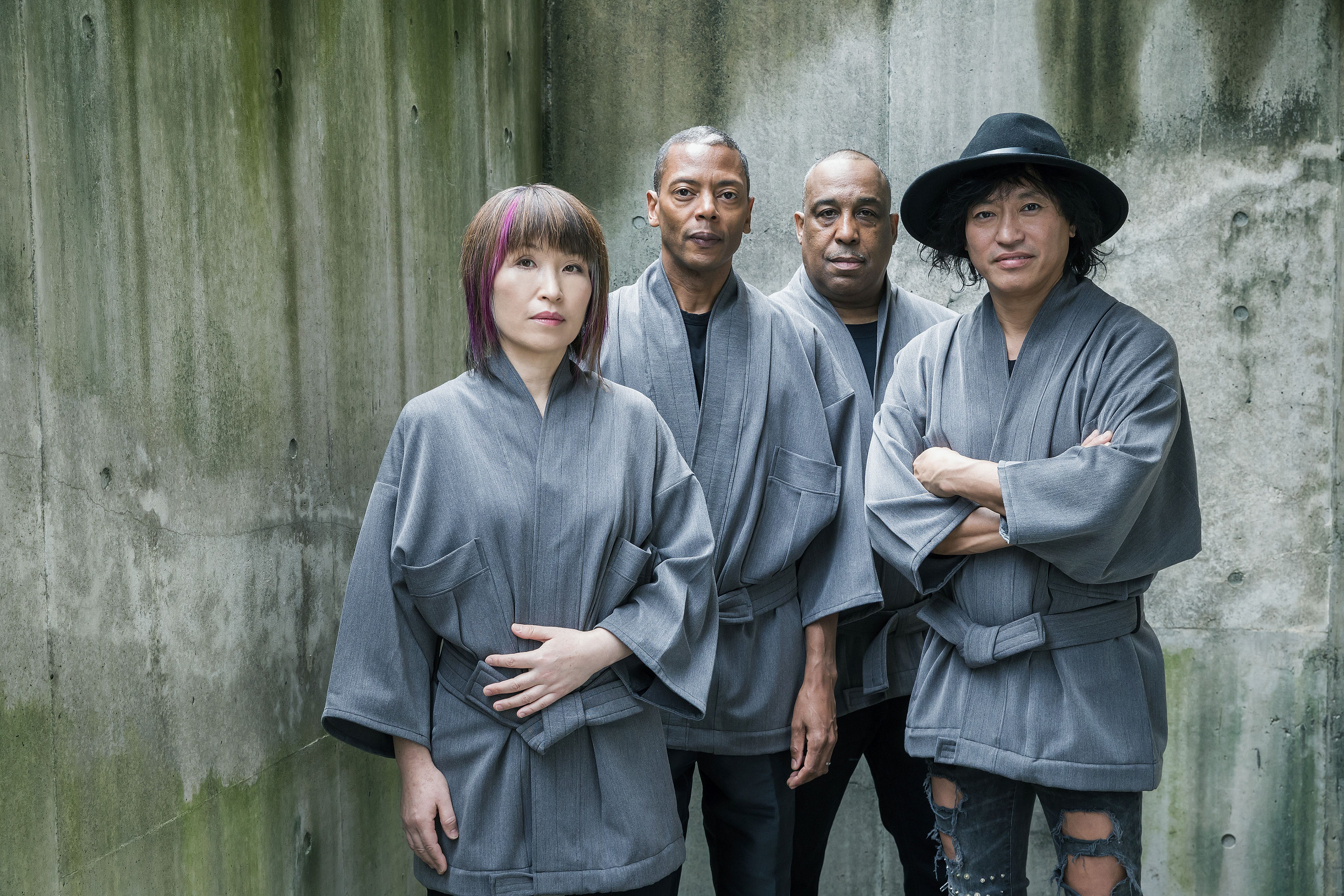
Current release: Yumiko Ohno teams up with Kenji "Jino" Hino (bass), Jeff Mills (electronics), and Gerald Mitchell (keys) for a new Spiral Deluxe album. The Love Pretender has been announced for release on March 14th 2025 via Axis.
[Read our Kenji "Jino" Hino interview]
[Read our Jeff Mills interview]
[Read our Gerald Mitchell interview]
If you enjoyed this Yumiko Ohno interview and would like to know more about her music, visit her on Instagram.
What were some of the musical experiences which planted a seed for your interest in electronic music?
When I was 13 years old, I first saw the Electrical Parade at Disneyland. I was fascinated by the Moog music by Jean Jacques Perrey and Gershon Kingsley, and bought a Mini Moog about 10 years later.
The second was going to Sound Factory, a club in New York, in 1989.
Most genres of music make use of electronic production means. What does the term “electronic music” mean today, would you say?
Just as you compose music on a guitar or keyboard, you can easily create a song by playing an electronic instrument.
Over the past 50 years since the 1970s, the number of electronic instruments has exploded, making it very accessible and easy for even beginners to compose music.
Electronic music has become one of the major genres of music, and within it, pop, rock, ambient, jazz, experimental, club music, etc.,
I grew up mainly listening to electronic music but have of lately, along with others I've spoken to, been somewhat disappointed by most new releases. I'd be curious about your own view on this, the “creative health” of the scene and potential reasons for the disappointment.
The performances involving the actual use of human hands are not involved enough, so detailed expressions are cut out. Furthermore, the sound is not expressive enough.
Also, the use of musical instruments is rather monotonous. We need to discover new ways of using them.
What were some of the recent releases, or performances of electronic music that left a deep impact on you?
This isn't something particularly recent. But I would like to mention a sound and image exhibition held in Kyoto in 2023.
Ryuichi Sakamoto's “async” at Ambient Kyoto 2023 was a three-dimensional sound exhibition in a large atrium space, with ultra-high-resolution images by Shiro Takatani projected on a large horizontal screen nearly 30 meters long.
It was a wonderful work of stillness, beauty, and even madness.
What kind of musical/sonic materials, and ideas are particularly stimulating for your work right now?
I think that stereophonic sound and immersive sound are very suitable for electronic music.
I have been meeting more video creators than ever before, and their works have made me think about what kind of music is interesting again.
Where do most of your inspirations to create come from – rather from internal impulses or external ones? Which current social / political / ecological or other developments make you feel like you need to respond as an artist?
I often have sudden flashes of inspiration when I am touching an instrument. I think my emotions sometimes resonate with the tone of that instrument.
I have rarely included a direct antithesis or message to society or politics in my music recently. But of course, the dissatisfaction is always there.
Music has become a lot more global, and incorporating elements from other parts of the world or the musical spectrum is commonplace. Do you still think there are city scenes with a distinct, unique sound? How does your local scene influence your work?
The music being created in various cities is changing little by little.
I live in Tokyo, where the current image of music is idol? Anime? J-Rock? In Tokyo, since the end of the 80s, the city was filled with various music from all over the world, and there was no record or CD that I could not get. It was normal for me to search for rare records in a situation where I could listen to anything.
One of the records I came across in that way was Jeff Mills' 12-inch “GROWTH,” one of my favorite records that I still treasure to this day.
Today, electronic music has an interesting relationship between honouring its roots and exploring the unknown. What does the balance between these two poles look like in your music?
I think about that constantly. We must respect and be influenced by the great music of the past, and create something new.
To do this, I think we need to keep our antennae open for music, movies, art, information, and various other things, polish our sense of style, and strive to keep a flexible mind.
Otherwise, I feel that we will not be able to shine as brightly as we have in the past.
How much potential for something “new” is there still in electronic music? What could this “new” look like?
It is possible that “new” things that have not yet been seen or heard of will be created.
I can't say in a few words what I feel is “new” because I think what I feel will change depending on my age, environment, and career.
But I can say what I hope for. I hope that human performance techniques and electronic instrument techniques can be successfully combined to make something expressive and smooth to listen to.
What were some of the recent tools you bought, used, or saw/read about which changed your perspective about production, performing, and making music?
Teenage Engineering's OB-4. The OB-4 can be used as a radio, and its broadcasts can be sampled and hold-played, creating the interesting feeling of “time” repeating itself forever.
Do you think that there is a limit to what can be done in sound design – and what defines these limits?
I don't think there are limits.
In as far as it is applicable to your work, how would you describe the interaction between your music and DJing/DJ culture and clubs?
Everyone, including myself, makes and plays music to be liberated, and goes to clubs and DJs to listen to music to experience it.
Even though we are in different positions as creators and listeners, I think we all share the same spirit of enjoying music.
How, would you say are your live performances and your recording projects connected at the moment? How do they mutually influence and feed off each other?
Most of what we record and edit is meticulously thought out and crafted, so for live performance, we want to change the arrangements a bit and use as much live music as possible to bring more interest and depth to the music.
Even if AI will not entirely replace human composition, it looks set to have a significant impact on it. What does the terms composing/producing mean in the era of AI, do you feel?
It is becoming difficult to tell the difference between humans and AI, and it may be necessary to indicate “human” and “AI” in the credits in the future …
I hope that the songs created by humans will always be original, because AI has grown up with reference to these originals.
Are there approaches, artists, festivals, labels, spaces or anyone/-thing else out there who you feel deserve a shout out for taking electronic music into the future?
Sonar Barcelona had a wide range of artists and the acoustics were excellent.