Published
Part 2
Tell me a bit about the Logos association and your reasons for deciding to work with them on this project.
I became aware of Logos more than 10 years ago now, when I was in Ghent to play a live set and one of the promoters showed me the foundation's website. I started looking at some photos and reading about the instruments they made and immediately found it to be something truly unique and extremely fascinating.
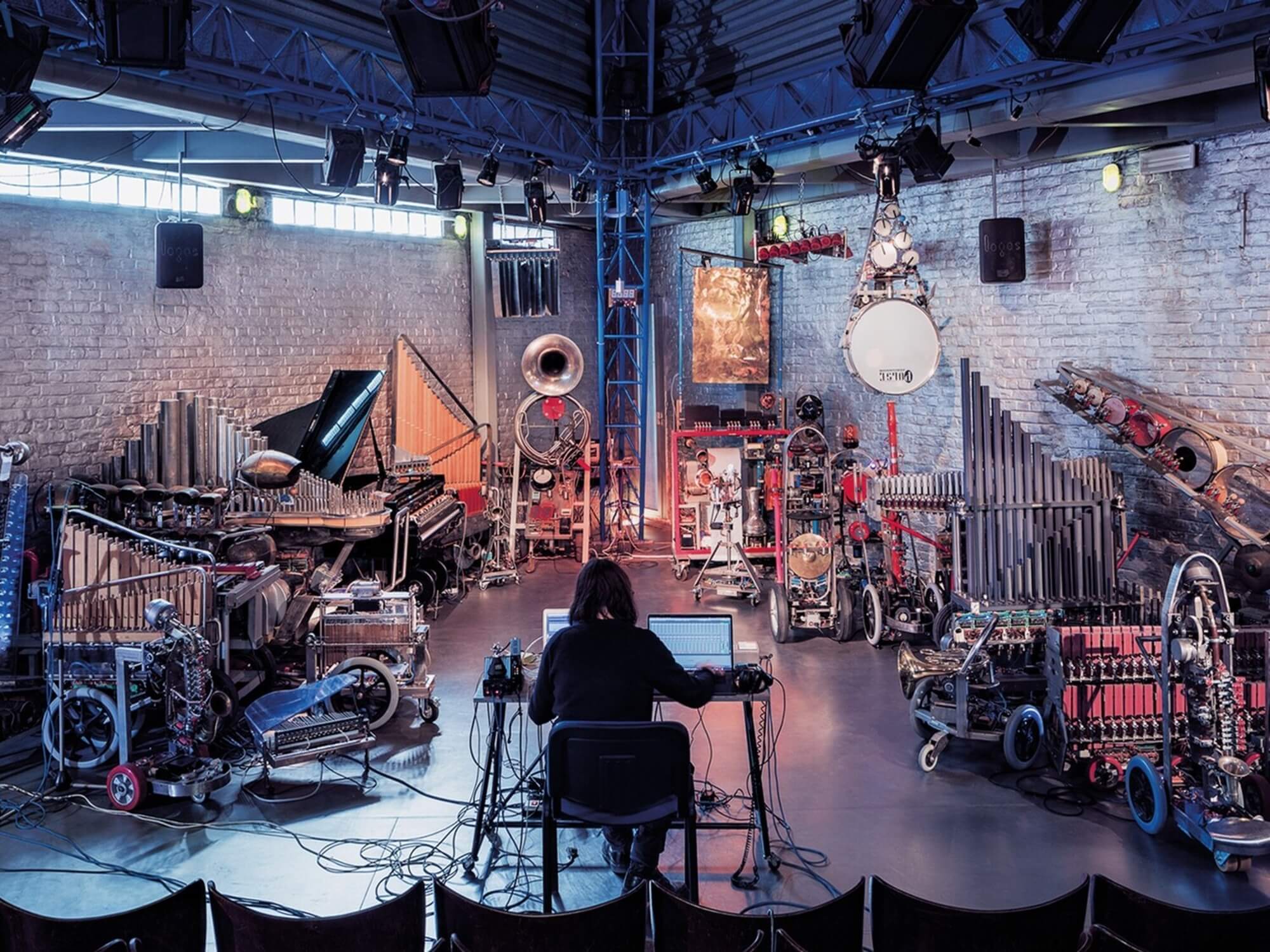
I had long been aware of Yamaha's MIDI-controlled Disklavier piano and midi controlled organs, but I had never seen a full orchestra of digitally controlled acoustic instruments. Many of these are also out of the ordinary instruments, we are not just talking about pianos, organs or drums, but also self-built instruments with various types of woods, metals, bells and even sirens, washing machine motors and digitally controllable propellerheads! I immediately understood the potential of what Godfried and the other people at the Logos foundation were doing, and I decided to contact them.
[Read our Disklavier feature by Jameszoo]
[Read our Disklavier feature by Deru]
I wrote a first piece there (the first on the album) for my Conservatory thesis project almost 10 years ago now. Unfortunately, afterwards the foundation had some problems with funding. This also made it more complex for me to go ahead with the recordings of an entire album, which is why I created a crowdfunding campaign on Kickstarter back in 2018.
How did the collaboration unfold – and what were challenges you had to master and insights you gained through it? Have there been situations where you were genuinely surprised by the aural results of working with your machines? Is there an element of creativity in what these machines are doing?
Certainly, both in a positive but also negative sense.
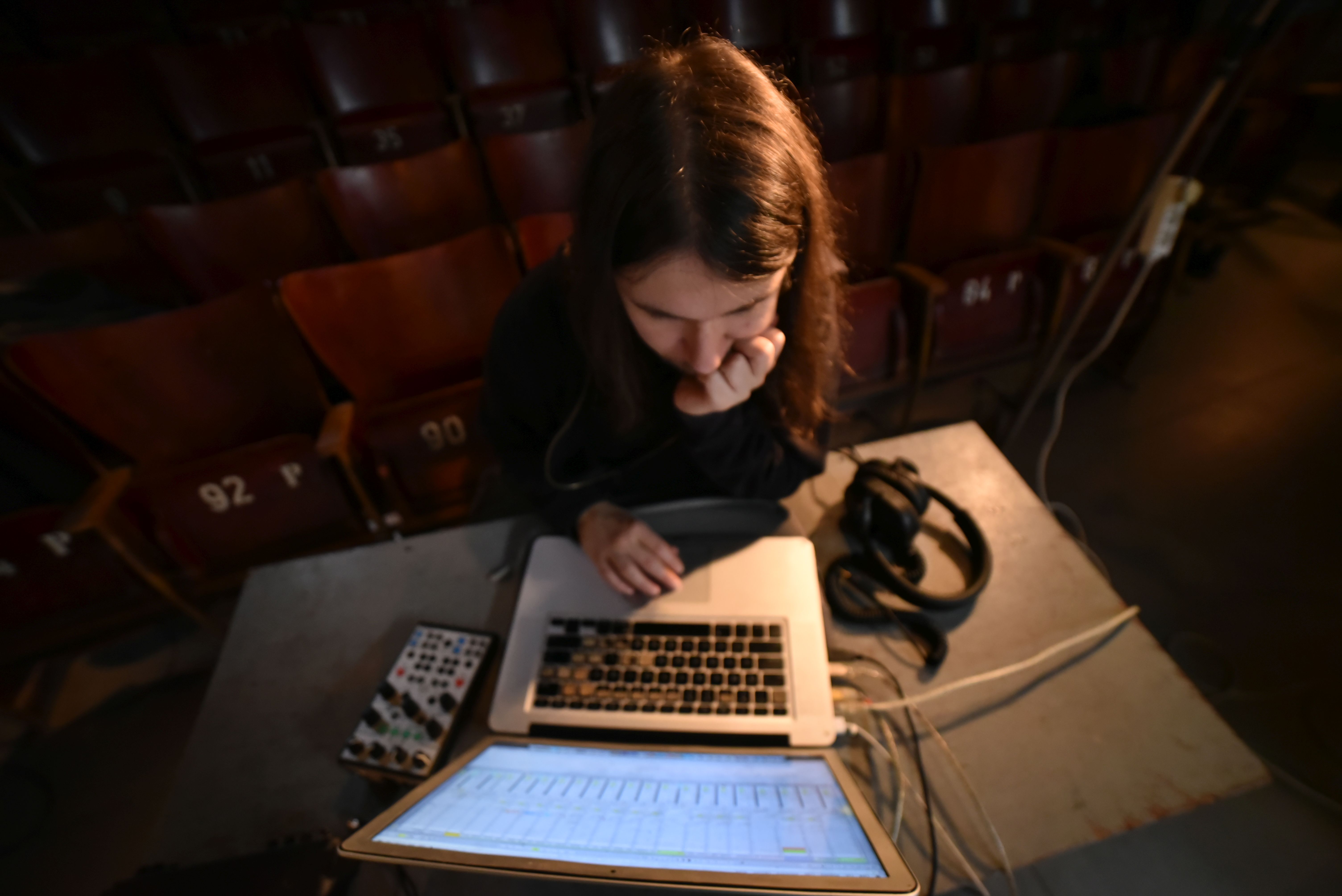
Since I live in Florence and the instruments are in Ghent, I started writing musical drafts on my computer without hearing the results immediately. Every time I went to Belgium I started to rehearse what I wrote, and sometimes I was surprised in a good way, as it is very magical to hear what you wrote resonate in an acoustic space for the first time.
Other times, however, it was also frustrating because, as I was saying, these are electronic but also acoustic and mechanical instruments and so they are subject to many variables. A simple example is how the dynamic intensity scale of a piano is not linear at all when it is driven by solenoids and how this is different in the various frequency ranges. And it gets even more complicated in wind instruments were the air flow influences many parameters at the same time (sound pressure, timbre, pitch etc).
There are so many variables also given by the mechanical movements, which is why I always ended up having to completely change what I had previously compose to obtain the desired result.
In terms of the performance, how important is the visual element for your music?
It depends on the individual musical project. In some cases it isn't at all, as I am fascinated by the abstract nature of electronic music and often some visual additions can be distracting from the music. In the case of Musica Automata, however, the visual element is extremely important. Which is why I think I will only do concerts if we can actually bring the robots there without any pre-recorded tracks.
The listener can hear and see where the sounds come from, finding a precise correlation between the movement of the instrument and the perceived sound. These robots are deliberately "naked", meaning that the electronics and mechanics are not hidden under a metal or plastic shell. This is also a performative choice, so the audience can see how they work during their performance.
A few years back I spoke to Moritz Simon Geist, and he said that robotics and music machines offer “a different way of interacting with the music.” Is that something you can relate to?
Definitely. With electronic music the compositional possibilities are so immense that it is so easy to get lost.
Writing music for these robots, which still have a huge variety of timbres, helped me focus more on other aspects of composition and recording, that I usually don’t pay as much attention to when composing electronic music.
For a while, having techno played by humans was a pretty popular concept – and it still comes up occasionally. Would you say that this is essentially the same thing just from a different angle? Are you interested in this at all?
If you mean techno, like electronic dance music in a broader sense, definitely there is something in common. I'm definitely influenced by techno and electronic music, but I think that the starting point of this project is quite different, as is the final result. In fact, in this album there is nothing there that you can directly relate to techno, except for a few bars with a bass drum beat in the first track "Musica Automata."
I suppose that with human musicians playing electronic music with acoustic instruments there might be a chance that the typical abstraction of a piece of electronic music could get lost during an acoustic/electric reinterpretation. But this really depends on how the music is played.
I don't like to preclude any possibilities. In my opinion all approaches to composition and performance are equally valid. What really matters is the outcome.
Today, the debate about machine music has been almost completely taken over by AI. The differences between what you're doing and working with AI are obvious - where do you see the overlaps? Could you see integrating AI concepts into what you are doing?
I don't see any overlap since every note, every single timbre automation and change of speed is written.
I've been following a bit the recent developments of AI in the music field, but I haven't found anything yet that I'm interested in using in my music. Perhaps also due to the hype on this topic and the abuse of the term AI itself. However, I have listened some interesting albums recently, which were partially produced with the use of AI.
I think it will still take some time to understand if it is just a hype that will soon disappoint us with its results or, instead if with further developments, we’ll get increasingly interesting results.
To some, the advent of AI and 'intelligent' composing tools offers potential for machines to contribute to the creative process. What are your hopes, fears, expectations and possible concrete plans in this regard?
I have no particular hopes and certainly no fears about that. Several musicians use it for "creative" tasks as you say, but ultimately they will still have to be good at discerning.
And if you think about it, the task of a composer is precisely this most of the time: if using traditional scales, discerning which note of the 7 to use, which chords. Or in the production context, to choose which mic, pre-amp, reverb o delay is best for a certain context.
There has almost always been an element of speculation about the furure when it comes to working with machines. In relation to music, which direction could things move towards in the future? Which direction do you see your own work going?
I'm not sure, but personally I would be interested in hybrid electroacoustic instruments, using digitally generated complex sounds combined with acoustic elements. These can be simple resonators or, even better, acoustic elements that are an integrated part of a complex oscillating system.
I have used some instruments like that at the Logos foundation during the recording of the album. Example 1; Example 2
I think it's definitely an interesting direction to broaden the tonal and performance possibilities of acoustic instruments with digital controls.