Published
Name: Luise Volkmann
Nationality: German
Occupation: Composer, saxophonist, improviser, sound artist
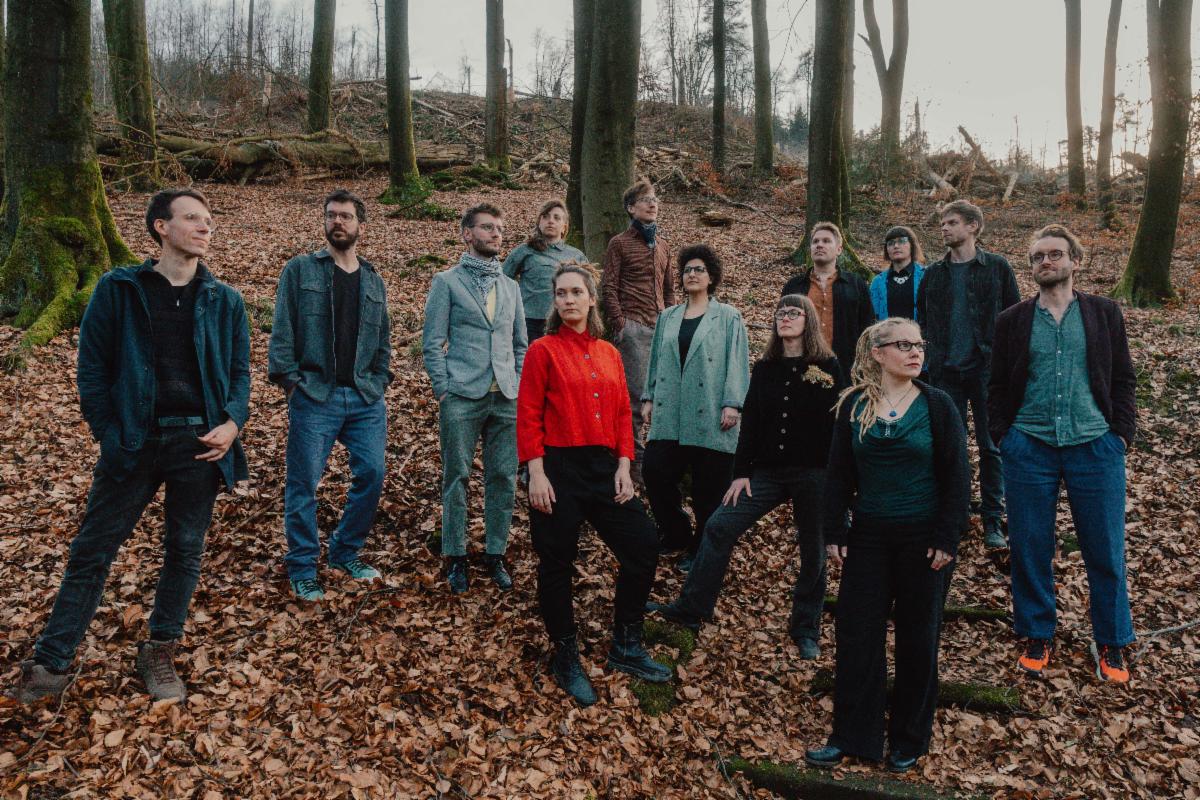
Current release: Luise Volkmann's new single "Among Oaks" is out now. It is harbinger for a full-length album with her large ensemble Été Large to celebrate their tenth anniversary in October 2025.
Recommendations for Cologne, Germany: I recommend going to the river. The Rhine is a huge river that divides the city in two. The scenery on both sides of the river is beautiful. The beaches of Rhodenkirchen are especially nice.
Things I am passionate about but rarely get to talk about: I am a passionate gardener. If you can call me a nerd about anything, it's flowers and trees. I love knowing their names, watching them grow and trying to understand how they thrive. My balcony is my green oasis.
If you enjoyed this Luise Volkmann interview and would like to stay up to date with her music, visit her official homepage. She is also on Instagram, Soundcloud, and bandcamp.
What were some of the musical experiences which planted a seed for your interest in jazz?
Before I became interested in jazz, I was interested in creating my own music. I enjoyed being playful with music, improvising and trying out things.
It was the saxophone that pushed me towards jazz, because if you wanted to study music in Germany and improvise, going into jazz was the only option.
It was only much later, when I discovered free jazz musicians like Ornette Coleman, Sun Ra, and Charles Mingus, Nina Simone, that I really got into jazz.
What does the term jazz mean today, would you say?
It's an ambivalent term. I love the word and the sound of it. And, of course, I feel at home in this genre.
But there are also many jazz projects that I don't like, and I can understand why people who have tried a jazz concert for the first time and had a negative experience would never go back.
Unfortunately, that word mostly attracts older people. So, if you want to reach a younger audience, you either have to neglect the word 'jazz' or ... I don’t know … come up with something else.
For me, it's clear that you can never judge a genre as a whole; it's the individual expression of the musicians or band that you either like or dislike. Let the music speak for itself, not the genre.
As of today, what kind of materials, ideas, and technologies are particularly stimulating for you?
I’ve been thinking a lot about the idea of folk music lately.
Maybe because in Germany we’re often seen as a country without our own folklore, and in the past years I’ve come into contact with Greek and Brazilian folk music through different projects.
I find it fascinating that something can be both old and alive at the same time — memory and a vision of the future. That’s how I want my music to be, too.
Where do most of your inspirations to create come from – rather from internal impulses or external ones? Which current social / political / ecological or other developments make you feel like you need to respond as an artist?
I think what’s been on my mind the most is environmental destruction.
Even though I live in the city, my relationship and connection to the natural world plays a huge role in my life. And I’m often sad and helpless when I see how carelessly we treat our surroundings. This is a topic I can relate to without question, and that’s why many of my songs deal with it.
But with the sheer amount of global problems, and with the deep divisions in the society I live in, I often find it harder to commit to just one topic. I’ve always seen myself as a very political person, but the issues keep getting more complex, and simple, short answers are often expected.
I think my overarching theme in music is always the invitation to dialogue. My music tries to be a space for reflection, maybe even to bring people together, and hopefully to spark the energy to act. It’s a quiet kind of being political.
Tell me a bit about the sounds & creative directions, artists & communities, as well as the colleagues & creative hotspots of your current hometown, please. How do they influence your music?
Cologne as a city doesn’t really shape me. Before that I lived in Paris, and there I soaked up the chaos and contrasts like a sponge — punk circus, a Senegalese band with a free jazz marching band, bakers teaming up with actors …
These days, I get my spark from specific musical encounters. People who’ve kept me inspired — and still do — are Kiko Dinucci, Athina Kontou, Max Andrzejewski, and Wallis Bird.
[Read our Wallis Bird interview]
[Read the thoughts of Max Andrzejewski in our TRAINING interview]
Jazz has always had an interesting relationship between honouring its roots and exploring the unknown. What does the balance between these two poles look like in your music?
Yes, that’s true. And I think this is thanks to the very special African-American heritage this music has. It has the power I was speaking about earlier: it is old and vivid at the same time.
It is hard to find a meaningful way to engage with this Black heritage, but I am very conscious and thankful for this quality of jazz. I think I try to balance the lyrical and epic with the explorative and playful.
How much potential for something “new” is there still in jazz? What could this “new” look like?
I think something is always “new” when a musician manages to shape and express their very own personal aesthetic world — and invites others to be part of it. That’s when the “new” becomes valuable for the community, because it brings someone else’s strangeness into your emotional world and invites self-reflection.
Of course, that has nothing to do with genres. Who came up with that idea anyway?
For many artists, life-changing musical experiences take place live. How do you see that yourself?
I completely agree. Live music is the most important thing for me. And sometimes I wonder how long we’ll still have it in such a big form as a society.
When you think about it, it’s kind of crazy: a bunch of people who don’t know each other, and — in my music — don’t exactly know what’s going to happen next, come together in a room and give themselves over to it. They’re simply there, giving their time, opening themselves to whatever is about to happen. Isn’t that something unbelievably beautiful? Where else in our capitalist society do moments like that still exist?
And the best part is: it’s not just us on stage deciding what happens next. It comes into being through the interplay with the audience. The potential is incredible when so many people communicate on a nonverbal level. And sometimes it really happens: someone breaks the convention, and the magic happens.
How, would you say are your live performances and your recording projects connected at the moment? How do they mutually influence and feed off each other?
I try to see album productions more and more as independent works — not as a documentation of a live band, but as a special way of working with a format.
Especially since CDs have almost disappeared, I’ve recently been working again with cassette and vinyl. Each of these formats has its own limitations and advantages, so it’s exciting to think specifically for that medium.
Also, the production level of albums has become so incredibly high that it’s hard not to want to join in. But I love it when the live music then sounds different again than on the recording.
Ímprovisation is obviously an essential element of jazz, but I would assume that just like composition, it is transforming. How do you feel has the role of improvisation changed in jazz?
I would say that I see improvisation and composition as the same approach to music, just with a different approach to timing.
In my view, music always needs a certain level of improvisation; otherwise, the potential for interaction disappears.
What, would you say, are the key ideas behind your approach to improvisation?
I guess my aesthetic draws me to sound as the first parameter. I love to play with beautiful, weird, astonishing sound blends. Rhythmic melodies are my second layer. I think of melodies more as rhythmic constructions and not so much in a harmonic way.
And then I want the saxophone to sing — almost like a voice, super close and intimate.
Are there approaches, artists, festivals, labels, spaces or anyone/-thing else out there who you feel deserve a shout out for taking jazz into the future?
I love Café Oto in London. The three times I’ve played there were some of the most beautiful concerts, with such a wonderful audience.
The Montreux Festival intends to preserve its archive of recordings for future generations. Do you personally feels it's important that everything should remain available forever - or is there something to be said for letting beautiful moments pass and linger in the memories of those that experienced them?
Impermanence is part of life.