Part 2
For Karakoz, how did you realise your goals in terms of the production, including effects for your current release?
The production process was mostly done in Rome, together with Filippo Brancadoro, a friend and expert ear whom I trust a lot.
One of the most interesting parts of the production process is working with archival and field recordings: working with this material to shape it into a form that fits the overall mood of the work.
The idea is that they are a sort of spirits, ghosts, telling stories, visible and invisible, blurred, nuanced. A sort of dreamlike dimension that seems clear upon awakening but quickly disappears into the fumes of memory. This is the ritual that seeks to bring this past and these noisy spirits back to life, giving them a voice (and a sound) again. This is why what I do has been defined as Mediterranean hauntology, and I think it's a term that fits perfectly.
To create this sensation, we filtered voices and recordings through modular synth systems or through chain effects and tape echoes. Working as analog as possible to give that typical grain of memory, as if it were an old photo found in the drawer of an abandoned house, capable of telling so much.
My attention to this material was very high, both for the aesthetic success and for the value of these recordings and the respect they deserve while being reworked.
Exploring darker themes in the music often goes hand in hand with the accompanying artwork. Tell me a bit about this relating to your new release.
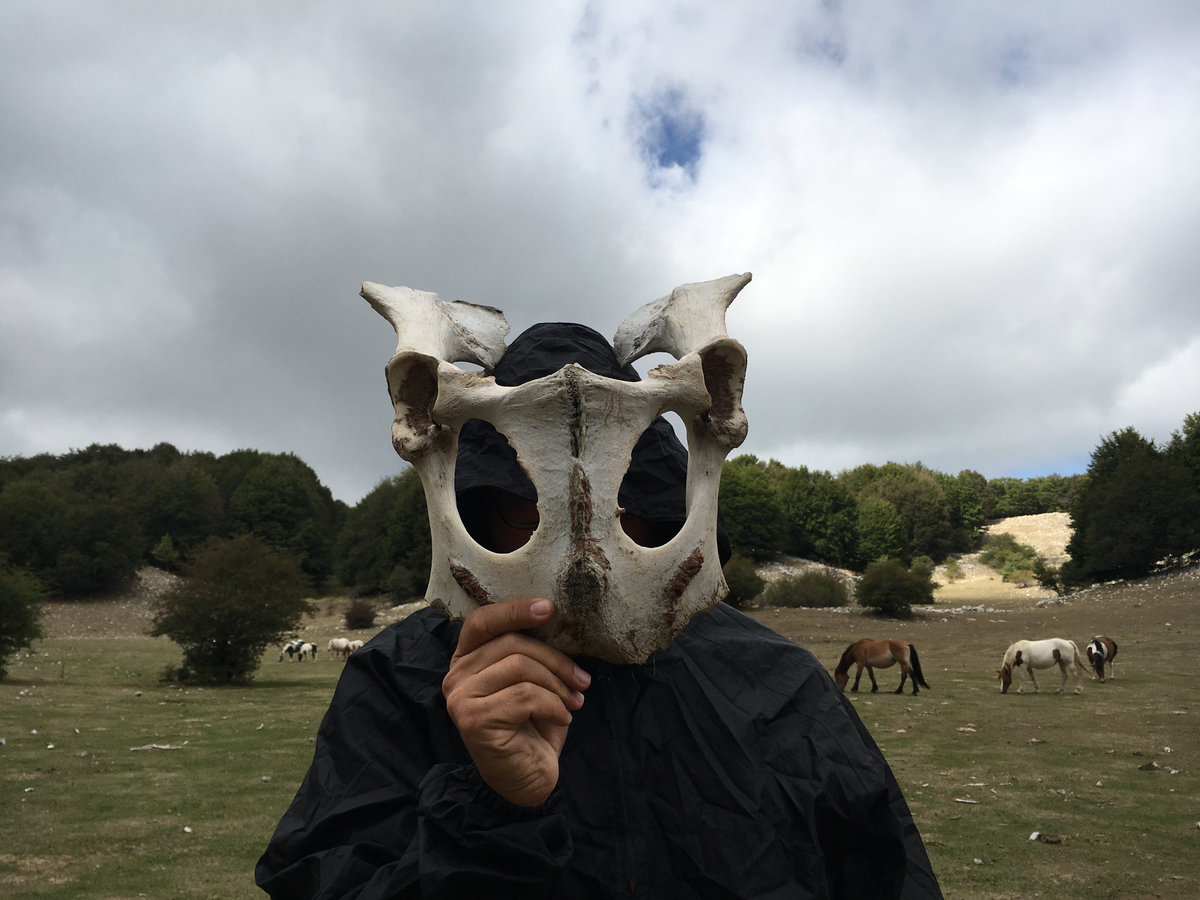
All of Mai Mai Mai's imagery is tied and connected to the musical side. From the performances, with their stage costumes, video projections and lights, to the merch ... and of course the album artworks. For Karakoz, being recorded in Palestine and immersed in those sounds and stories, I wanted to draw on themes that have always been dear to me but obviously connected to local folklore.
So if in the past I've used masks and characters more closely linked to southern Italy, for this cover I was inspired by ancient books of Arabic mysticism, and what you see on the cover is a JINN: a spirit, a "genius" as it is also called, an entity that moves between the human world and that of the sky, a bit like intermediaries of the supernatural world.
They can be invoked or found by chance in special places ... they accompanied my journey, and I sought encounters during those weeks. I think that being there on the album cover is a warning to the listener, but also a guide to what they will find engraved in the vinyl grooves.
Legend has it that a jinn lurks in the Bethlehem souk, and if you wander the market at night, when there are no people around and you're enveloped in darkness and silence, you might encounter or hear it. I spent a few hours recording the market with my Zoom, and perhaps some sign of its presence is captured in those sounds.
Hence the piece "Jinn of the Bethlehem Souk," which uses recordings of the market combined with the synths and flutes of maestro Osama Abu Ali.
I would love to know a little about the feedback you've received from listeners or critics about what they thought some of your darker songs are about or the impact it had on them – have there been “misunderstandings” or did you perhaps even gain new “insights?”
As I've told you, Mai Mai Mai's musical work approaches the culture and traditions of southern Italy and the Mediterranean. It's a film soundtrack that tells ancient stories, both present and future, populated by ghosts and spirits, shadows, dreams, legends, and traditions. The output is very obscure, as is the subject matter and the background.
One thing that's amazed me is that this approach and my research often inspires listeners to become curious and delve deeper into what my music is about. Far from having a purely ethnomusicological approach, what I often manage to convey to the listener is this world that is both distant and very close at the same time, a collective but also personal memory, ghosts of a shared past that haunt our homes.
And it often seems that my work has ignited this desire to delve deeper and discover more about these themes. It's as if my music captures this curiosity and this desire to understand one's own traditions, one's own past.
It happened with Nel Sud, my 2019 album, made entirely using audio from documentaries shot in southern Italy in the 1950s and 1960s (and using the original footage manipulated for the live performance).
Knowing that what you were hearing were sounds, voices, and songs recorded decades earlier in a magical, ancient world, which seems so distant but is actually our own, the world we live in now and which obviously still maintains strong connections with that past, even as it is disappearing.
Sharing music on stage can change the way it is experienced, both for musicians the listeners. Can you talk about this a bit, especially in the light of darker themes?
The moment of the live performance is truly important, and it's so precisely because of the relationship it establishes between those present. This is why I prefer to play in atypical places, meaning places not usually used for live music or DJs. I feel the ritual takes on much more meaning when the space is also suited to this type of experience: like churches or in nature, at sunset or dawn.
This is precisely because I try to dismantle the musician/audience dynamic typical of live concerts; I seek an intimacy that connects, a moment of powerful sharing. Then, obviously, everyone experiences the performance in a completely personal way, and a Mai Mai Mai live set is just as suitable for a museum at 7 pm sitting down to listen as it is for a club at 3 am. For me, it's always an intense experience in which I give so much emotionally.
I'm happy to see it resonates so much with those who have the desire and sensitivity to listen. Just as it reaches even the most distracted, it's certainly an intense sound that can't go unnoticed. It can envelop and transport you, or, on the contrary, distance and repel you.
But I'm happy that this feeling of being part of a ritual and an intense moment of sharing ends up being clear to everyone in the room: it's a message that, even if unspoken, comes across clearly through the sound and the atmosphere it creates.
Throughout the history of art, there have been artists who did not want to exorcise their demons, afraid they might lose their creative spark. What's your take on that?
For me, it's all about spirits, ghosts, and demons. I really don't know what I should be exorcising!
Whether they're spirits from southern Italy, Arabian Jinns, or ghosts inhabiting an old Greek temple, I make sure it's a stimulating encounter, an exchange of energy and inspiration, a respectful séance...