Published
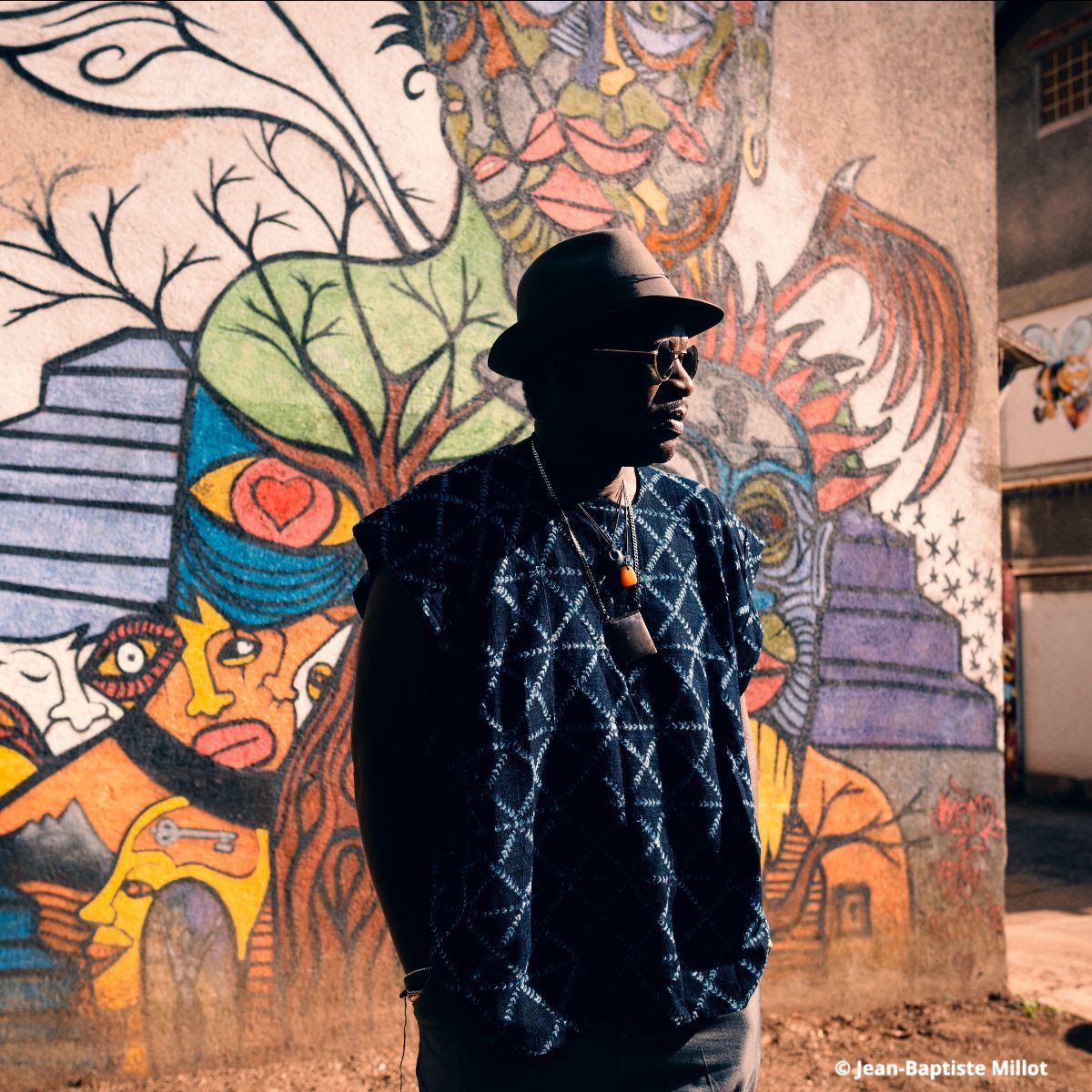
Name: Mangane
Occupation: Singer, songwriter, guitarist, kalimba player
Nationality: Senegalese
Current release: Mangane's album Zoom Zemmatt is out via Laborie Jazz.
Recommendations: Wasis Diop with Toxu (1998): This is an album that had a big impact on me when it came out, and I still listen to it regularly. There's a very poetic dimension to the lyrics, which address social issues while being delivered with an extremely expressive and unique voice. I’m also very sensitive to his inventive musical compositions, which I find very modern and transporting.
Thione Seck with Orientissime (2005), for its production, its writing, and the ability of this iconic figure in Senegalese music to reinvent and synthesize. He’s perhaps not well-known outside of our borders, except maybe in Northern Europe, but in Senegal, he was called the "poet musician."
And more recently, Black Pumas with their self-titled debut album (2019), a blend of funk and soul—a very personal and powerful synthesis of all African-American music. I’m really impressed by the maturity and mastery of this guitar-voice duo, who also know how to surround themselves with great musicians.
(And if I could add a fourth, it would be Weather Report with Joe Zawinul, whose energy and musical richness I adore, especially in the Live at Montreux 1976 performance.)
[Read our feature on the Montreux Jazz Festival]
Do you think that some of your earliest musical experiences planted a seed for your interest in writing lyrics or poetry? How and when did you start writing?
I come from Thiès in Senegal, and the neighborhood where I grew up is called DVF (derrière la voix ferrée - behind the railway).
Thiès is the city where the railway in Senegal was established, an important crossroads on the road to Saint-Louis, Mali, south to Sine-Saloum, and east to Tambacounda. This neighborhood was a privileged place of human and linguistic intersections from various regions of Africa, which I was immersed in throughout my childhood and adolescence.
There were many celebrations, ceremonies, and evenings where Mandinka, Serer, Wolof, and Soninke worlds mingled, during a vibrant and diverse period for music in West Africa. It was a rich blend of musical fusions, particularly between traditional and jazz, nourished by the influence of music from the Americas, the Caribbean, and Europe.
For instance, Touré Kunda, Xalam, Youssou Ndour’s Star Band, Orchestra Baobab, Omar Pene’s Super Diamono in Senegal, Bembeya Jazz in Guinea, Salif Keita and Mory Kanté's Rail Band in Mali and Guinea …
At the same time, at school, we regularly had artists come to present their work. And then, in middle school, we had a theater club that allowed me to experiment with performing and interpreting texts. I really enjoyed that, and it’s actually through that experience that I became aware that I had a voice.
There was also a literary club that I attended, and the teacher, who also played guitar, encouraged me to try writing. I followed his advice, and that’s how I got started.
Over time, I developed my artistic identity, nourished by all these influences and marked by a personal sense of fusion, which I began to develop with the Nakodje group in the late 90s.
It’s often said that “music begins where words end.” What do you think about that?
Lyrics are a form of music in themselves, enriching the melody and harmonies. I come from a language, Wolof, that is marked by its rhythm; it’s lively, vibrant, and expressive both in sound and content. It’s a great partner for musical composition. In my work, there’s no dissociation between music and lyrics; everything is composed fluidly and sensitively, depending on the moment.
I play every day, at all hours, and there’s often background sound accompanying me, whether it’s from the radio or elsewhere, helping me focus. Everything I hear at any moment can spark an idea for writing, whether it’s a conversation, a show, the news, or observations from the street or while travelling …
It’s the same for music—a sound can inspire me to create a melody, which then leads to working on harmonies. The lyrics develop alongside this work, in parallel. It can be the reverse, but always within the same creative process.
I’ve noticed that during my daily walks, a melody or theme often emerges, perhaps because it’s a meditative moment conducive to letting go, introspection, and the emergence of creative material.
Entering new worlds and escapism through music and literature have always exerted a strong pull on me. What do you think you’re drawn to most when it comes to writing?
Writing allows me to express through words a sensation, a perception of what I see in the world around me and my understanding of humanity and life in general. I see it as both a political and poetic process.
Writing allows me to think, reflect, and share these creative processes through composition. I want to propel the listener into my universe, into my world, just like I experience music when encountering other artists.
When you're writing song lyrics, do you sense or see a connection between your voice and the text? Does it need to feel and sound “good” or “right” to sing certain words? What's your perspective in this regard of singing someone else's songs versus your own?
When the words come, I try to find the most fitting place for the voice to give the words their rhythmic and melodic space. It’s my instinct and experience guiding me—I’d call it a feeling.
If I’m covering someone else’s songs, I need to truly reinterpret them with my own sensitivity.
I love the play of reappropriation through voice and music, which allows for discovering a composition differently and telling another story while keeping its original essence.
To what extent are you consciously aware of the meaning of the lyrics you're writing during the creative process? Do you need to have a concrete concept, or can the words take the lead?
I usually write a text based on a theme I want to address. The words come, and I take the time to assemble them—they never take over, as they are interdependent on the musical composition. The music guides the choice of one word over another to maintain coherence in musicality (cf. "Emmènes-moi").
I’m also increasingly trying to play with the cross-pollination of languages, adding English or French when those words resonate or better express my thoughts. This becomes a game, and Wolof is constructed in this way—it’s a language that absorbs and evolves dynamically through the incorporation of foreign words that enrich it.
What were some of the artists and albums that inspired you early on purely based on the strength of their lyrics? What moves you in the lyrics of other artists?
In my mother tongue, Senegalese composers like Wasis Diop, Thione Seck, Youssou Ndour, the groups Xalam, and Touré Kunda also inspire my writing.
They each have their uniqueness but share a popular and profound address that allows everyone to identify and reflect, with erudite musical compositions that they skillfully make accessible to everyone.
In French: Edith Piaf, Jacques Brel, and Claude Nougaro, who have very strong artistic personalities, carried by their voices and their choice of texts with remarkable lyrical strength in Piaf and Brel. It's the musically creative fusion, also present in Nougaro's writing, that particularly interests me.
Anglophones: Pink Floyd, The Police, Bob Marley. Very different artistic identities. Their lyrics take us into very personal worlds connected to the world they live in, each expressing the symbiosis and inseparable bond between text and music.
I love the dreamy quality of Pink Floyd, very British ("Wish You Were Here"), that of The Police (all albums), very energetic with a personal and rich groove. Bob Marley is the songwriter of commitment and struggle, who also turned it into a musical style still very present today.
I have always considered many forms of music to be a form of poetry as well. Where do you personally see similarities? What can music express that may be out of reach for poetry?
For me, music is poetic expression. It touches the senses first.
Music has the ability to be universally understood and accessible, without language barriers—that’s its strength, the ability to unite everyone who engages with it through a sensory approach, without distinction (cf. "La famille").
It can allow someone to approach a text differently, even if they don’t understand the meaning. Music can also complement writing, taking it elsewhere or helping access emotion (cf. "Maam Souley"). It can also accompany, complete, or be a foundation.
I love jazz for its great expressive freedom, open to improvisation, offering endless possibilities and encounters; it's a dialogue-driven music. Of course, traditional music, for example African, often stems from a poetic act through its texts, relying on melodic compositions that tell metaphorical stories, deeply marked by the richness of the language and the imagination of the people it comes from.
This makes me think of the blues, where lyrics and rhythm are closely connected, born from African cultures shaped by history and the resistance of peoples whose identities were threatened, becoming personal and collective resistance music, a foundation for many styles yesterday and today.
I choose to sing primarily in Wolof, my mother tongue, which shaped my thoughts and my way of being in the world. I know that not everyone understands this language, but I trust in people’s ability to grasp the musicality of the words and be drawn into my universe. What’s expressed in the writing is not secondary, but it can be transcended—what matters is the expressiveness, the poetic quality, the sensitivity, the journey.
How do you see the relationship between harmony, rhythm, and melody? Do you feel that honing your sense of rhythm and groove has an effect on your lyric-writing skills?
Rhythm, melody, and groove are extremely important in my musical creation. These are the materials I use to compose harmonies.
Groove allows everyone to deeply feel the music—it’s fundamental to the kind of music I offer, heavily rooted in rhythmic fusion. It’s music that takes its full measure live. I need my lyrics to build on the harmonic pulses to contribute to the dominance of this groove (cf. "Nguistal" and "Jubbantil").
Creativity can reach many different corners of our lives. Do you feel as though writing or performing a piece of poetry is inherently different from something like making a great cup of coffee? What do you express through music that you couldn't or wouldn't in more 'mundane' tasks?
Good question—I love drinking a great cup of coffee, and often, while savoring it, words or melodies come to me …
Making a good coffee to drink, or better, to share, is an opportunity to sit down and relax. Enjoying it isn’t that far from the pleasure and mechanisms that creative expression or listening to a beloved piece of music engenders. It’s not a task for me, but a moment of well-being—both are similar in my mind.
However, the music has this extra gift of touching our senses in a universal, immediate, and often stronger way.