Published
Part 2
Do you feel that honing your compositional / songwriting skills has an effect on your drumming skills?
Yes, definitely—on several levels. On one hand, it influences the orchestration of the drum set. I make conscious decisions about when and how to use specific elements of the kit. I intentionally shape my playing and actively listen to the other instruments, while dosing the energy level of my playing.
On the other hand, it sharpens my sensitivity for shaping musical dramaturgy. As a drummer, I have a lot of power to shape the arc of a song—through dynamics, density, and sound choices—and to make it feel coherent and meaningful.
As a drummer, you’re never just playing beats; you're a central pivot point in the band and in the music itself.
I've long been intrigued by bands or ensembles where the drummer is the leader and/or main composer. In as far as it is possible to generalise, what do you think changes in terms of the music or performance in these situations?
After thinking about this question, I can't give a general answer. But of course, the experience of playing drums in a band influences how drummers think and compose.
I believe a key factor is viewing the drum set as a compositional tool, with all its possibilities. Perhaps there's also a kind of compositional decisiveness that comes with it, because our instrument naturally has a very defined sound and rhythms are very concrete. We make a lot of decisions and have to consciously commit to groove and sound, because a groove can't be played half-heartedly.
This likely influences our composing as well. After all, composing is essentially about making decisions.
In AKKU QUINTET, I take on the role of composer myself. I use multiple compositional approaches—one of them involves seeing the other instruments as extensions of the drum set. I expand the orchestration of the drums across the entire band. The drums are woven into the music, not simply layered on top. Harmony, melody, and groove are not perceived as separate elements, but rather fused into a unified whole.
Drummers may also have a more intuitive approach to instruments like piano or guitar. Combined with “drumming concepts,” this can lead them to create unusual and interesting ideas or patterns—ideas that a classically trained pianist, for example, might not arrive at.
How are you making use of the timbral and textural potentials/possibilities of your drums and percussion instruments when making music?
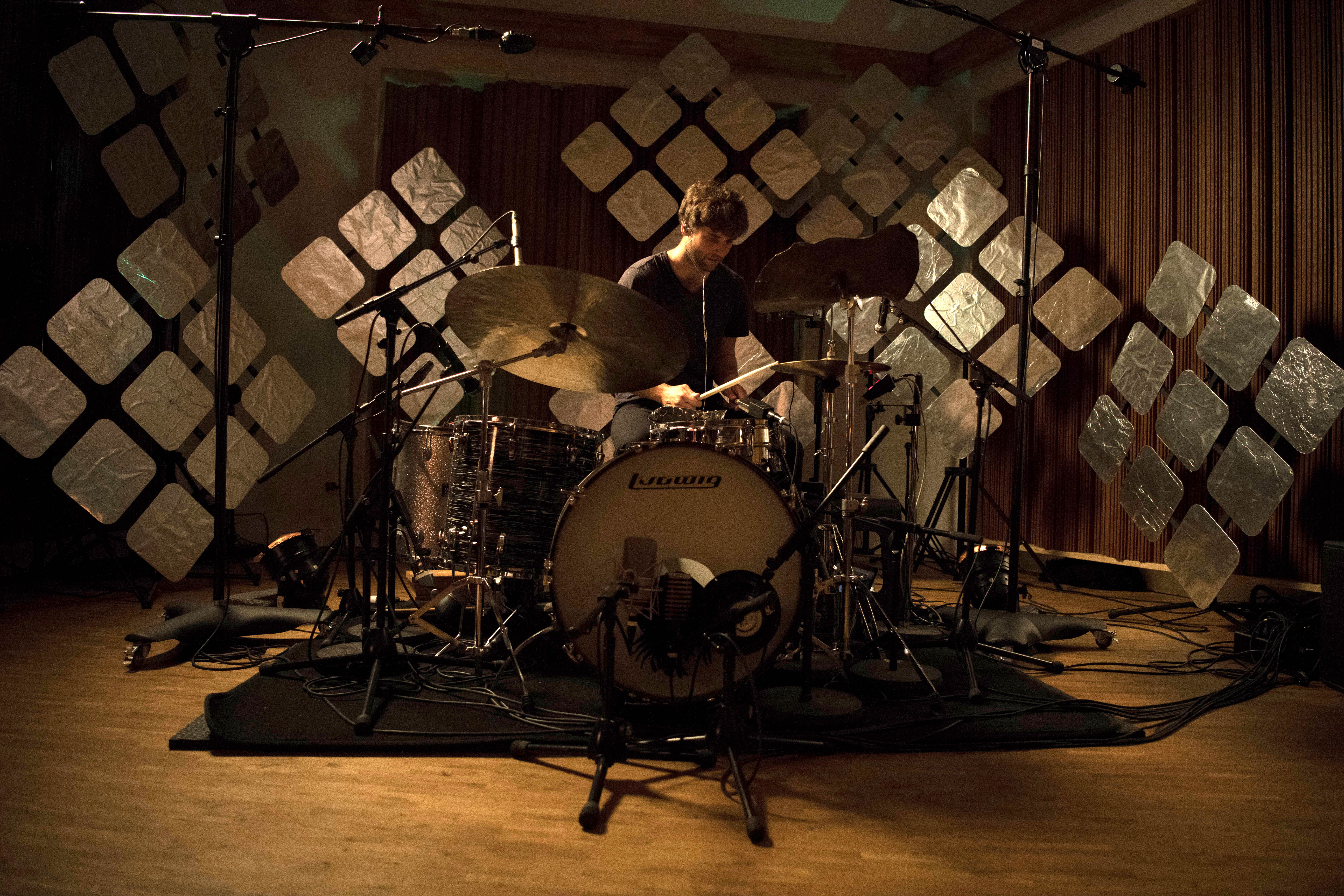
I use percussive elements to give “standard” beats a more personal touch and to make the song more distinctive. It makes the music more colorful, lively, and less technical or mechanical. I usually use small percussion items that I place on an additional floor tom.
Since I play a rather minimalistic setup, I also try to get as many sound variations as possible out of every instrument in the drum set. I always enjoy listening to and watching drummers who orchestrate grooves in a percussive way.
How has technology, such as drum machines and sequencers, impacted the way rhythm is created and perceived? Has it been a concrete influence on your own approach?
I think drum machines and sequencers have mainly had a strong influence on our listening habits. Our “quantization tolerance”—both as listeners and as players—has become very small because of them. I remember that after a night in the club, I would end up playing very “electronic” beats the next day.
In that context, I find my solo project HEARTBEAT DRUMMING to be an exciting, diametrically opposed approach. It's absolutely organic drumming—not machine drumming.
That doesn’t mean I look down on machine-based drumming. I actually enjoy playing in electronic contexts and have no problem playing disco beats all night long :-)
Physical strain is a particularly serious issue for many drummers. How does it manifest itself, how do you deal with it and in how far does it affect your creativity?
So far, I consider myself lucky to have been spared any physical issues that would limit my drumming. It’s more the carrying of equipment where I have to be careful.
I make a conscious effort to stay physically fit so that I can continue playing without discomfort for as long as possible. I think it’s important to listen to your body and not overstrain it.
Many recording engineers have remarked that the drums can be particularly hard to capture. What makes drums sound great on record and in a live setting?
Of course, it depends heavily on the music, and the emphasis on different elements is a matter of taste.
The best starting point for a good drum sound is when the unamplified kit already sounds good on its own. I believe that before we even talk about microphone techniques, the drummer has the biggest influence on how well the kit comes across in a recording or in a room.
It also helps when the drummer is aware of how the different elements of the kit behave in the mix. For example, in recording situations, I try to play the hi-hat subtly, because it's often picked up clearly by other mics as well, which can lead to issues in the mix.
Drums and percussion are remarkably often used for physical therapy / healing. What, from your point of view, makes them particularly suitable tools for this?
The good thing about drums and percussive instruments is that you can play them and immediately produce a sound. Their directness and primal quality make them accessible to everyone, even without prior knowledge. You can be creative without the fear of playing wrong notes. Through the immediate and powerful feedback, they strengthen the sense of self-efficacy.
It works well on your own, but playing in a group can be a powerful experience.
I believe the vibrations of percussive instruments can have a positive effect on both body and mind. Repetitive playing can bring you into a meditative state, connect you with your body, and help quiet the mind. I still find it fascinating how positively practicing and making music affects my own mental well-being.