Published
Name: Marmalade Knives
Members: Clinton Wilkins (guitar), Mark Robinson (bass), Adam Kriney (drums)
Interviewee: Clinton Wilkins
Nationality: American
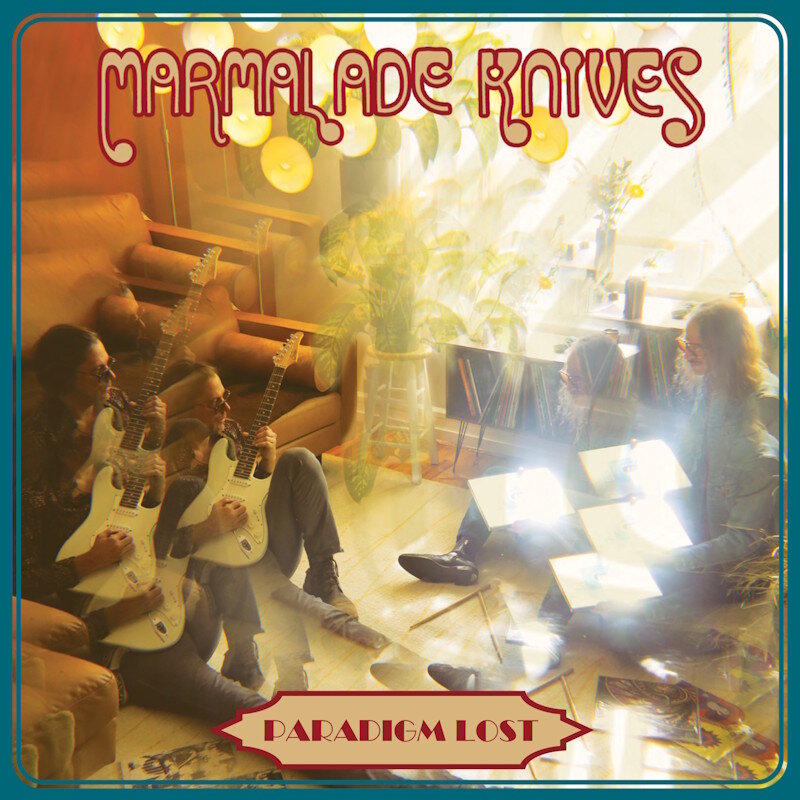
Current release: Marmalade Knives's new album Paradigm Lost is out via Electric Valley.
Hometown Recommendations: Asheville, NC, is very close to the erstwhile site of the experimental incubator of the avant-garde, Black Mountain College. Luminaries from the world of art and music and dance and poetry passed through there in the 30s, 40s, and 50s, from Josef and Anni Albers to John Cage, Robert Rauschenberg, Willem de Kooning, Merce Cunningham, Charles Olson, Robert Creeley, et al.
In addition to the beautiful nature in every direction, there is a Black Mountain College Museum in Asheville that is worth checking out.
If you enjoyed this Marmalade Knives interview and would like to know more about the band and their music, visit them on Instagram, Facebook, and bandcamp.
How would you describe your personal relationship with Krautrock? When and how did it start?
Krautrock first appeared on my musical radar in the late 90s as I was becoming more aware of and interested in Brian Eno’s contributions to David Bowie’s Berlin trilogy and to releases by Cluster and Harmonia, two more electronic-leaning Krautrock groups I’d soon get to know.
[Read our Brian Eno interview on climate change]
[Read our Cluster's Roedelius interview]
[Read our Harmonia's Michael Rother interview]
Around this same time I was treated to a listening session that really blew my mind; it was Can’s Tago Mago and Future Days that really stuck with me and prompted me to start to dig.
Very soon thereafter I discovered Amon Düül II’s Yeti, which remains to this day one of my all-time favorite albums.
As if possessed, I started listening to as many Krautrock bands as I could find, and I was routinely floored by the variety of musical approaches and styles that somehow all fit under this heading.
Amon Düül II’s deft handling of well-crafted heavy rock songs, sprawling art-rock song suites, and sheer psychedelic improvisations—sometimes all on the same album—instantly and for all time made them a personal favorite of this or any other genre.
But I found myself equally drawn to the hypnotic echo-laden guitar compositions of Achim Reichel, Manuel Göttsching, and Günter Schickert: A.R. & Machines, Ash Ra Tempel, and GAM accordingly also won inclusion in the pantheon.
Same goes for Popol Vuh—and by a certain extension Gila—who blew me away with their compositional range and ability to appeal to heart and spirit.
[Read our Manuel Göttsching interview]
Tell me about one or two of your favourite Krautrock records please.
Okay I apologize in advance because I’m going to mention more than one or two. I can’t even name just one Amon Düül II album …
I have to mention Yeti here again but I’m also almost equally enamored with Carnival in Babylon and Wolf City. I love Bury My Heart at Wounded Knee by Gila (featuring Florian Fricke), as well as Schwingungen by Ash Ra Tempel and Echo by A.R. & Machines.
A more under-the-radar echo guitar classic that deserves mention: Eiszeit by Günter Schickert. And a final lesser-known heavy rock classic in my eyes and ears: Can’t Get Through by Hairy Chapter.
Krautrock always seemed like a phenomenon connected to a very specific era in German history. What about this music and its time do you connect with?
I had already connected deeply with the spirit pervading the musical explorations of the mid to late 60s, if primarily from US and UK sources. My personal discovery of the vast underground expanse of Krautrock gloriously amplified my awe at the apparent limitlessness of it all, at the wellspring of creative genius at that time (late 60s/early 70s) that was so much deeper than I’d dared to imagine.
“Free rock” became for me the subgenre of all subgenres and an identification that encompassed a very specific spirit: one of commitment to experimentation and courage to examine depths with an ultimate objective to bring about dynamism or catharsis at the level of heart, mind, soul. I soon understood that this wildly creative ethos was in evidence in music from all over the globe during this same time frame—Sweden, basically all of Europe, Japan, South America, Africa, the Middle East.
But I’ll always return to Krautrock as the particular strain of the stuff that I connected with most personally and deeply.
Many of the original Kraut musicians loved blues, rock, and psychedelia; they were intrigued by electronics and improvisation; they rebelled against virtuosity, classical education and the superficiality of Schlager on German radio. How much of that do you recognise in your own creative preferences and interests?
I have always been drawn to the deeper end of the pool and feel infinitely more rewarded by music and literature and art that ask for a measure of upfront investment.
I personally wouldn’t discount artists who arrive at interesting expressions or statements either via or in spite of classical education and/or virtuosity; I do have a preference for music and musicians who appear capable of swimming (as opposed to sinking) in currents of improvisational unknown.
Both in the music and the way it was made, Krautrock was about imagining different worlds. What is the experience of listening to this music like for you and what kinds of worlds is it taking you to? What is your preferred way of listening to it?
Not long after becoming acquainted with Krautrock I went into a several-year visual art phase, and I found that putting on long-form exploratory music, usually Krautrock, was indispensable to the act of painting for me.
People whose intent was to imagine different worlds begat music that, along with someone similarly intent on imagining different worlds, helped beget art of a different medium.
A lot of the Kraut spirit came to life through musicians living in communities, playing and recording together every single day. Have you ever tried working and creating in such a constellation? Is it possible to emulate this process from a home studio?
I can say I’ve attempted this to an extent but can’t say it was terribly fruitful, unfortunately.
I spent about 9 months in a kind of collective quite cut off from any sort of cultural center, and we played music and recorded nearly every day. We were all very much steeped in outer-frontier music and art and it seemed only natural for us to sequester ourselves in a manner consistent with that of some of our heroes.
I was fairly new to the guitar at this time and perhaps wasn’t so confident in my ability to express the ideas circulating within me. Also it so happened that complexities related to interpersonal dynamics, or maybe just the commonly cited “creative differences”, got in the way. Life, in other words, got in the way, and my path to a measure of musical fulfilment would be delayed by several years.
The process of making this second Marmalade Knives LP was experimental in its own way, but nearly the opposite way: rather than living in a community we were pretty dramatically siloed across 3 cities. The fact that the album mostly succeeds in sounding cohesive (as I believe it does) is a testament to the overlap in how we’re wired and in what we could envision.
So to an extent yes, I think the home studio can accommodate a range of strategies and approaches.
What instruments or equipment are you using to create your music? Are there any vintage instruments that you find essential to get your sound right?
I have been known to covet vintage amps and mics and Echoplexes, etc, but honestly I felt all along I just needed a guitar and a handful of effects pedals—not necessarily vintage—to get the ball rolling.
I had a great deal of confidence in Adam, who played drums on and recorded and mixed the album, to dial in the appropriate feel on the back end.
Tell me a bit about the role that improvisation and inventive arrangement techniques (like cut-up) play for your work?
There were very definite cut-up arrangements employed in our debut, Amnesia. Justin, who initially formed the group with me, and I had many recordings of just the two of us playing, a very experimental loop-based approach.
After we assembled a full rock band and put together a collection of songs through gradually refined improvisations, we decided to insert some of those former loop-based recordings in the interstices of these full-band compositions for the first LP.
Regarding Paradigm Lost, Adam and I passed ideas back and forth from Asheville to NY to create demos; once we got the framework settled enough we got together in person to record the drums and rhythm guitar; layering in the bass and lead guitar then became their own exercises in improvisational creativity.
There is a single cut-up interstitial on the second LP but overall I think it’s more focused on fully articulated progressive psych compositions.
I got into Kraut via Tangerine Dream and early Ash Ra and to me, the motoric beat was never quite as important. Today, it seems as though it's the defining element. Are you interested in it? Are you making use if it? What makes it special to you?
This is a great observation and question. While there may be hints of motorik on the new LP, it hasn’t been the staple for me that it seems to be across the neo-psych spectrum at present.
I certainly loved Can and Neu!, and I can definitely see how such a persistent groove lends itself to unfurling of different top-layer timbres and melodies in a hypnotic and expansive way … but I wouldn’t say it’s been a defining element of our sound.
Did you ever visit one of the birthplaces of the genre – Berlin, Düsseldorf, Munich – or any spaces related to the history of Kraut? Do you own any paraphernalia from the era?
Only paraphernalia would be stacks of LPs.
I visited Berlin in 2001 and loved it. In 2008 I was in Croatia and planned to take a train to Munich to, among other things, meet John Weinzierl (of Amon Düül II), whom I’d been corresponding with a bit by email. I came down with fever on the day I was supposed to depart and missed my chance.
Several of the original Kraut pioneers recently passed away or withdrawn from making new music. If some of your personal favourite artists were affected as well – can you share a little what did their music meant and means to you?
Losing Damo and Chris Karrer last year hurt, as did losing Manuel Göttsching and Klaus Schulze in 2022. Florian Fricke died shortly after I first heard about Popol Vuh (2001), and I’ve always felt a certain closeness to him.
I had a vivid dream once in which I saw Florian in a crowded multiroom event space; there was brief eye contact but he was moving away, apparently not wanting to engage with anyone; I continued to weave through the crowd in an attempt to find him; no idea what I intended to say if I managed to catch up with him.
I was halted by a group of 3 men when I felt myself getting closer; they ushered me into a side room and one of them opened up this gatefold LP jacket for me; it was a Tangerine Dream album and the man pointed to one of the 3 men shown on jacket and said, “That’s me.”
I looked up and saw Edgar Froese! This is when he was still alive. I mentioned trying to find Florian and he told me I wouldn’t be able to speak with him … ”not yet.”