Published
Part 2
Once a piece is finished, how important is it for you to let it lie and evaluate it later on? How much improvement and refinement do you personally allow until you're satisfied with a piece? What does this process look like in practise?
Letting a piece lie and taking a breath after it’s finished or nearly finished is completely integral for the way in which I work. It is this distance between the act of making and the act of evaluating that allows the artist to judge with some degree of distance or detachment how much the work has realized the original vision or intention, or to allow that vision to expand more fulsomely.
Because much of my work is about “selecting” partially finished fragments from my sound and language archive and finding ways to integrate them to serve a vaster vision, taking substantial breaks after a work is finished to see how it holds up to perception and what it feels like over time is essential.
When you're in the studio to record a piece, how important is the actual performance and the moment of performing the song still in an age where so much can be “done and fixed in post?
The moment of documenting an “actual performance” is absolutely critical for how I conceive of sound recordings, but given the nature of digital media, this performance is no longer only constrained to the act playing an instrument but includes editing and production processes as means of conditioning the sound and performing the nuances of the vision.
There are undoubtedly a host of excellent singular qualities that result from the documentation of an unrepeatable performance, but the idea that editing, even though repeatable and iterable through digital memory, is fundamentally different from an instrumental performance is a bit arbitrary from my standpoint.
The approach I often take tries to valourize both the specificity of a particular psychical or emotional state and its expression in sound while also weaving these recordings into a piece on a larger time-scale that, generally speaking, is performed through collaged assembly “in post”.
Again, this notion of “post” seems somewhat slippery to me insofar as even after the artist completes the work, whether the work be a document of an actual performance or a digital hodgepodge, it still has to constitute itself in the perception of the witness which is also altered in “post”.
Even recording a solo song is usually a collaborative process. Tell me about the importance of trust between the participants, personal relationships between musicians and engineers and the freedom to perform and try things – rather than gear, technique or “chops” - for creating a great song.
As one whose process is naturally hermetic, I’ve had to consciously force myself into more typically integrated situations just to explore this trust and the relationship of making something so intimate with others.
Trust, as well as joy, is certainly critical as you cannot proceed at all if there are misgivings about the work or intentions of another participant involved in realizing the work. Beyond the influence of engineers on the final sound, there is also label aesthetic choices, format, and the manner in which the work is presented to the public which condition the final reality of the work, all the way up until the perception of the audience or witness, and their subsequent memory of this perception.
All of these processes necessarily alter and warp the work from it’s relative “purity” as it manifests itself in the mind of a single artist but the world and its contents are signal bent by nature so anyone wanting to control all aspects of the work’s reception and final presentation is ultimately contending with spectres and heartache of fascism, though this spirit of control is something we all must contend with in our lives.
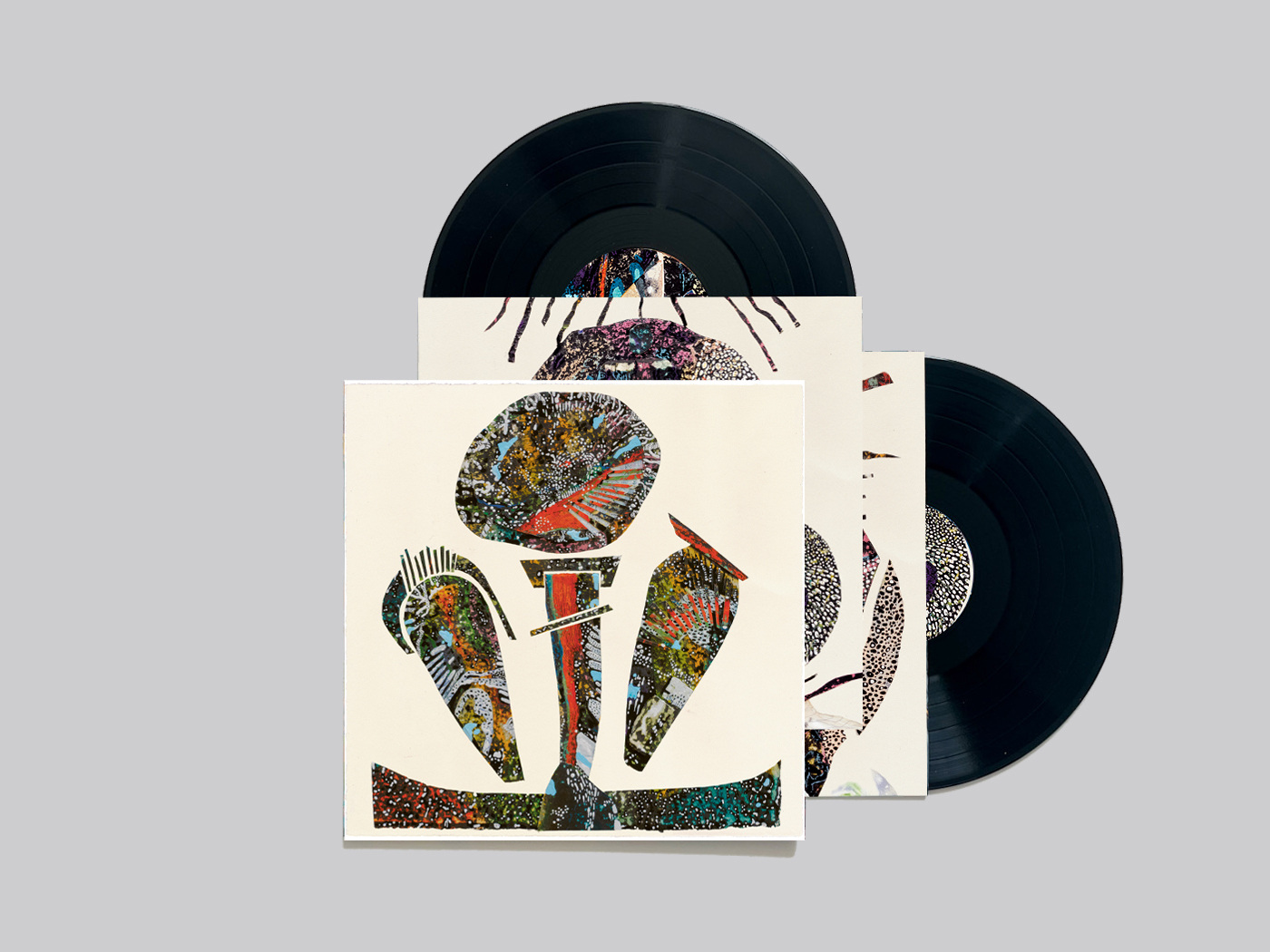
Khôra Gestures of Perception Cover Image by Jon Joanis
What's your take on the role and importance of production, including mixing and mastering for you personally? In terms of what they contribute to a song, what is the balance between the composition and the arrangement (performance)?
All technical elements contribute to the final condition of the work and so I find any line that would divide creative from technical work somewhat arbitrary on some level.
Although the world is full of characters who excel at only one of these (technical engineering or raw creativity) and tend to ossify into particular roles, I think it’s important for an artist to bring as many technical processes into their domain of agency as possible, although from a collaborative standpoint, it’s just another form of trust. These engineering processes dramatically alter the perception of the work and are hugely important for the works durability in many cases.
Because technical proficiency has also been married historically to some extent to economic status, there is also a socio-political dimension to the technical treatment of a work which feeds back into the message of the art. For example, work of an intentionally “lo-fi” character levies an inherent critique of the status quo of radio-ready music production and explodes what some people presume is the fixed connection between technical mastery and the inherent caliber of the work.
After finishing a piece or album and releasing something into the world, there can be a sense of emptiness. Can you relate to this – and how do you return to the state of creativity after experiencing it?
This is definitely an experience I can relate to. There is a very palpable feeling of emptiness or directionlessness after a work is brought to fruition, primarily because it consumed all of one’s waking and dreaming time up until that point. This is why it’s important to always have other work to be ready to move on to once a piece is completed.
In my experience, the emptiness derives from the completion of a specific work and doesn't necessarily speak to exhaustion of the creative state itself so it’s only a question of orienting oneself towards fresh parameters and a newly elaborated goal or revelation once another has been realized.
Music is a language, but like any language, it can lead to misunderstandings. In which way has your own work – or perhaps the work of artists you like or admire - been misunderstood? How do you deal with this?
Misunderstanding is one of human beings’ most profound features.
Much like the concept of the anxiety of influence in literature, one could say that all forms of creativity are essentially misunderstandings of other forms of creativity. This should not be of a concern to an artist as it pertains to the reception of their work, or only insofar as they are consciously playing and experimenting with ways of understanding in the very type of work they are doing.
Of course, politically, misunderstanding of a work or artist can get messy and moralistic in our hyper-connected world very quickly but this is not something I’m preoccupied with since the very question of the nature of reality, its interpretation or understanding is what art is exploring to begin with, so there is no interpretation that should catch the artist off guard, even if it may be wholly antithetical to the reason they made the work in the first place.
This ambiguity is the life blood of existence.
Creativity can reach many different corners of our lives. Do you personally feel as though writing a piece of music is inherently different from something like making a great cup of coffee? What do you express through music that you couldn't or wouldn't in more 'mundane' tasks?
I think this loops back to my response to the first question in the series. There is of course a difference but whether this difference between “numinous” or “mundane” types of creativity is taken as essential is a question of individual or cultural values.
The incisiveness with which certain modes of expression can exact their power on us is clearly dependent on the form they take. In the history of art, there is a privilege given to the senses associated with the ears and eyes as they relate to the contemplation and the mechanics of mind. But there are also histories of recipes or daily rituals which are passed down verbally or through gestures in familial or cultural lineages which are powerful but not as subject to critical analysis because of their quotidian nature.
What we typically refer to as artworks are called and distinguished as such because they don’t at first seem to be overtly related to physical survival or other basic organic concerns of life and can be distinguished from the arts of cooking or craft on this basis. At best, art which is not “mundane” points to forms of temporality which are transcendent.
In the same breath, there is a necessity concerning spiritual/psychical health and cultural balance that is related to abstract forms of art that is hard to describe and relates directly to operations of daily balance through meditation.
The “taste” of something comes down to how the witness has their sensorium engaged in the topology of the work and the arbitrary separation of mundane and numinous forms of expression comes down to an abstract line a cultural paradigm draws between its cultural agents, between those concerned with spiritual well-being and those oriented toward organic robustness, both or which seem inextricably linked from my vantage.