Published
Part 2
In relation to sound, one often reads words like “material”, “sculpting”, and “design”. Do you feel these terms have a relationship to your own work of and approach towards sound? What are the “material” qualities of sound?
I think that these words, especially “material”, allude to when not only the temporal but also the spatial qualities of sound are revealed. When I think of “material” qualities of sound, I think of experiences when it feels almost as though I can touch the sound, as if the sound assumes a physical shape in space.
In the past I was very interested in the more typical things associated with the spatiality of sound – surround sound, multiple speakers, etc. – but I am currently more intrigued by how, for example, sounds played back through one speaker can assume different positions in the room, depending on harmony and timbre.
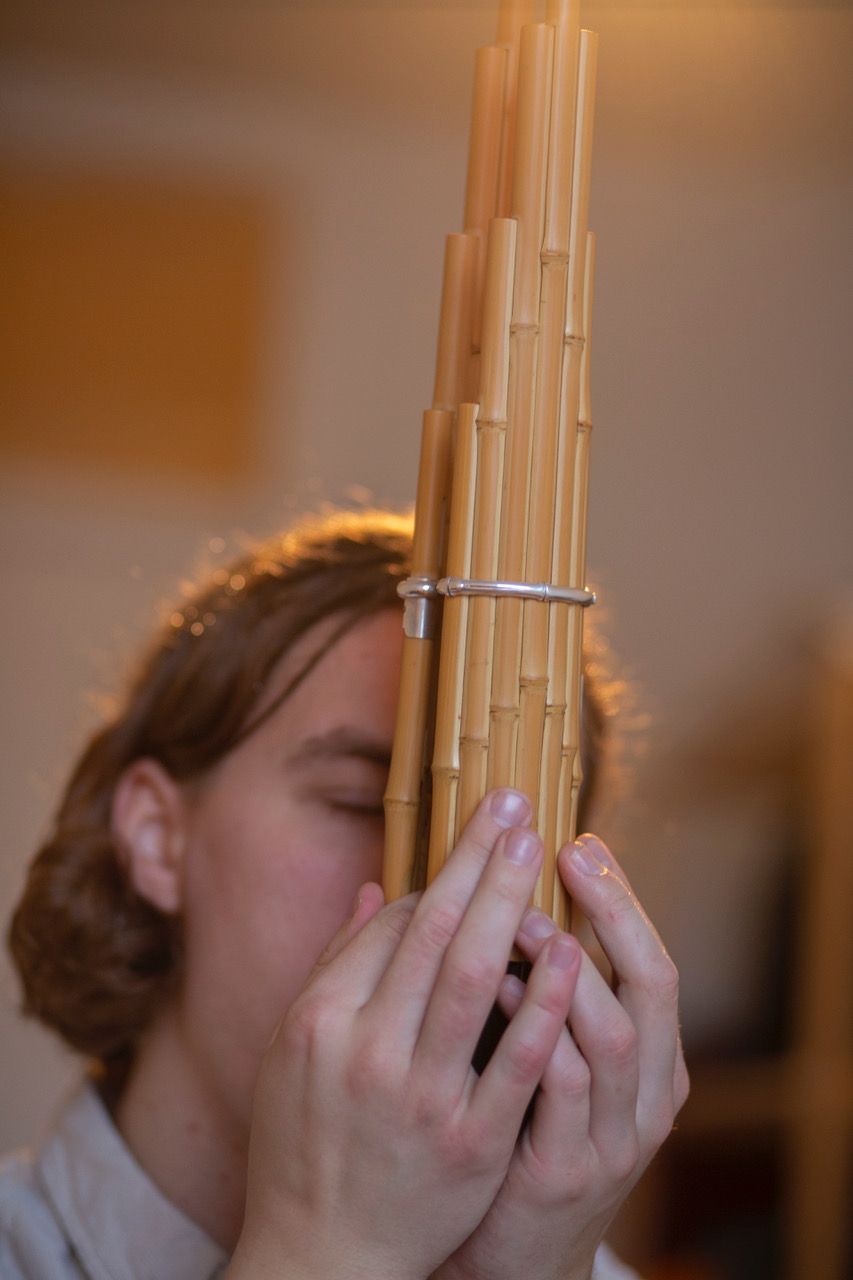
For example, I regard listening to the sound of the shō, at least from my euclidean position and perspective in space, as a very spatial auditory experience. The different pitches and their overtones really dance around the listener.
Harmonic progressions and melodic development has often been described as a play with tension and release, with repetition and variation. When working with sound, what guides your decisions?
I remember after being introduced to just intonation, and more importantly tuning with more precision than equal temperament, how I really started thinking about consonance and dissonance in a more detailed manner. This also coincided with me studying counterpoint with a wonderful teacher, who explained to me how many of the typical counterpoint rules are derived from ideas of what intervals are tunable for singers, both harmonically and melodically.
Listening to Renaissance counterpoint really changed my perception of Western harmony and what is considered consonant and dissonant. What I ended up deciding at that time was that, at its core, I wanted my music to feature slow changes from dissonant sounds to consonant sounds. What I quickly realized, however, was that I was describing a music which was basically just a stretched out version of Western harmony ...
At this point in time, I approach these ideas of tension and release (or dissonance and consonance, respectively) in a rather intuitive way, and I mostly just listen for progressions that sound and feel good. Sometimes rigid tuning theory can help, where the harmonic progressions are guided by neat tricks in tuning and intonation. But usually I regard the progressions only as stretched out melodic phrases and treat them as such.
I’ve come to consider beauty and sincerity to be very important musical qualities, and I want my music to sound honest even though it often times has a strong conceptual foundation.
Acoustic ecology, the biophony, and even the acoustics of public places have drawn a lot of attention. How important is sound for our overall well-being and in how far do you feel the “acoustic health” of a society or environment is reflective of its overall health?
Again, I approach listening to and experiencing environmental and anthropic sounds in a rather intuitive way. Considering anthropic sounds as generally damaging to a sounding environments in society can often times lead in to a rather naturalistic point of view, which I think can be dangerous.
Of course, I very much enjoy going to remote locations which feature softer soundscapes than urban environments and just listening to birds, waves or the wind. But I think that there is beauty to be found in hearing engines and loud people. I don’t think that the “acoustic health” of a society reflects its overall health.
This question reminded me of a song by Swedish singer Fred Åkerström called “Natt i en stad” (in English: “Night in a city”), where he explains to what I assume to be his lover how he cannot be quiet nor whisper, but can only sing. He relates being quiet to the night, and the act of whispering to the rain, and how he cannot match them because they have been doing it for thousands of years. However, he says that:
But like the city, I can sing
And I will sing, softly for you
Because the city can cry and the city can smile And it will be silent for us
… which I find to be a very sincere and profound way of expressing the difference between “natural” and urban sounding environments.
Tinnitus and developing hyperacusis are very real risks for anyone working with sound. Do you take precautions in this regard and if you’re suffering from these or similar issues – how do you cope with them?
I try to remember to always wear earplugs if I’m going to a concert I know will be loud.
I used to have some ringing in one of my ears (which I know was caused by my friend’s punk show) but it seems to have faded, luckily.
Very specific sounds can be considered as pleasant – as in ASRM – or extremely disagreeable – as in Misophonia. Do you have any experience with and ideas on the relation between certain sounds and strong emotional responses?
When I was writing my bachelor’s thesis in 2019, I got the chance to spend a full working day in the anechoic chamber at the Royal Institute of Technology (KTH) in Stockholm. While there, I basically just sat still and listened, and tried to formulate my experience through voice memos on my phone, in an attempt to record both my verbalized impression of the room as well as the actual sound of the room at the same time.
I remember considering how unnatural it felt to hear sounds without any reverberation, and how it was almost as if my cognitive system latched on to the resonance of the railing I was sitting on and considered that to be the natural reverberation of the room. It was really fascinating to experience how much of our experience of loudness and proximity is dependent on our experience of reverberation.
That year, I had also worked with music specific for headphones. With that music, I considered the intimacy that is afforded by headphones, and although I was not using sounds that are generally associated with ASMR, I think that this is one of the key qualities of ASMR: the sounds used are very amplified with little to no reverberation. If a listener hears for example a very amplified whisper, it creates the expectation that if the person speaking would speak with their normal voice the loudness would be painful.
Although this might be technically impossible – the listener probably has their headphones set to a normal listening level, so if very loud sounds would be played they would probably clip – I think that the very amplified soft sounds at least communicate the potential of very loud sounds occurring. Because of this, the listener has to trust the person creating the sound, which I think plays a part of the appeal of ASMR.
It is a very nice feeling as a listener to feel that one can trust the performer or sound-maker.
We can surround us with sound every second of the day. The great pianist Glenn Gould even considered this the ultimate delight. How do you see that yourself and what importance does silence hold from your point of view?
I really think that it’s important to rest one’s ears from time to time. Both in terms of resetting our auditory system, as well as to reduce the various stimuli that we come into contact with on a daily basis.
When specifically speaking of music, I sometimes listen to music on commutes, but I also find it very inspiring to only listen to the surrounding environment. As with my experience at the Nison-in temple in Kyoto, listening for spontaneous musical constellations in everyday sounding environments can lead to very beautiful musical experiences.