Published
Name: Mauricio Fleury
Occupation: Composer, multi instrumentalist, producer, DJ
Nationality: Brazilian
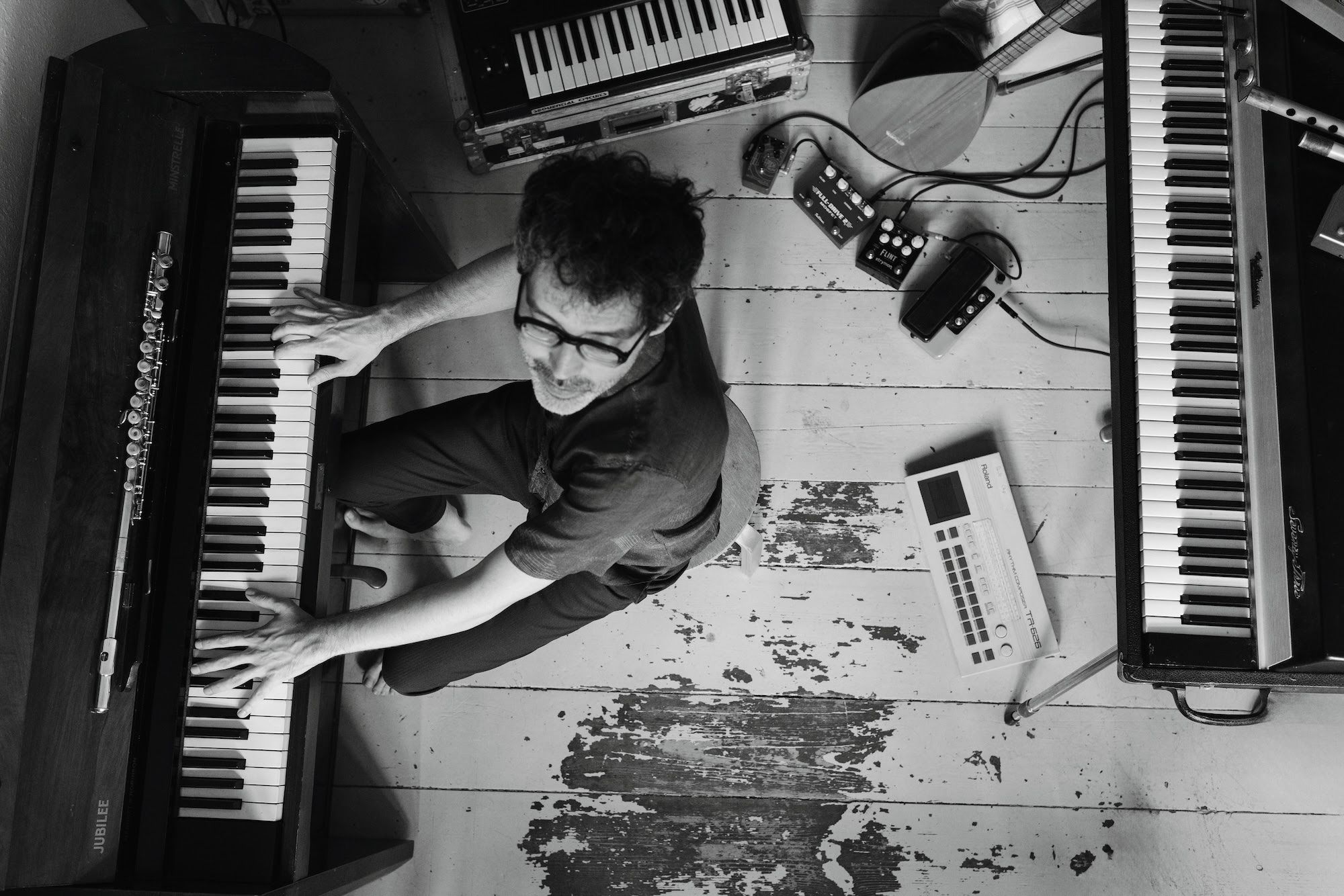
Current release: Mauricio Fleury's new album Revoada is out via Altercat. Next to himself on piano, Fender Rhodes, clavinet, Hammond, Korg MS10, SCI Prophet V, SCI Pro-One, flute and guitar, it also features a band of Fabio Sá (acoustic and electric bass) and Vitor Cabral (drums, percussion). Order on bandcamp or directly from the label.
Shoutouts: There are many, really a lot of people doing this, searching, experimenting, I could quote so many! Artists I'll mention like Cassie Kinoshi, Ben Lamar Gay or Amaro Freitas, but also Mariá Portugal, Mauricio Takara, Otis Sandsjö, Angel Bat Dawid … The list goes on and on!
[Read our Ben Lamar Gay interview]
If you enjoyed reading this Mauricio Fleury interview and would like to stay up to date with his music, visit him on Instagram, and Soundcloud.
What were some of the musical experiences which planted a seed for your interest in jazz?
There were so many … but one I can remember was one day when I was going through my father’s record collection and found Big Fun by Miles Davis.
As a fourteen year old, I could never imagine one could be so free in music; that moment broadened my musical taste to all types of experimentation.
What does the term jazz mean today, would you say?
To be honest, labels and terms are not something that mean much to me. I love a lot of “jazz artists”, but there’s people that don’t like the current application of the term jazz and I understand them as well.
The term BAM (Black American Music) makes a lot of sense, but should we be confined to terms? I think music should be free of these boundaries.
In the end, if you’re searching for your voice, your thing in music, then these labels and categories become less relevant. It’s much more a question of how to sell it or “in which shelf should it be placed”, so it’s not really driving the art realm.
As of today, what kind of materials, ideas, and technologies are particularly stimulating for you?
In times of AI generated or just overproduced music with lots of editing and such, I’m becoming more and more interested in recording as much as I can live and spontaneously, keeping the mistakes.
That’s what makes things human and makes me want to listen to certain records over and over again.
Where do most of your inspirations to create come from – rather from internal impulses or external ones? Which current social / political / ecological or other developments make you feel like you need to respond as an artist?
Normally it’s just melodies or rhythms that come to my mind and then I’ll understand what type of messages or inspirations this first idea can carry.
Sometimes it’s kind of an incomplete story and it won’t even be totally revealed. We gotta reflect the times, but I feel that maybe it shouldn’t be taken as just following trends or subjects or responding to them, it’s more about finding the connection with people, be it about the struggle or the joy …
The affirmation of the freedom of thought and sound is something that interests me a lot.
Tell me a bit about the sounds & creative directions, artists & communities, as well as the colleagues & creative hotspots of your current hometown, please. How do they influence your music?
It’s a big influence for sure, especially because I’m seeing myself as part of a somewhat diverse scene in Berlin, working on different roles with artists from different parts of the world -- and that inspires me a lot.
It’s also about the freedom of wearing different shoes, doing something different every day. This is all very inspiring to me and I’m happy to be working with artists and groups such as Ekowmania & The Rhythmers, Joa Luna, Batila & The Dreambus, Cassie Kinoshi, K’boko, Ziggy Zeitgeist or Cassette Heads amongst others.
[Read our Ziggy Zeitgeist interview]
What role do electronic tools and instruments play for your creative process?
I like to work with whatever tools possible, so I use a lot of electronic tools and instruments, also Plugins and VSTs, music notation software, DAWs, etc.
It’s virtually impossible to work 100% out of the digital world nowadays; they play a big role, but I’m still very passionate about the use of tape, spring reverb, tube amps and mics, etc ... and especially capturing music live, with improvisation.
Thanks to technological advances, collaboration has become a lot easier. What have been some of the most fruitful collaborations for you recently and what approaches to and modes of collaboration currently seem best to you?
Maybe it helps to keep in touch with people and communicate. But for me to collaborate makes so much more sense when it’s done live, eye-to-eye. Nothing can replace the moment of aligning the vibrations to the people you’re playing with, that’s when great surprises can arise.
You can get nice results and of course, we had to collaborate by distance during the Corona pandemic. But it’s so much faster and nicer to do it on the spot.
Jazz has always had an interesting relationship between honouring its roots and exploring the unknown. What does the balance between these two poles look like in your music?
I don’t see this as a “jazz” thing. This impulse of balancing the past and the future is an operation visible in so many cultural manifestations, and for me it’s just part of the process of being an artist or a musician.
You carry the knowledge you accumulated through learning -- be it with records or lessons -- and you put that to work for something that feels new or fresh or at least represents the moment. But it’s always the relocation of something from one place to another.
How much potential for something “new” is there still in jazz? What could this “new” look like?
I think great fresh music is being done by a lot of people. I personally could point out people like Ben Lamar Gay, Amaro Freitas or Cassie Kinoshi, who play “jazz stages” or festivals and whatnot.
But labelling such artists as “jazz” sounds a bit limiting in my opinion, music is just universal. And the “new” and the “old” are present on it. It always comes from a place, so the “new” just for being new can quickly become a cliche or a trend and the creativity is gone.
You need to have a big repertoire to come up with something fresh, so there’s a lot of “old” in the “new”. Maybe the “new” says more about who listens than who’s playing, meaning that it’s just something people haven’t heard before, it’s not like it never existed.
For many artists, life-changing musical experiences take place live. How do you see that yourself?
It can be live, it can be through a record.
Life-changing musical experiences happened in both domains for me, for sure.
How, would you say are your live performances and your recording projects connected at the moment? How do they mutually influence and feed off each other?
A lot. I made the Revoada album with Vitor Cabral and Fábio Sa because we had been playing together for many months, and that is noticeable in the way we play and breath through the music.
Since moving to Berlin, I’ve been working live with different people and this has influenced me so much. I’m sure this will reflect on my next musical works.
Improvisation is obviously an essential element of jazz, but I would assume that just like composition, it is transforming. How do you feel has the role of improvisation changed in jazz?
Not sure it changed so much.
I think it’s still very important and I’ve been seeing more and more people from an academic background wanting to improvise and many artists mixing composition and improvisation at the same time.
What, would you say, are the key ideas behind your approach to improvisation?
One idea comes from Hermeto Pascoal, who said: “improvisation without mistakes is no improvisation”.
If you know where you’re going, you’re not improvising. You should surprise yourself even with mistakes and stuff that won’t be so “efficient” but that can take you to different places.
The Montreux Festival intends to preserve its archive of recordings for future generations. Do you personally feels it's important that everything should remain available forever - or is there something to be said for letting beautiful moments pass and linger in the memories of those that experienced them?
Nothing will remain available forever. Records will go scarce, servers and digital folders will vanish at some point.
Platforms for distribution of music already have a quite limited catalogue, in my opinion - it’s really not like we have everything available to listen to at any time. You gotta search for it and if someone is interested in a live recording of this or that, it’s fine, it’s gonna be a document of a moment, moments will pass, too, and memories will linger.
But the recording of a live performance will never replace the live experience and vice-versa.