Published
Name: Afro Celt Sound System
Permanent members: N'Faly Kouyate, Johnny Kalsi
Interviewee: N'Faly Kouyate
Nationality: Guinean
Occupation: Singer, songwriter, kora player, balafon player
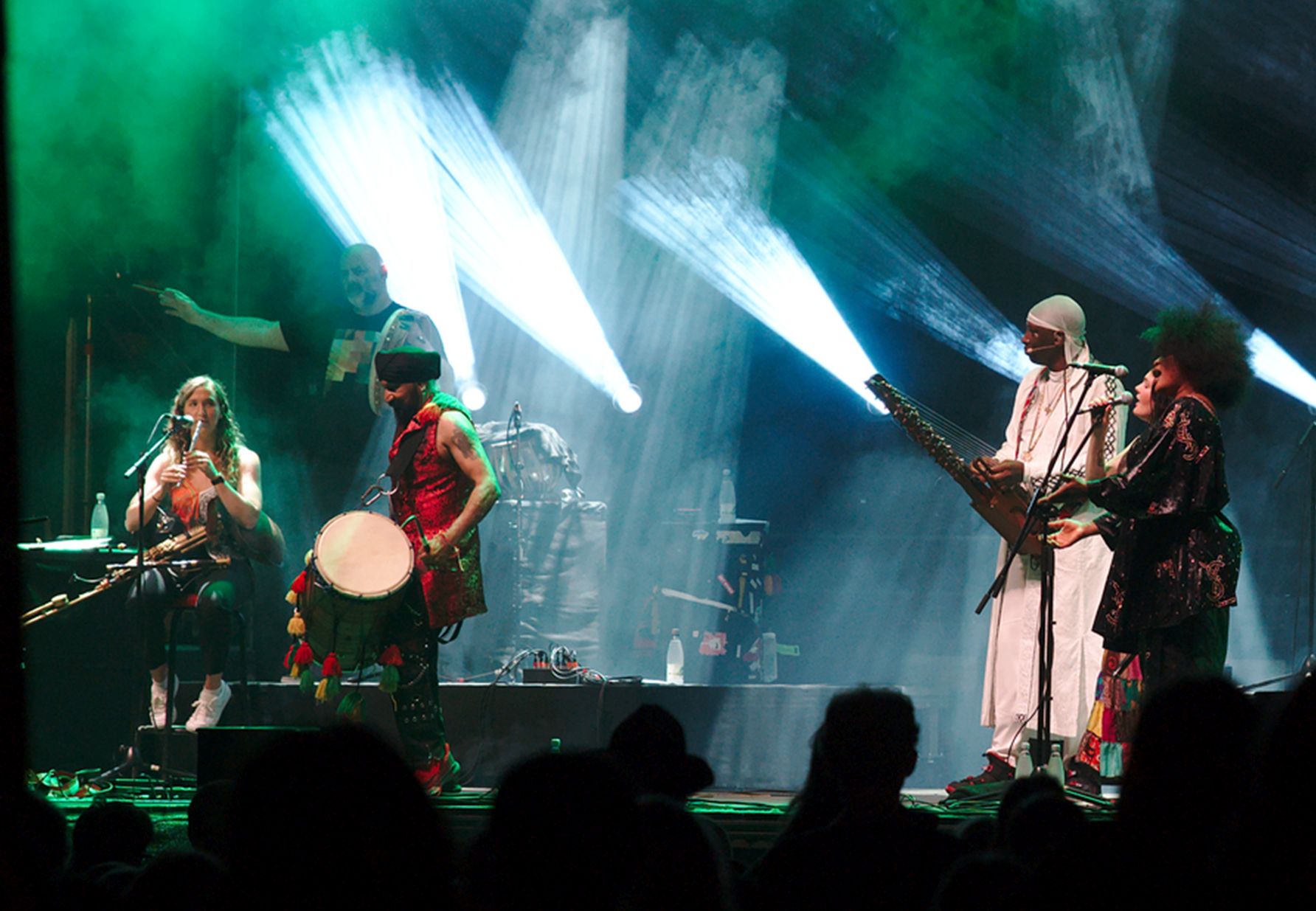
Current Event: Afro Celt Sound System are one one of the acts performing at the Musicport Festival 2024. Under the headline of “A Magnet for World-Class Musical Diversity,” the festival will take place at Whitby’s landmark Pavilion - Friday October 25 – Sunday October 27 2024. Get tickets here. Other acts at the event include Divanhana, Chahat Mahmood Ali Qawwal Group, Rokia Koné, Karolina Wegrzyn, Fulu Miziki as well as Jah Wobble and The Invaders of the Heart.
Recommendations: I recommend Black Panther.
[Read our Johnny Kalsi interview]
[Read our Divanhana interview]
[Read our Rokia Koné interview]
[Read our Karolina Wegrzyn interview]
If you enjoyed this Afro Celt Sound System interview and would like to know more about the band and their music, visit their official homepage. They are also on Instagram, Facebook, and Soundcloud.
Where does the impulse to create something come from for you? What role do often-cited sources of inspiration such as dreams, other forms of art, personal relationships, politics, etc., play?
My sources of inspiration are varied. Sometimes I'm asked to compose on a topic, or I wake up with a desire to compose, or while playing, handling one of my instruments.
To start, do you need concrete ideas – or what some have called a 'visualization' of the finished work? What does the balance between planning and chance look like for you?
For me, it depends. I'm often inspired by a situation, and then I feel a strong urge to compose immediately.
Is there a preparatory phase for your process? Do you need your tools arranged in a particular way, for example, do you need to do 'research' or create 'draft versions'?
Yes, sometimes I can look at an object, it inspires me, and I compose accordingly. Just like when someone asks me to compose on a topic, it's immediate.
But don't give me a text to turn into songs - I can do it but I don't like it.
Do you have certain rituals to get yourself in the right mindset to create? What role do certain foods or stimulants like coffee, lighting, scents, exercise, or reading poetry play?
I call it the influence of the environment. I'm one of those people for whom composing is very easy. That's why Simon [Emmerson] would provoke me even in the dressing room before or after concerts, coming with his guitar or mandolin when I have my kora or balafon, and we start jamming, creating songs that he quickly recorded on his phone and called me about another day to finish.
During long tours, while everyone else is resting, I'm taken to the studio, where I find many instruments already set up, and I start creating. Many Afro Celt songs are composed this way; sometimes they have other singers perform on them.
For example, "When You Are Falling," where Peter Gabriel sang, was entirely composed in Mandinka by me, then they added other instruments. I put my voice on the piece, then backing vocals, and then invited him to put his voice on it, and they replaced my voice while he continued with Iarla [Ó Lionáird] on the song.
What makes lyrics good to you? What are your own ambitions and challenges in this regard?
Lyrics can be very good or very bad. For example, the word "hello" when pronounced at the right moment, everyone might appreciate you for being polite because you greet everyone. But when you shout the same word loudly in all directions, people might immediately think you're crazy ...!
So pronunciation is important.
Many writers have claimed that once they enter the process, certain aspects of the narrative escape their control. Do you like to keep strict control, or is there a sense of following things where they lead you?
When I compose songs with my kora, I let it guide me into its universe; it fills me with emotions. Once I'm full, melodies come out of my mouth, and words follow them.
Often, new ideas and alternative paths open up during writing, pulling and pushing the creator in a different direction. Does this happen to you too, and how do you handle it? What do you do with these ideas?
I like to let myself be carried away by the power of words obtained through the magic of my balafon or kora.
There are many descriptions of the creative state. How would you describe it personally? Is there an element of spirituality in what you do?
Definitely.
You know, I was born into a family of griots. Griots are people from the Mandinka kingdom. In this kingdom, the population was organized into different classes or castes; they advised the king, the royal court, and the population. They were negotiators for establishing peace between people, conducting marriages, baptisms, and when there was a dispute between two people, cities, or nations, they would intervene to establish peace.
Otherwise, they would sing to encourage the army to face the common enemy; they are everywhere in society like blood in the human body. That's why we named them Djéli, which means the blood of society. Their weapon is the word, so you understand that we can do anything with words. Therefore, we can use it as we wish.
When you're in the studio recording a track, how important is the actual performance and the moment of interpreting the song, in an era where so much can be "done and corrected in post-production"?
I'm a perfectionist; I like to start with clean music because when I start, I like to do one voice after another to directly build a polyphony.
The same goes for a first take of the kora, then a second, then a third. To quickly complete the melody.
Once a track is finished, how important is it for you to let it rest and evaluate it later? How many improvements and refinements do you personally allow until you're satisfied with a track? What does this process look like in practice?
I'm never satisfied with a track; every time I listen to it, I always think, "Ah, I should do it like this, like that." In short, only the eternal can do better.
Even recording a solo song is usually a collaborative process. Tell me about the importance of trust between participants, personal relationships between musicians and engineers, and the freedom to perform and try things – rather than focusing on equipment, technique, or "skills" – to create a great song.
Very often, I listen carefully to musicians, technicians, management, and even those who aren't into music; their opinions matter to me because they are the ones who buy the product and might hear things I don't.
Listening to music depends also on your own feelings and mood. So it's always better to have a good team you can trust.
What is your opinion on the role and importance of production, including mixing and mastering, for you personally? In terms of what they bring to a song, what is the balance between composition and arrangement (performance)?
It's a long question because, for me, we form a team of cooks. Some bring ingredients, salt, pepper, meat or fish, or vegetarian dishes. Others bring fire, others water, charcoal, and some bring good humor.
It's the combination of all these elements that leads to good work.
After finishing a track or an album and releasing it to the world, there can be a sense of emptiness. Can you relate to that – and how do you return to the creative state after experiencing it?
For me, it's not over; it's just the beginning. When I finish an album, I have to follow it and track its sales, the success it will have.
I don't stop when the album is finished; I just switch hats to promotion, sales, like what I'm doing now, making myself available for all kinds of interviews. I go to autograph signings for the fans.
Music is a language, but like any language, it can lead to misunderstandings. In what way has your own work – or perhaps the work of artists you like or admire – been misunderstood? How do you handle that?
Music is not rewarded, or musicians are not rewarded to their true value, because the artist is enormous; music is in everything, but it comes last in all decisions.
When there's no budget, it's in culture that cuts are made, yet no one in the world can carry out their activities without music.
Creativity can reach many different corners of our lives. Do you personally feel that writing a piece of music is fundamentally different from something like making a great cup of coffee? What do you want to express through music that you couldn't or wouldn't in more 'mundane' tasks?
I use music to denounce the flaws of society; I advise; I invite people to do good around them ...