Part 1
Name: NicoNote
Occupation: Vocalist, composer, multi-disciplinary artist
Nationality: Italian-Austrian
Current release: NicoNote's new album REGOLA, a suite in nine parts inspired by Hildegard von Bingen (1098-1179), is slated for release September 26th 2024 via New Interplanetary Melodies.
Pure vocal recordings recommendations:
Demetrio Stratos - Cantare la Voce (Cramps Records, 1978)
Meredith Monk - Key (Increase Records, 1971)
Sheila Chandra - Weaving My Ancestors' Voices (Real World Records, 1992)
The Hilliard Ensemble - Tenebrae (ECM, 1991)
Graindelavoix - Josquin the Undead: Laments, Deplorations and Dances of Death (Glossa Music, 2021)
If you enjoyed this NicoNote interview and would like to know more, visit her on Instagram, Soundcloud, twitter, and tumblr.
Do you think that some of your earliest musical experiences planted a seed for your interest in your voice and singing? How and when did you start singing?
I have always had an intimate relationship with singing. I used my voice from a very young age, we sang at home and in church services, especially in Austria.
In fact, singing was part of my daily life, something very evocative and poetic. I studied piano from a very young age, although I didn’t study piano for many years. I also did classical dance. There was a seed in the family, on the Austrian side, for this kind of thing, so music and singing were very present.
Growing up, music was my adolescent catharsis. My salvation. I started out as a listener and then, from a very young age, began to experience theatre in which the voice was a ritual element. I had the good fortune to meet Tadeus Kantor at a rehearsal in Florence at the age of 16, it was a blast! And then I met people who were part of the Roy Hart Theatre as well as the likes of Yoshi Oida and Akademia Ruchu in didactic workshops at a very early age. The stage became a place to manifest myself.
So music has long been my medium, my revenge on the world so to speak, and step by step I have learned to channel my great passions, my deep feelings, into my voice. Voice as alchemy. As a ritual.
If you're also playing other instruments, how does the expressive potential of these compare to your own voice?
I studied piano as a child, but my instrument is my voice. I do cut-ups and live performances with loops, turntables and samples.
The expression is drawn in space, between sound and voice as fluid elements, like two streams of magma intersecting. However, the voice manifests the body. The life pulse. The blood and the spirit. The here and now.
Singing is an integral part of all cultures, and traditions. Which of these do you draw from – and why?
The first sound of a primitive man may have been an accidental sound, an unarticulated sound, perhaps of pain or fear or pleasure. Later it became a formalised sound. The voice can reproduce a sound that was heard, provoked by chance, imagined.
My expressive roots and path are in Western cultures, I am tied to the song form, although I have struggled all my life to transcend it. My path and background is cross-cultural and atypical. I come from post-punk and new wave pop music. A special moment in which material spaces, like clubs and concert halls, played an important role, especially in the realisation and creation of imagery.
My approach is mainly that of a researcher, with a transversal, non-academic form of training and a wide experience also in the theatre, with directors like Romeo Castellucci, Patricia Allio, Silvia Costa. It basically means that my path in music comes from a transversal experience of stage and theatre work, as well as music creation in pop and electro-acoustic music.
Fundamentally, my creativity has been shaped by my experiences and research, and is guided by the aim of exploring new forms, new languages.
What were some of the main challenges in your development as a singer/vocalist? Which practices, exercises, or experiences were most helpful in reaching your goals – were there also “harmful” ones?
There are many voices and many techniques, but beyond the choice of expressive languages, what has always been a source of inspiration for me is the search for the sounds of the voice.
Voice is a versatile instrument that reflects different states of consciousness and different visions. What's fascinating about this process isn't necessarily the result, but the act of giving and understanding oneself through the voice. I have also been involved in voice teaching. I often work with my students on their artistic identity. 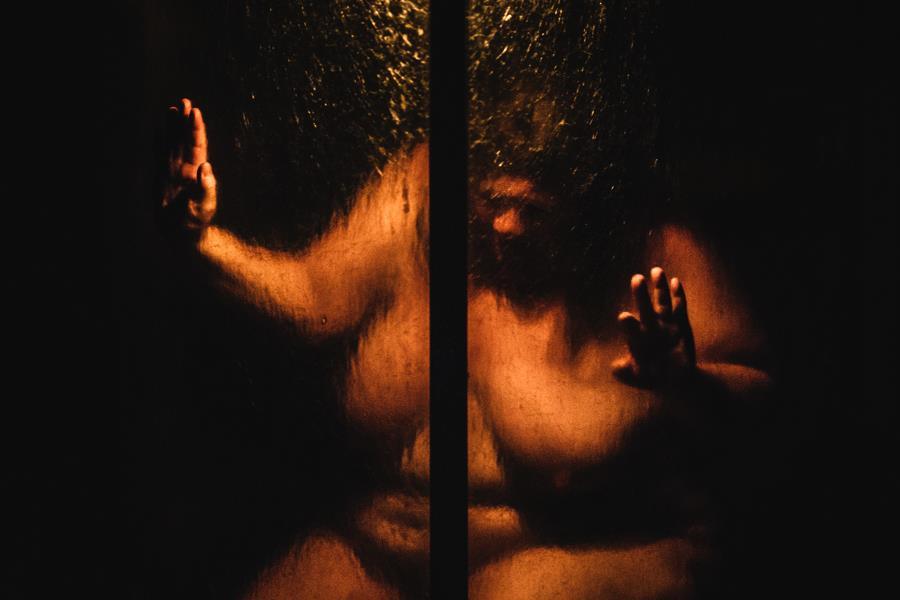
Orestea directed by Romeo Castellucci; photo by Guido Mencari
How do you see the relationship between harmony, rhythm and melody? Do you feel that honing your sense of rhythm and groove has an effect on your singing skills?
Yes. Perhaps it does. Everything takes off and lands, boundaries mix, lines intertwine, add up and articulate, create a dialogue, within oneself and with the listener, the audience.
The sound floats in an ambient sense, a space where everything is connected. A world of worlds.
What are the things you hear in a voice when listening to a vocalist? What moves you in the voices of other singers?
Authenticity, the search for uniqueness, singularity.
How would you describe the physical sensation of singing? [Where do you feel the voice, do you have a visual sensation/representation, is there a sense of release or tension etc …]
I like to think of the voice as a kind of gaze that embraces one’s surroundings and transforms them. It's an embrace, a breath that expands prescribed boundaries.
The physical side of things is all about mechanics. I take in all the details and think about what I want to achieve. Our bodies are all connected, so it's important to combine the sensitivity of our vision with the movement of the body. The breath flows through the entire body, and it is from the body that the air leaves, becoming and drawing the sound.
The voice is always a kind of drawing, made up of layers, of several overlapping worlds. From imagination to sound, there's a process to be followed. It's a journey that takes us outside and inside ourselves.
What kind of musical settings and situations do you think are ideal for your own voice?
I’d like to link this to an idea I call The Fluid Sound. In composing with the voice there is an analogy with the liquid world, I am inspired by floating in sound, being carried, finding a tuning. The key word is floating.
Staying in the flow to express what my body-animal-spirit felt intimately. Being a particle of this macrocosm, grasping its climate, the clues carried by the soundwave I dive into. To be in touch with the exact moment when the flow of sound is in dialogue with my deepest resonances.
The voice can expand our sensitivity in a suprisingly intense way, but the body's limit is always present. One can only accept it as a mystery: from the body emanates the voice, a molecule of sound and energy. Sound is freer, it has more space. It is an ocean to surrender to. Suspending language, letting it flow.
It’s like a seemingly motionless journey into the boundless territory of sound, like an extreme limbo where the symphony takes shape. An abyss in which one crosses the border of the dream and is possessed by the events of it. A dream of liquid sound, vibrating together for us and those listening. Resonances brought to light from the bowels' darkness. Fragments to hold on to, in order to climb the ladder of emotions again.
This is how my composition happens, a combination of voice and sound, a mixture of dreams, sounds, poetic words and visions, from which to feel unity and synthesis. Wave upon wave.
We have a speaking voice and a singing voice. Do these feel like they are natural extensions of each other, ends on a spectrum or different in kind?
I never separate the singing voice from the speaking voice, I see it as a choice of the performer.
Each song, each "piece" has its own needs, its own expressive vocal needs. I always like to remember a beautiful phrase by the great French actor Jean Louis Barrault: "Every character has its breath". So every character, every moment (in life) and in the theatre has its breath, ‘son souffle’; its specific figure, its core, its essence. It is this centre, this ‘’souffle’’, that has to be sought, to be explored, to be known.
And as an interpreter, this tells me which voice to draw for each project ...
From whispers to screams, from different colours to dynamics, what are the potentials and limits of your voice? How much of your vocal performance can and do you want to control?
For me, the core of the matter is to know and study the voice and its potential. Not to do more and more weird things with the voice, but to follow our intuition and manifest it as best we can. Every voice is unique. Uniqueness of voice and uniqueness of being. Everyone has a unique journey.
There are many methods, many schools of acting and singing, many voices, many possible directions. Surely our voice is unique. And this uniqueness needs to be nurtured, stimulated, explored. Everyone has an insight. We must follow this insight, we must have the courage to listen to it. It is a contemplative attitude that requires us to be open, to see and feel. It is a mindful attitude.
Of course you will sometimes be wrong, like the explorers who followed their intuition! It's part of the job. You go back and start again.