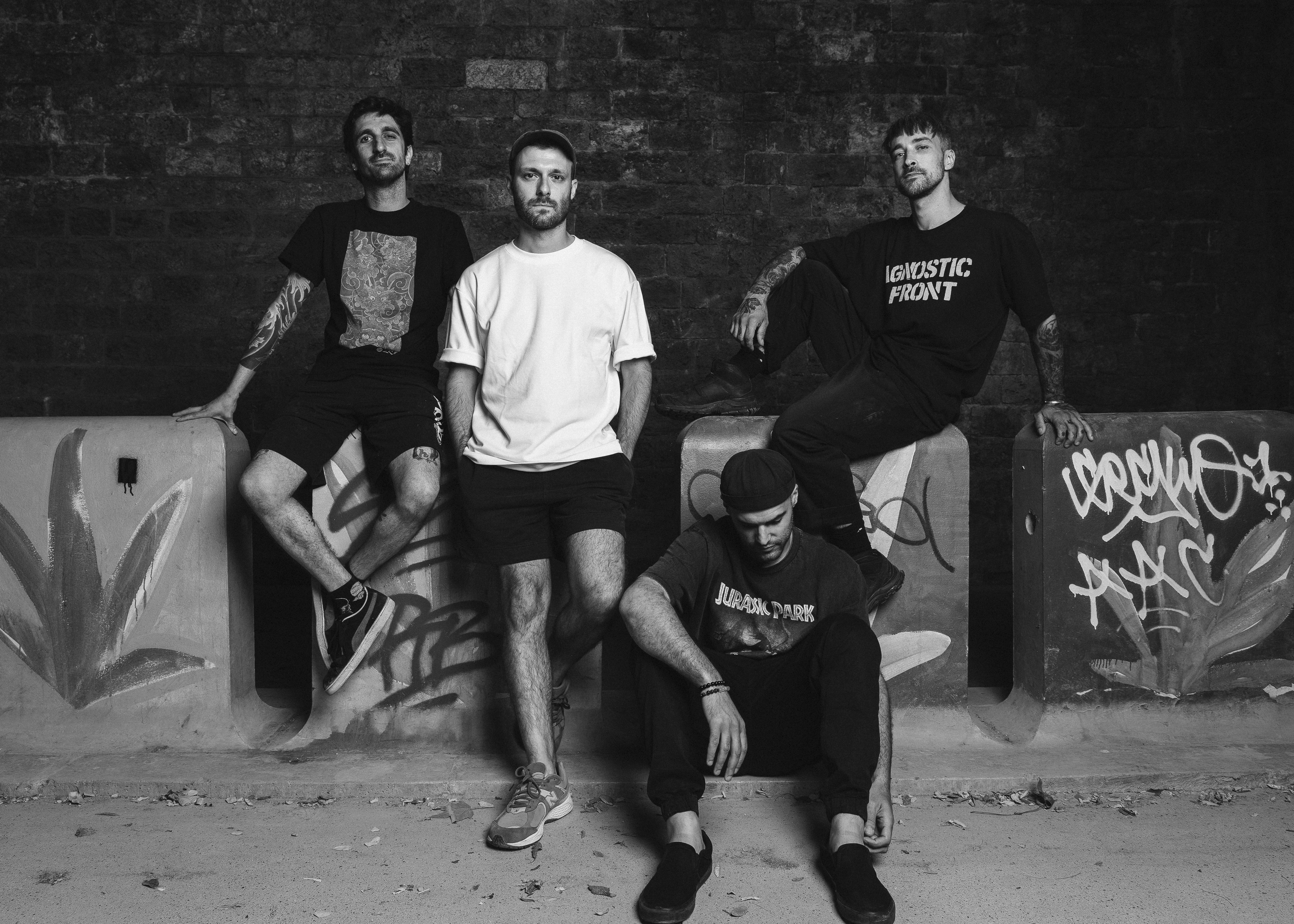
Published
Part 2
Tell me, if applicable, about the concrete lyrical themes that you felt drawn to for Tears For Everything.
Arthur: While working on the vocal demos for Tears For Everything, one thing quickly became clear: there had to be a narrative thread connecting the songs. Not with the intention of making a concept album, but rather to create a cohesive story that ties the lyrics together.
I wrote most of the lyrics myself, except for “Solace” and “The Drop”, which were written by Guillaume, our drummer. Both songs touch on the theme of addiction, and from there came the desire to go deeper — to explore what lies beyond addiction and reach the core subject of the record: isolation, both physical and mental.
The lyrics delve into this sense of unease through the different stages of life of a genderless character, evolving within our modern society. Their journey unfolds almost chronologically, from youth to adulthood, tracing an inner evolution where each song represents a different phase.
The goal was never to deliver a social critique — that’s been done many times before — but rather to ask the right questions: How can change begin when everything seems to be falling apart?
The lyrics, infused with metaphors and moments of absurdity, don’t try to offer clear answers. Instead, they invite the listener to reflect, to feel, and perhaps to recognize themselves in this universal, fragile search for meaning.
When it comes to exploring darker themes, what's your approach to writing lyrics? What makes lyrics good in this regard?
Arthur : When it comes to writing lyrics, even if the themes explored can feel dark, the goal is never to make them sound dark. That tension — that sense of darkness — already exists in the music itself.
Instead, the writing leans toward more metaphorical, sometimes absurd or even humorous directions, as a way to better understand what this fictional figure is experiencing. This character never explicitly expresses pain; the emotion is revealed through imagery, visions, and distorted perceptions that emerge along the way.
One key moment during the album’s production was sharing all the lyrics with the rest of the band. Everyone immediately connected with this narrative approach, and it became clear that it reflected the emotional path we wanted the album to follow.
Tell me about the creative process for Tears For Everything, please.
Yann: On this record, I had a much bigger role in the writing process. I brought a lot of riffs and even some full song structures — something I didn’t do as much before. Usually, we’d work everything out together as a band. But some tracks, like “Juvenile” and “Conqueror,” came to me in one go.
I recorded demos with guitars, bass, and even drums to give a clearer idea of the sound I had in mind. Boris also contributed great bass lines on “Cement Diktat” and “The Drop,” which we later reworked together. That collaborative energy kept the writing process alive.
Then there were more spontaneous moments, like “Tunnel” and “Abyss,” which were born out of improvisation and took shape really quickly.
In the end, it’s a very hybrid album — part calculated, part instinctive. We took our time, almost four years, to refine it and let it evolve naturally.
And honestly, we’re really proud of the result.
How did you realise your goals in terms of the production, including effects for your current release?
Yann: The production and sound design were very much built in the moment, in the studio, with Francis, our producer.
We spent time layering sounds, adding textures, effects, and vocal harmonies. Francis has this rare talent for understanding the bigger picture while staying open to spontaneous ideas. The deeper we got into the sessions, the more he could sense where the album was heading — and he kept adding touches that brought it all together.
But it’s also worth mentioning that Arthur had already laid some incredible groundwork in the demos. He’d come up with vocal ideas, loops, effects, and rhythmic breaks that carried a real Mike Patton-like creativity — which he then reshaped through his own lens. His input had a huge impact on the record’s final shape.
Those textures and second voices became part of the album’s DNA, giving it that unique sonic identity we were after.
Exploring darker themes in the music often goes hand in hand with the accompanying artwork. Tell me a bit about this relating to your new release.
Yann: The artwork was a real challenge to get right.
At first, Arthur suggested a very striking image — a face trapped in concrete, with only the mouth and nose visible, giving a sense of suffocation. It was originally a piece by a Japanese artist, and it stayed with us instantly. Since it was complicated to use that photo directly, we reached out to Alexandre Le Mouroux, who reinterpreted the idea through his own photography.
After some research, he found the “Wall of the Federated”, in the Père Lachaise Cemetery in Paris. In front of this wall, 147 members of the National Guard, fighters of the Paris Commune, were executed by the army of Versailles at the end of the “Semaine sanglante” in May 1871, and their bodies were thrown into a mass grave at the foot of the wall. Since then, it has come to symbolize the struggle for liberation, and we used a close shot of one of these faces to illustrate the album.
Alex definitely captured — and even expanded — the original concept. That tension between confinement and expression, between humanity and raw matter, really mirrors the music. We’re extremely proud of it.
I would love to know a little about the feedback you've received from listeners or critics about what they thought some of your darker songs are about or the impact it had on them – have there been “misunderstandings” or did you perhaps even gain new “insights”?
Yann: For this album, we haven’t really had any misunderstandings or conflicting interpretations. Both the audience and the press have understood it the way we intended.
In the past, it was maybe more complicated. We sometimes joked around or used more playful imagery through our photos or videos, which didn’t always match the darker tone of the songs.
But with Tears for Everything, we made sure everything was consistent — the visuals, the videos, the promo photos — everything aligns with the emotional tone of the music. And I think people really picked up on that cohesion.
Sharing music on stage can change the way it is experienced, both for musicians and listeners. Can you talk about this a bit, especially in the light of darker themes?
Yann: Absolutely. As I mentioned earlier, the energy exchange with the audience has a huge impact. It changes everything.
Most of our songs are dark by nature, though some have more luminous moments. But overall, our sets follow a kind of descent — they grow heavier and darker toward the end.
A song like “Tunnel,” which deals with the mental collapse of the album’s protagonist, is a perfect example.
We usually play it last, and its monolithic, metronomic pulse creates a kind of trance. The crowd often starts moving instinctively, almost like disembodied silhouettes letting go of everything.
I love that — that state of release where people stop thinking and just move with the sound. It’s pure, cathartic, and deeply human.
Throughout the history of art, there have been artists who did not want to exorcise their demons, afraid they might lose their creative spark. What's your take on that?
Yann: I think as long as your demons are there, you need to talk about them — but there are many ways to do that. And they’re not only personal: there are also the demons we see around us — poverty, human decay, injustice. Unfortunately, those are endless sources of inspiration.
When it comes to personal demons, though, I don’t think music alone can heal them. Talking about them helps, yes, but it doesn’t fix the root of the problem. That kind of healing comes from introspection, from therapy, from self-work.
For me, music is an outlet — it helps you express, maybe even understand, your pain. It doesn’t erase it, but it transforms it into something that can connect with others. And that, in itself, is a powerful form of release.