Published
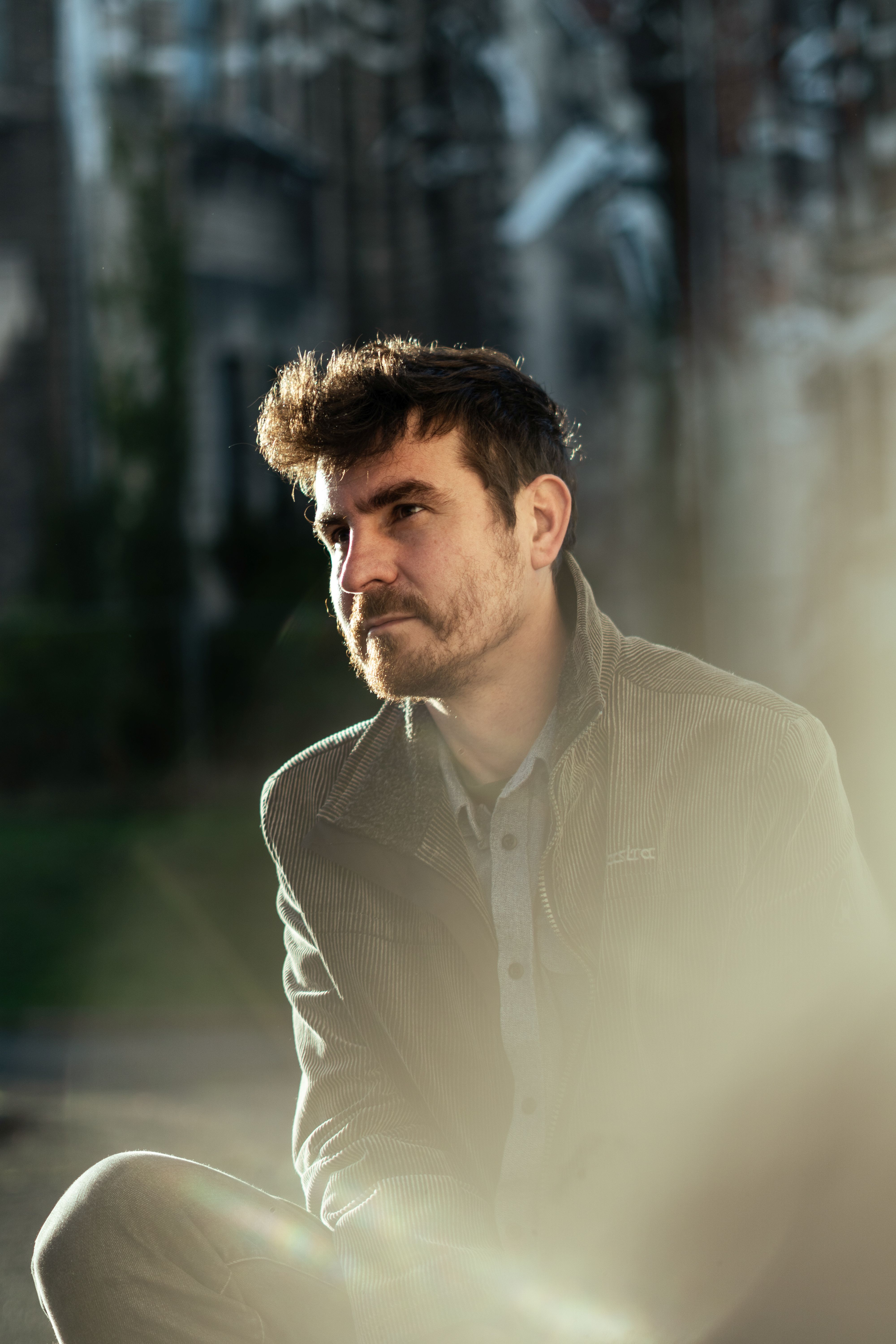
Name: Pavel Tchikov
Occupation: Composer, improviser, multi-instrumentalist, producer
Nationality: Russian
Current release: Pavel Tchikov teams up with G.W. Sok under their duo name of Sopa Boba for the album That Moment, out via Sub Rosa.
Recommendation for his current hometown of Liège, Belgium: Have a meal at Mezcla (Iranian and Iberian food), then grab a coffee at Constantin Café, get a record at Lost In Sound and maybe go to a show at l'An Vert or l'Armande ...
Topic I am passionate about but rarely get to talk about: This album ... Seems I'm the only one in my environment to consider it as an absolute masterpiece... :-)
[Read our G.W. Sok interview]
If you enjoyed this Pavel Tchikov interview and would like to stay up to date with his music and projects, visit him on Instagram, Facebook, and bandcamp.
For a deeper dive, read our earlier Pavel Tchikov interview.
Where does the impulse to create something come from for you? What role do often-quoted sources of inspiration like dreams, other forms of art, personal relationships, politics etc play?
My usual creative process is triggered by a sudden impulse.
Usually it grows for a long time at the edge of subconsciousness, fed by all the variety of events of life - either reflections, emotional experiences, readings, psychological problems, etc ... And then, one moment, all this energy concentrates into one point and takes over to become sounds.
However Sopa Boba was a bit different since it's a collaborative project. There was already that story by Nicoleta Esinencu. Dramaturg Jean Vangeebergen proposed me to work on it. The story reminded me of my childhood. Seems like all the connections between the images from the story and my emotional baggage were already there and were waiting to become music.
On top of that Jean suggested some raw colours and ambiances for each section of the story. So there was a conceptual frame, the emotional charge was waiting to get transformed, the only thing left to do was to work.
For you to get started, do there need to be concrete ideas – or what some have called a 'visualisation' of the finished work? What does the balance between planning and chance look like for you?
It depends a lot on the project I'm working on. For an album such as That Moment, the visualisation of the global shape of the work is crucial.
It's a story, which has a timeline already, it's divided in several acts with different atmospheres, different protagonists ... There should be articulations between the different sections, each part should connect the listener to the next one, there's a message, you have to pay attention to the balance of all the elements in order to keep the attention of the listener so (s)he gets the message, while giving some air for a rest when if needed.
I usually love thinking about the global album while composing smaller sections. Of course there are deviations, because the headroom for surprises is still there, and sometimes the unexpected happens. As a composer I should always stay open to it, cause there's magic in there.
Then those unexpected elements have to be integrated into the whole piece and each element reshapes the global structure each time.
Is there a preparation phase for your process? Do you require your tools to be laid out in a particular way, for example, do you need to do 'research' or create 'early versions'?
The most important thing I need is to experience life. I cannot tell something consistent in musical language if I didn't live some consistent experiences of life. My body and soul have to be charged in a certain way with emotions, which I need to assimilate before they would be ready to pass through the artistic prism.
These experiences don’t necessary need to be new, they could come from the past. But then I'll need to find a way to establish the connections with it. Bring that emotional charge to the present, and in a way live it again.
Other than that, for each work I always like to make something I've never done before. It's a rule and a driving force. At the time when Jean reached out to offer to work on That Moment I was seriously shifting from instrumental to electronic music, but I'd never done a true electronic album yet. In parallel I had been thinking about composing for string quartet for a long time, but dared not commit to it.
So those two “never done” things became the compositional frame for Sopa Boba's new album.
Do you have certain rituals to get you into the right mindset for creating? What role do certain foods or stimulants like coffee, lighting, scents, exercise or reading poetry play?
No, all I usually need is time.
Tell me a bit about the way the new material developed and gradually took its final form, please.
Each album has its own way to get brought to the world. For That Moment, after reading the story, I already had some of the riffs and strings parts in mind.
This time I made all the production with a new hybrid set-up linking Ableton Live with my modular system, which allows throwing new ideas quickly, without thinking about the arrangements, and thanks to its CV integration, without even worrying about the final timbre, even while working with modulars. All the control signals could be recorded and then applied to different sound sources as often as needed. This allows comebacks and adaptations of the old materials to the current musical shape.
This new production set-up allowed me to write sections quickly, which helped keeping the raw emotional charge from the firsts intuitions, and then reshape them if needed during the progress of the work. So every song started with that raw form of basic ideas with no strict arrangement, just enough to allow G.W. Sok to record his first vocal takes.
And from there I will start to work on the real arrangement in order to support the vocals and give them the right background and rhythm. This will point out the deficiencies in the previous arrangement, and open gaps for new ideas to explore in order to solve those problems.
That's where those backs and forths between Ableton and the modular I talked above really come to work. It's also the moment where I'll point out the headroom for some extra ideas to be explored.
What makes lyrics good in your opinion? What are your own ambitions and challenges in this regard?
Fortunately I didn't have to write the lyrics for this project!
It's usually the most difficult part of work for me. I don't have any writing skills, however sometimes I really want vocals for some pieces. So I have to do it, and it's a really hard job for me.
Usually I want the lyrics to be quite open and symbolic, to be connected to something bigger than the word itself. However it's the job of poets, and I'm a musician, so if I can't find a better solution than doing it on my own, I'll try the best I can ... But I'm never entirely satisfied.
I'm currently working on a new solo album of ... pop songs. Well, since I never did it, it should be at least exciting!
Many writers have claimed that as soon as they enter into the process, certain aspects of the narrative are out of their hands. Do you like to keep strict control or is there a sense of following things where they lead you?
It depends on the project. Generally when there are lyrics, I find that they give a very strong direction to the music already. Words have lots of power and energy.
So a very important role of the music would be to define the rhythm. I mean not in the sense of a beat or a pulse, but operating on how the words spread or accelerate over the time ... what impact does this time-stretching do to the meaning, should the music blur the clarity of the message or rather bring it out, what should be repeated and what should be skipped ...
Those are the questions that I would work with while working on some music with lyrics. Which is indeed a more controlled process then getting lost in a modular improvisation. But both are fun !
There are many descriptions of the creative state. How would you describe it for you personally? Is there an element of spirituality to what you do?
I don't really have the words to describe it. And it's probably already a good description. Seems the need for creativity doesn't belong to the rational part of my being. Maybe it's quite the opposite. Seems that my awareness and knowledge can't help at all to figure out the creativity.
For sure understanding the tools you're using and the musical / instrumental theory helps in reaching the results you're going for. However this is more about work than creativity.
Creativity is a baffling impulse from somewhere invisible, which binds you to its energy, want it or not. In that way my artistic creativity is a spiritual activity, since I'm expressing a part of my being that I could not express in a rational way, something I cannot put words on, cause they won’t be right and won't tell it.
Seems it's the opposite force to my rational self, and I'm trying to hang in the centre of those forces. Which in a way seems to be a sort of psychic balance.
Once a piece is finished, how important is it for you to let it lie and evaluate it later on? How much improvement and refinement do you personally allow until you're satisfied with a piece?
Usually it's a long journey to get an album finished.
I like to let time pass and listen to the music with fresh ears over and over, in order to find some details to improve. I get satisfied only when I feel I could not improve anything anymore.
That's probably why I cannot listen to my albums anymore once they're released :-)
In terms of what they contribute to a song, what is the balance between the composition and the arrangement (including production, mixing and mastering)?
The financial reality of being an alternative artist often induces the musician to be the producer as well. I tried to anticipate this quite soon in my career and now, if the project requires it, I think about the production as part of the whole thing at the very beginning of the process, in terms of colours and timbres. And I really enjoy it.
For example, for That Moment, I had a very clear idea of how I wanted the strings to sound in relation to the electronics. This included the mic choices, natural reverbs, panning etc. and has an influence on the production of the electronic parts.
Another example would be a specific modular patch set for a precise section of a song, and that patch, besides its compositional elements, would also already include effects, compression, side-chaining, filtering and EQ … So the production becomes in a way part of the recorded performance.
This is again something I experienced for the first time thanks to that hybrid Ableton – modular set up.
After finishing a piece or album and releasing something into the world, there can be a sense of emptiness. Can you relate to this – and how do you return to the state of creativity after experiencing it?
I usually don't experience this.
Maybe because I always have lots of projects in the queue, or maybe because there's still too much things to do after the piece is finished. All this stuff like promo, booking, administration, rehearsals, etc.
I would love to know a little about the feedback you've received from listeners or critics about what they thought some of your songs are about or the impact it had on them – have there been “misunderstandings” or did you perhaps even gain new “insights?”
One thing I find absolutely genius about Nicoleta Esinencu's “That Moment” is her biting irony. Which gives the story a very important dimension that outpaces the tragedy, and reminds us of humanity through all those absolute inhuman, brutal and cruel scenes.
This irony was always very evident for me and my bandmates. But after our first shows I heard some people talking about it and I realised that they just didn't catch that offbeat humour. I've never looked at the piece from that a bit “too much serious” point of view, and I suddenly realised how heavy and uncomfortable it is to listen to this work if you miss that irony. I never thought about that.
Those people were angry about having received such a charge of “negativity”. Fortunately some people told me that they laughed a lot all through the show.
Do you have things that you are deeply interested in but rarely get to talk about?
I'm always surprised how rarely we're able to speak about death. Well it's probably one of the mysterious and maybe important things in ... life? At least we all have to experience it one day. Maybe very soon, or not.
I often feel uncomfortable asking people about it, and usually feel that others are uncomfortable to talk about it. Some people just don't seem to understand why we should even think about it.
I was very moved by my grandfather's death several years ago. During all his life he was trying hard to avoid the topic, to focus only on rational things, and he was very proud of it. However once he faced his last days, he was completely lost. He just had nothing to help him go through that situation, his entire rational world was collapsing and he was moving in all directions looking for a door to escape. A few days seemed not enough for a man to look in his death's eyes.
This event had a deep impact on me, and ever since I'm trying to keep the idea of death somewhere close to me.
I once heard a philosopher on the radio saying that the aim of art is “to entertain us in order to keep us away from thinking about death”. It blew my mind because for me the experience of art was always connected with the idea of death. I mean not death on its own, but as part of a whole. So I would say that maybe one of the aims of art is to keep us away from entertainment in order to help us to tame the idea of death?
I don't have answers for this, but it seems I feel that the human being has to go towards his death instead of trying to help his mind to escape the encounter with that idea. In any case I think we don't talk enough about it.