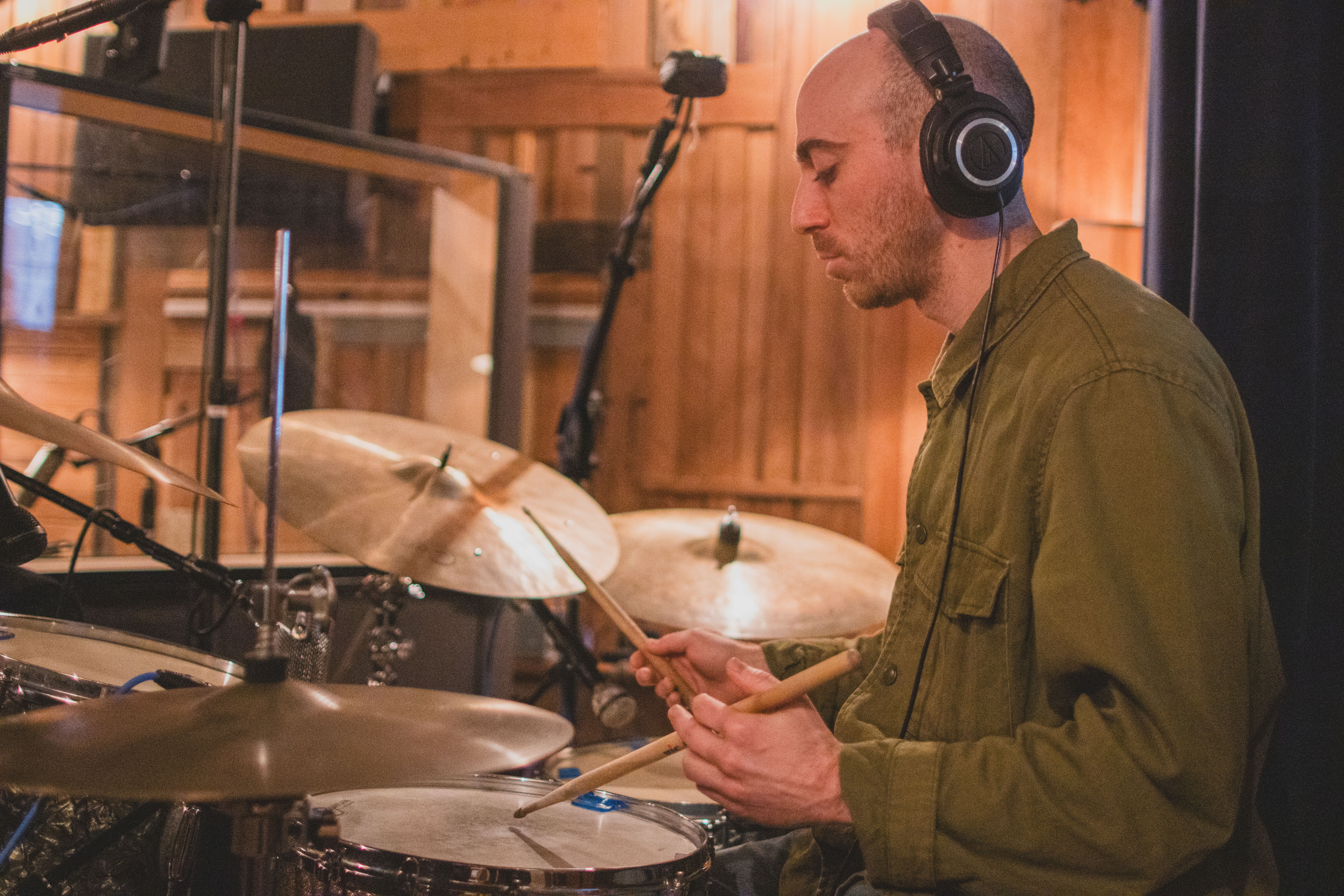
Published
Name: Peter Manheim
Nationality: American
Occupation: Drummer, percussionist, composer, producer
Current Release: Peter Manheim's new album new album Early Waves is out via Nü Bossa. Order the vinyl LP directly via Peter's bandcamp account.
Recommendation for New York City, USA: I recommend taking a walk in Prospect Park (in Brooklyn) during the day. It’s beautiful and often a much needed respite from the overwhelm of the city.
Pure drumming recommendations: I love Korean Samul Nori (사물놀이) Percussion groups. Here is an example of the legendary Kim Duk Soo with his ensemble.
If you enjoyed this Peter Manheim interview and would like to know more about his music, visit his official homepage. He is also on Instagram, and bandcamp.
Peter Manheim also drums in Resavoir. For a deeper dive, read our Resavoir interview.
It seems as though most aspiring artists are drawn to the drums and percussion for one of two reasons: Creating sound/noise and creating rhythm. What captivated you?
I cannot remember the specifics but I have a sense of being drawn to it, thinking it looked powerful and cool.
I was a shy, small kid. I had been taking piano for years but not enjoying it very much. Drums seemed to me more free and fun and also I could actually play the music I liked with them.
I started playing drums at 13 and at that age the music I listened to was mostly classic rock, punk, and metal music. When I first started playing drum set, that is the kind of music I would play with my friends.
When I listen to music, I see shapes, objects and colours. Others experience emotions. Everything around drums, on the other hand, is based on touch, vibration, and movement. Does this mean that your own perception as a listener is also more connected to touch, vibration, and movement? What happens in your body when you're listening?
I had not considered this before. For me, music tends to bring up emotions and thoughts. Not so much visuals. Different music affects me in different ways. My favorite music tends to either bring a lot of energy to my body or help my body to relax.
I was watching a performance of traditional Korean drumming the other night in NYC and it was so powerful. I was very affected. I felt tingling through my body, waves of ecstatic joy, and even emotional release that I suppressed a bit. If I had felt more comfortable to do so, I would have started crying.
This sort of reaction rarely happens, but I relish those moments and they stick with me.
What was your first drum set like and what are you using today? What, to you personally, are factors in terms of build and design that you appreciate in drums and percussion instruments?
My first drumset was a Yamaha stage custom advantage. Definitely a decent beginner rock kit. 22 inch bass drum. Now I appreciate smaller drums. I am often performing in quieter situations, and I can dig into smaller drums, to a certain extent, without them being too loud.
Though the sound is my priority, I love when the drums have deep colors. I have a snare drum that is a beautiful red sparkle. And I often play with a kit that has a deep blue “oyster pearl” wrap. I generally like vintage drums more than new ones.
Late Rush-drummer Neil Peart said: “The equipment is not an influence. It doesn't affect the way I play. It's an expression of the way I play.” What's your take on that?
The equipment is absolutely an influence for me.
For example if I’m playing a rock kit with bigger drums, different ideas will come to me than if I was playing a small bebop kit. I will probably play less rudimental vocabulary - I may play more John Bonham type fills than Philly Joe Jones. The tuning affects my playing too. If the drums are tuned more dead (less decay) then I may play more notes and/or play more precisely.
This all happens intuitively and I generally don’t think about it in the moment. I perform on hand percussion setups too, often congas or frame drums, and setups that are a mix of drums and hand percussion. The sound of the instruments I am using will bring up certain ideas that my mind relates to that sound.
I think Neil Peart's approach to playing different equipment is common, but it doesn't resonate so much with me. If I was touring a lot and performing the same music every night, I imagine I would start to move towards his approach out of necessity.
The drums and percussive instruments are an integral part of many cultures, and traditions. Which of these do you draw from in your playing – and why?
So many …
Jazz Tradition (African American Diaspora) - this is my main influence. So many drummers. To name just a few big influences: Elvin Jones, Roy Haynes, and Billy Higgins.
I was thinking a lot about Elvin Jones when I wrote and recorded “NSS”. I started writing it as a vehicle to play in that (Elvin Jones) style.
Madagascar and Zimbabwe: Shona and Salegy music, were the main influences in my drum part to (the song) “Early Waves”. Though the drums were originally programmed and my influence for that was Principe records from Lisbon.
Moroccan - especially Gnawa music and Chaabi. When I was in high school I was introduced to Gnawa music by a history teacher who knew I was a drummer and lent me a number of CDs from the Essaouira Gnawa Festival. Those really opened up my ears and I immediately fell in love with that music.
Also, I have been playing in a band recently (called Yallah Yallah) with a great Moroccan drummer named Nizar Dahmani and have been learning from playing alongside him.
Korean - I have worked with a number of Korean bands in NYC, most notably Rami Seo’s band. She introduced me to traditional Korean drumming and rhythms.
I have been listening to a lot of Kim Duk Soo in the last couple years. I have not yet found a way to incorporate any of those rhythms in my music but I hope to in the future.
Chicago Footwork - This music, especially by DJ Rashad, DJ Spinn, Traxman, RP Boo, and DJ Manny has been a huge influence for me.
I fell in love with the music after hearing it from a security guard’s phone in the employee cafeteria while working at The Grand Hotel in Mackanaw Island Michigan (playing dinner jazz every night). I had never heard anything like it and quickly became obsessed.
The influences can be heard in “Lost Dayz” and “The Gate” from my EP, and in my drum part to “Pressure” from Early Waves.
I also learned a lot from the late great Senegalese drummer Modou “Mamadou” Sarr Mbengue. He was a close friend and my band was originally created to be his backing band.
He sadly passed away in 2023, but the rhythms he taught me, as well as playing beside him (he played talking drums) were huge influences on my approach playing the drums and bandleading. The new album is dedicated to him.
What were some of the main challenges in your development as a drummer / percussionist?
I had a lot of challenges with chronic pain – especially in my hands, wrist and lower back. It made it very difficult to practice at certain points in my life. It got so bad that it was difficult to imagine a future in drumming professionally.
After many years of this, I eventually found the mind-body approach of the late Dr. John Sarno, which steered me in the right direction. It took a couple of years of diligent work, but I resolved the issues.
[For Dr. Sarno's book Healing Back Pain: The Mind-Body Connection, visit Amazon]
Which practices, exercises, or experiences were most helpful in reaching your goals?
Something that has really helped me reach my goals in recent years was to understand the importance of consistency over quantity and learning to trust that consistent work will lead to improvement. Having resolved the physical issues also has made it easier to be consistent.
Also studying with different drummers has really helped - since moving to NYC I have studied with the great drummers Marvin “Bugalu” Smith and Dan Weiss for extended periods. Both kept me honest and helped me stay focused.
I tend to get overwhelmed by the amount of material I can be practicing and all the areas that I want to improve in. Having someone that I trust tell me what to work on is very helpful in combating these tendencies.
How would you describe the physical sensation of playing the drums? [Where do you feel the resonances/pulse/groove, what are emotional sensations, is there a sense of release or tension etc …]
While I am performing, if I am really in the moment, it’s like I am being pulled. Like I’m surfing and trying to stay on the wave (I’ve never surfed before but it seems like a good analogy).
In general there is a lot of tension and release. Ideally the tension and release are balanced.
How do non-percussion instruments contribute to the overall rhythmic texture of a piece?
Every instrument has rhythmic responsibility. Every note that is played by anyone will affect the groove. When other musicians are not in the pocket, the drummer has to play overly clear – it is difficult and not enjoyable for me to be the drummer in those situations.
Though this is true in any music, it is very clear in my music. I write a lot from the piano and my songs often have very specific keyboard parts that are an integral part of the rhythmic feel. Examples are “Peace Groove,” “NSS”, and “Pressure.”
Dan Pierson, who plays keyboards in my band, is very good at keeping the groove when he switches from these parts to a solo. In “Peace Groove” (the Early Waves version) you can hear how Dan is very intentional in his rhythm during his wurlitzer solo (starting at 2:07).
He plays a lot of rhythmic chords interspersed with his melodic lines and contributes to the groove as much as he was when he was playing the keyboard part. He doesn’t suddenly go to soloing mode and float over the band.
Do you feel that honing your compositional / songwriting skills has an effect on your drumming skills?
I can answer from a slightly different angle: Many of my songs were written with programmed drums. Programming drums is an effective way for me to start a song and get ideas flowing. Most songs from my EP still have those electronic drums, often mixed with live percussion. Example: “Faded”
When it comes time to perform the songs live for the first time, I generally find it difficult to play the drum parts the way I am hearing them. Most of the parts aren’t too technically demanding, but they are written in styles that I am not used to playing … so getting the songs performance-ready has required a lot of practice on my part. From the new album, “Pressure”, “Karo”, and “Early Waves” were all written this way.
I think that this process of learning the parts that I programmed has made me a better drummer. It is also fun and satisfying.
I feel that I become more actualized as an artist. Different parts of my creative personality are interacting and learning from each other.
I've long been intrigued by bands or ensembles where the drummer is the leader and/or main composer. In as far as it is possible to generalise, what do you think changes in terms of the music or performance in these situations?
In my experience, when a drummer leads a band, the focus tends to be more on the sound of the whole ensemble. When the leader is a singer, guitarist, saxophonist etc, the band is generally there to support the leader and make them shine as bright as possible.
The drummer’s main job will always be to support and be the bedrock for the band, even as the leader – we don’t have a choice because nobody else has the power to do it right!