Published
Part 2
What are the spaces/places/sound sources that you find yourself most drawn to?
For this project, I wanted to actually get away from focusing on a physical location, and think about other parameters of space. I also wanted to concentrate on something beyond our normal scope of vision and understanding.
Insects seemed the perfect catalyst for such an exploration. They both exist in a uniquely defined space, and they define that space with their unique existence. Leafcutter ants actually transform large swaths of jungle by, in essence, creating clearings in the overgrowth where the sun can get through to the top levels of their dwellings. They are also underground farmers, using the collected leaf pulp to grow a unique fungus they feed on and use to raise their young.
There’s so much I learned about these creatures, from the structure of their community to the physical spaces they create. They even have a graveyard in their nest! This seemingly simple and contained line of creative inquiry took me deep in the heart of a Costa Rican rainforest, where the biodiversity surrounding these ants was also mindblowing. I’ve never experienced such life.
It was a fruitful framework to work with, to say the least, and a reminder that if we stop to consider something small, we will undoubtedly be lead to something much greater.
Can you take me through the process of realising a field recording on the basis of a project or album that's particularly dear to you?
For this project, I needed to figure out how to record ants. It turns out they make ultrasonic sounds, and to capture this I had to experiment with different recording devices. Listening to a lush jungle with an ultrasonic microphone is an amazing experience, as the insects, for one, truly come to the forefront. Using techniques such as pitching and speed-variating the recordings brought new discoveries as well, as the fast trill of a frog or a bird, for instance, became a rhythmic pulse, like a conga drum.
These raw recordings were put into simple editing software, to extract the most interesting bits. I try to refine the sounds to their essence, filtering out extraneous noises and such, and getting a feel for what they are doing, on their own, and in relation to other sounds from the same space.
Finally, the sound bites were loaded into various sampling machines between me and my musical collaborators, and became ready to be played with and manipulated in real time in an improvisational performance / recording session.
What are some of your considerations with regards to the artistic qualities of a recording?
Our main consideration for this session was to feel like we covered a wide spectrum of emotions. With total improvisation, there is no roadmap. We just go, and the unspoken idea is that we’ll stop when everyone feels like we’ve exhausted some sort of spectrum of emotions, or musical expression (or we simply need a break physically or mentally). The music to develops organically, as it instinctively unfolds in and out of multiple movements.
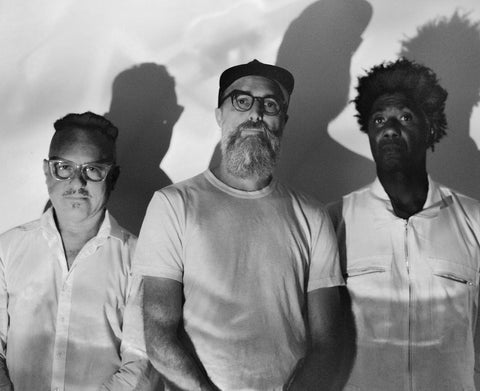
We also set up a large scrim and a projector in the recording studio, so Mia, David and I could watch footage from the rainforest—footage of the ants themselves and the surrounding jungle—while we were performing. In addition to generally setting the tone of the session, the visual cues added another element to the improvisation, so we could in effect live-score the footage we were watching, bringing another layer of interactivity.
Is authenticity an important element for your work? Do you take an issue with cutting, editing, arranging and processing field recordings?
I prefer a mixture of untouched and “touched” material. That’s what we’re doing here—using raw materials and inserting a creative process, so the end result should be something that contains both elements.
I want to both respect the sounds we’re working with, and, to actually work with them.
There is a fine line between cultural exchange and appropriation. What are your thoughts on the limits of using field recordings?
This is a central concern of mine, as I said earlier. Having done this project, and a few earlier projects where I did on-location recording, I’ve found a shift in my own perspective. At this point, I no longer feel comfortable interacting with physical locations in this way, by traveling and field recording. I want to challenge my own process and explore different avenues of experimentation that don’t involve land.
I think focusing on the ants was a step in that direction, but the project I’m currently working on is removed from physical space entirely.
In any event, it’s a very fine line between cultural exchange and appropriation, and it’s likely safer to err on the side of leaving things as they are, not assuming any space, and challenging ourselves to find other ways of defining and connecting to ideas of space and surroundings.
Sometimes, field recordings can uncover surprising similarities between "natural sounds" and elements of human music. How do you interpret these and what is your own view on what connects these two realms and what sets them apart?
Absolutely—I think listening is the connecting factor. Once we really tune into a sound from the natural world (not meaning “from nature” but rather from whatever surroundings we are in), we find all the elements of what we think of as music. There’s often identifiable rhythm, melody, harmony. The system of overtones and resonances that happens with all sounds is a profound connective tissue as well. Human music is natural sounds, refined and focused to produce something that has relatability.
The recordings on this project are as “natural” as we could make them, because we were mixing field recordings and total improvisation. With this process there is no pre-meditation, no “let’s play in this key or at this tempo.” Rather we follow the field recordings, and react to them musically. What are they doing melodically or rhythmically, and what do they invoke in us as reactionary artists?
We try to inhabit the same open and unknown realm as the “natural sounds,” and connect to that space through our own creative nature.
The idea of acoustic ecology has drawn a lot of attention to the question of how much we are affected by the sound surrounding us. What's your take on this and on acoustic ecology as a movement in general?
I am a big supporter of an acoustic ecological viewpoint as it relates to preservation, and shifting peoples’ perspectives. Acoustic pollution is real, as is acoustic conservation.
The more we can realize that our (acoustic) perspective is but one of countless others, the more we can learn to respect our place in the whole.
From the concept of Nada Brahma to "In the Beginning was the Word", many spiritual traditions have regarded sound as the basis of the world. Regardless of whether you're taking a scientific or spiritual angle, what is your own take on the idea of a harmony of the spheres and sound as the foundational element of existence?
I recently attended a talk about the harmony of the spheres, Pythagorean theory of tuning, and overtones. The idea that, because of the universal mathematics involved in sound vibrations and overtones, everything is essentially “playing the same chord” is mind-blowing to me. Somehow it’s both frightening and comforting, that absolutely everything resonates together.
From a spiritual point of view, I like to remember that all of the power and emotions in sound and in music, occurs not because of what is vibrating in the air, but because of what is vibrating within ourselves. We are the receivers, and the vessels for our spiritual experience, or as I like to think of it, the experience of the more-than-human.
Sound is certainly a vital and fundamental element of existence and experience, and today I’m just grateful to be able to participate in that.