Published
Names: Philip Samartzis (PS), Michael Vorfeld (MV)
Nationality: Australian (Philip Samartzis), German (Michael Vorfeld)
Occupation: Percussionist, improviser (Michael), Sound artist, scholar, curator (Philip)
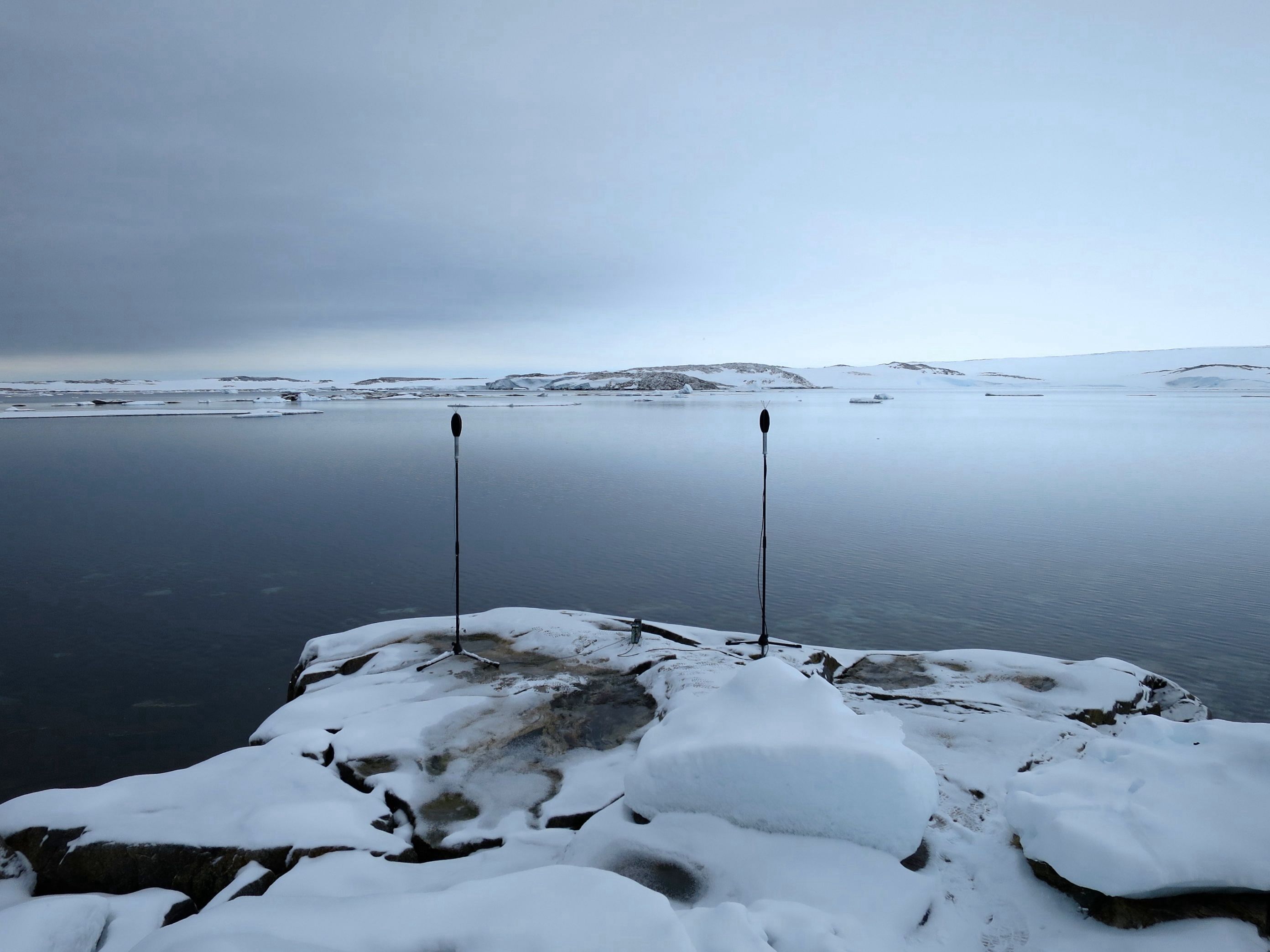
Current release: Philip Samartzis and Michael Vorfeld collaborate on Air Pressure, based on Samartzis's recordings from trips to the Antarctic. The album is out now via Room40.
If you enjoyed this interview with Philip Samartzis and Michael Vorfeld and would like to know more about their music, visit Philip's homepage on the site of RMIT University and the official homepage of Michael Vorfeld.
For a deeper dive, we recommend our earlier interview with the duo about this release and their work in the arctic.
Australia is so much closer to Antarctica than where I am based and the future and health of that continent would thus seem even more immediately connected for you. How would you describe your relationship with Antarctica and how different, possibly, is the medial focus on it in Australia compared to that of international media?
Antarctica holds a unique place in the minds of Australians, reflecting a deep historical and environmental connection. From the expeditions of the early Antarctic explorers known as the “Heroic Age” to recent studies on how the continent affects our climate and weather, Australia’s engagement with Antarctica is well-documented.
This connection has prehistoric roots, as Australia and Antarctica were once joined during the Gondwana supercontinent era. I often reflect on the parallels between these continents—both vast, arid, and largely desert-like.
It is worth noting that the Australian Antarctic Territory comprises 42% of Antarctica, a region encompassing 80% of mainland Australia in size, reinforcing the profound links between the two continents.
The changes on Antarctica have consequences for all humanity. Artists can often feel powerless and as though the actual change lies in activism and politics. What role, if any, do the arts have in this respect?
I believe the arts have a crucial role in addressing the transformations occurring in places like Antarctica, even if that role may feel indirect compared to climate activism or politics.
My work aims to bring people closer to the raw, often overwhelming beauty and complexity of the polar soundscape, which is increasingly affected by global warming. By recording and sharing these sounds, I hope to evoke a visceral response that statistics or headlines alone may not inspire.
Art can connect people emotionally to remote places and their communities, fostering empathy and urgency. While I may not directly influence policies, I believe that art can motivate a shift in public consciousness, making abstract environmental issues feel personal and immediate.
Artists can offer a different way of understanding, helping to bridge the gap between scientific data and human experience that creates a foundation for the public and policymakers to feel compelled to act.
One of the things I notice with field recordings is that context is extremely important – sometimes, even very negative changes can “sound beautiful.” What was that like for this set of recordings?
I agree that context is a critical consideration for the way Antarctica is perceived and understood. The ethereal sounds of the ice and wind can be seductive, yet they often mask serious environmental changes.
For instance, the dramatic noise of a calving glacier is impressive but signals concerning ice loss. Similarly, wind interacting with ice creates captivating sounds, yet these are often tied to shifting weather patterns. This highlights the importance of understanding the context behind each sound; it’s not just about their sono-musical qualities but also what they reveal about environmental changes and their wider implications.
Recording at Antarctic research stations further demonstrates how context influences perception. The mechanical thrum and clatter of equipment creates an industrial soundscape that sharply contrasts with the natural environment. These recordings are aesthetically intriguing, yet they highlight the human impact on this fragile setting.
The juxtaposition of sounds paradoxically underscores the urgency and complexity of ecological changes that researchers are working to understand and address, reflecting both scientific progress and environmental discord.
One of your recent artworks had the title “Listening to a changing environment.” What will these maps capture, what insights will listening to this changing environment offer?
My work in Switzerland mainly focuses on high-altitude alpine ecologies such as the atmospheric research station at Jungfraujoch – the highest continuously operating research station in Europe - and the Great Aletsch Glacier. This high-altitude setting allows me to capture how natural sounds like wind and ice interact with the operational noise of the station. Using expansive recording techniques, I aim to highlight the coexistence of scientific activity and nature, revealing the impacts of climate change on the glacier.
The Great Aletsch Glacier, Europe’s largest, serves as a key indicator of environmental change. My recordings register its various behaviours and characteristics, emphasizing its vulnerability to rising temperatures, and other factors such as the proliferation of microplastics and infrastructure projects. These themes inform a series of soundscapes I produced to illustrate the delicate balance between research and preserving the region's natural attributes, as heard on Atmospheres and Disturbances, available on Room40.
Eco Acoustics: Listening to a Changing Environment, produced with the Verbier 3D Foundation, is a companion sound work designed to be heard while walking between two glaciers in the Valais region of Switzerland. It acts as both a reflection and an exploration of climate change and human impact. Through site-specific mapping, I document the intricate sounds of the alpine landscape, revealing subtle characteristics and changes. Anthropogenic noise—machinery, transport, and industrial sounds—oftentimes encroach upon this rarefied soundscape, altering its ecological balance.
By immersing audiences in these sounds, I aim to foster an understanding of the need for environmental preservation and sustainable practices. This embodied auditory exploration bordered by two receding glaciers aims to connect people emotionally with the environment, encouraging greater care for our natural world.
Can you tell me a bit about the actual trips themselves? What were your impressions and memories?
My memories of Antarctica are etched vividly in sound and space. The vast, icy expanse presents a surreal soundscape where silence is as significant as the rare, oftentimes dramatic auditory interruptions one encounters there.
The persistent winds sculpting the ice create haunting, symphonic melodies that underscore the stark wilderness. The creaks and groans of glaciers and icebergs shifting under their colossal weight offer a constant reminder of the planet's dynamic nature. The research stations, equipped with advanced technologies for monitoring Earth and space, are hubs of activity amid the isolation.
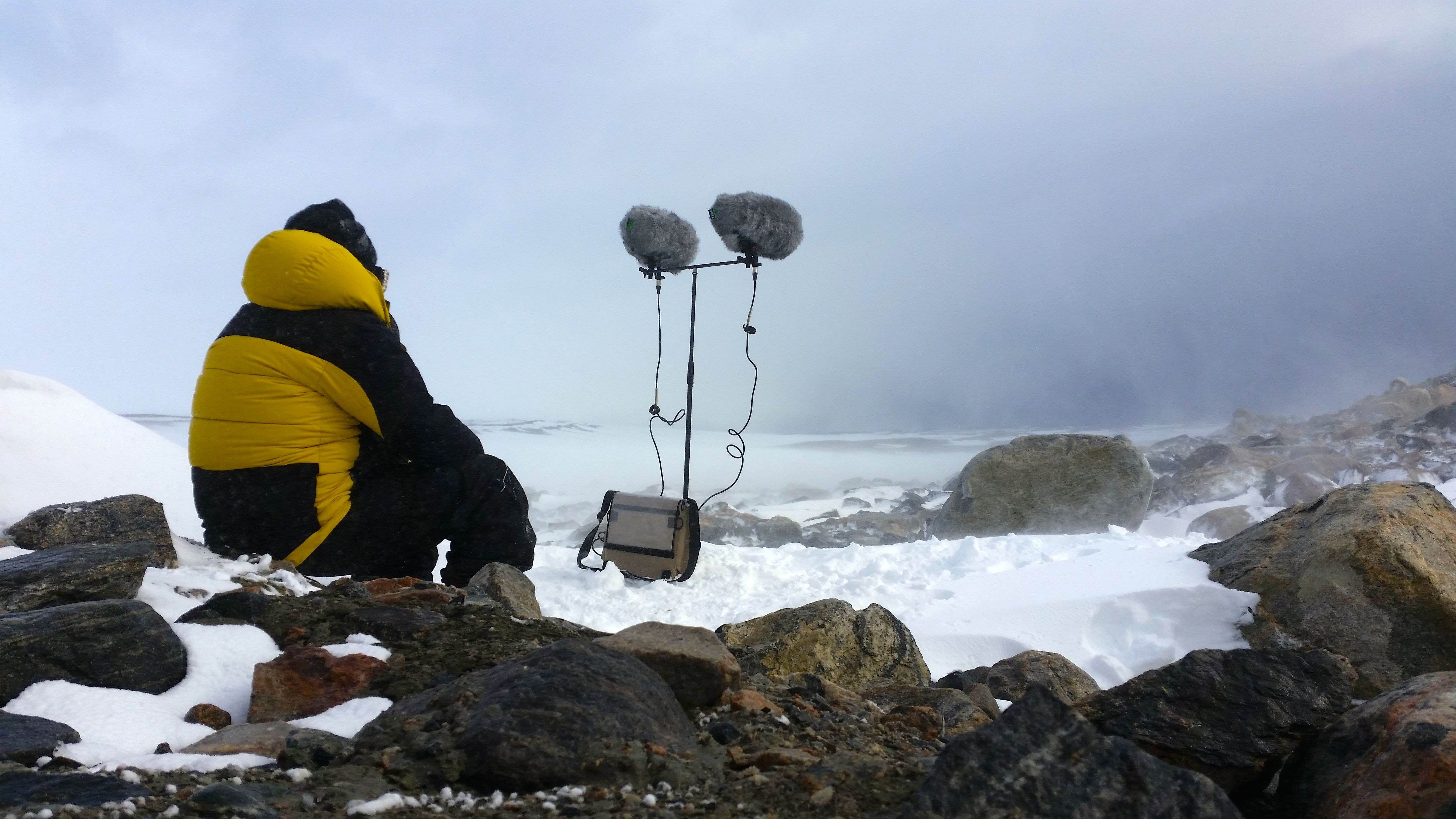
Recording in such an extreme environment is both challenging and exhilarating. The biting cold tests the limits of both the equipment and my endurance, but the rewards are unparalleled. Capturing the patter of ice granuals or the distant thunder of calving icebergs allows me to document the ephemeral quality of this fragile ecosystem.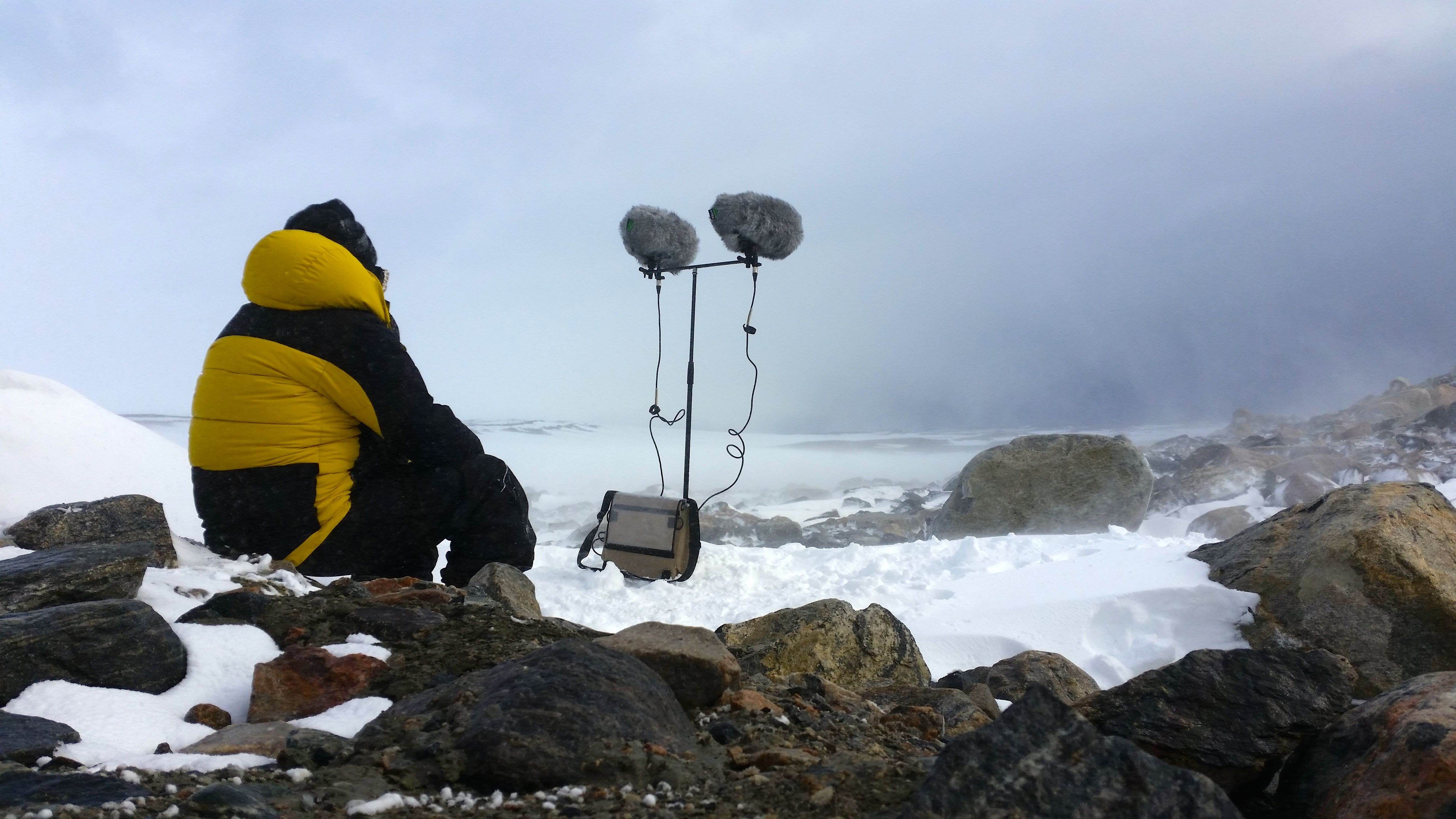
Philip Samartzis recording a blizzard at Jack's Hut
Yet, layered within these natural sounds are the subtle and not so subtle imprints of human presence. The rhythmic hum of research stations and the occasional drone of aircraft introduce anthropogenic elements that punctuate the natural Antarctic soundscape. These serve as reminders of human intrusion and impact, instilling the pristine auditory environment with a discordant edge.
These sounds are more than mere recordings; they are a narrative of a rapidly changing landscape. They speak of resilience and vulnerability, offering insights into the climatic shifts impacting our world. My time in Antarctica has profoundly shaped my artistic vision and sense of purpose, urging me to convey the urgency of environmental preservation through my work.
Was there also an exchange with scientists / climate modellers? If so, what was this like and what were some of the things you drew from this?
Through my interactions with scientists, I gained valuable insights into a variety of phenomena that deeply informed my work. For instance, they explained how subtle shifts in ice dynamics—such as the fracturing and movement of glaciers—are indicators of broader environmental changes. This understanding guided me in using hydrophones to capture the internal sounds of glaciers and icebergs, revealing the hidden yet profound shifts occurring beneath the surface.
Additionally, scientists explained how temperature fluctuations influence wind patterns, affecting everything from local weather systems to global climate trends. This knowledge encouraged me to focus on capturing the nuanced variations in wind sounds across different locations and conditions, highlighting changes that might otherwise go unnoticed. Scientists also introduced me to bioacoustics, highlighting how biological sounds, like those of penguins and seals, can indicate shifts in habitat and behaviour due to climate changes.
These examples underscore the complexities of the Antarctic environment and the critical need to document and understand such changes.
What were some of the sonically most striking places from your Antarctica visit for you personally? How would you describe the acoustic landscapes?
Several locations stand out for their distinct acoustic qualities, but one of the most memorable was recording at the edge of the Antarctic Plateau near Breid Basin. Here, the deep, resonant cracks and booms of shifting, breaking ice were truly powerful. Using hydrophones and acoustic microphones, I captured the internal sounds of the ice, uncovering a hidden, dynamic world beneath the surface.
Another striking location was the expansive ice field near the abandoned US station Wilkes during high wind conditions. The wind here was not just a constant rush of air; it interacted with the ice to create an eerie, symphonic chorus that enveloped me within the environment. The way the wind sculpted the soundscape, sometimes gentle and whispering, and other times fierce and howling, was amazing.
The experience recalls US Outpost 31 – the fictional setting of John Carpenter’s The Thing for the half-buried station poking out of the ice, scattered detritus, and the volatility of the conditions. The cover of Air Pressure features the decaying meteorological building located at Wilkes.
The research stations and scientific instrumentation also contributed significantly to the Antarctic soundscape. These areas were sonically fascinating due to the contrast they provided against the natural environment. The steady hum of generators, the rhythmic clanging of metal against metal, transport vehicles of various types and sizes, and the whirrs of various scientific equipment created an industrial sound layer that spoke to human presence and activity in this remote landscape.
These sounds often intermingled with the natural environment, highlighting the intersection between human endeavour and the expansive wilderness.
One aspect of capturing data is to establish just how acute the situation is in the Southern ocean and Western Antarctica. In as far as you were able to gather insights on this, how acute is it?
From my observations in the Southern Ocean and Eastern Antarctica where Australia’s three research stations are located, it's clear that the environmental situation is becoming increasingly critical. The reduction of sea ice, and the increase in frequency and intensity of ice calving events point to significant ice instability, indicative of rapid glacial retreat. These changes are direct consequences of rising temperatures and shifting conditions as predicted by climate scientists and forecasters.
Wind patterns have also undergone noticeable alterations, affecting both local weather and broader climate systems. These changes in atmospheric conditions highlight the profound impact of global climate shifts on these regions. Additionally, variations in the presence and behaviour of marine mammals suggest disruptions in ecosystems, likely linked to changing ice coverage and habitat conditions.
Though my time in Antarctica has been relatively brief, I witnessed some intense weather events. During my last visit in 2016, I experienced the strongest blizzard ever recorded at Casey Station during the Austral summer, with winds above 100 knots at their peak velocity. The memory of the remote station shuddering from the howling wind emerging from the white abyss remains vivid. This powerful storm highlights the extreme weather patterns that can occur, suggesting significant shifts in the region’s climate dynamics.
Air Pressure features recordings of dynamic weather events including the blizzard at Casey, as well as ones made at Davis Station and at several remote field huts scattered across the Vestfold Hills on the Ingrid Christensen Coast of Princess Elizabeth Land.
I believe you were selected for three Australian Antarctic Territory Fellowships. Does that mean there is still one to go – and if so, what are your plans for that trip?
In 2020, I was awarded a third fellowship to complete my sound map of the Australian Antarctic Territory, which includes a trip to Mawson Station – our oldest continuously operating station - aboard the new icebreaker RSV Nuyina. However, various issues, such as the ongoing impact of Covid on Antarctic operations and the icebreaker's series of mechanical failures, have delayed the voyage.
Despite these setbacks, I'm in discussion with the Antarctic Division to reschedule for the 2026/27 season, and I'm optimistic about the opportunity. This trip will enable me to make new recordings and to compare recordings from previous voyages on the RSV Aurora Australis and of other research stations, providing insights into the technologies and infrastructure in the environmental context of the Australian Antarctic Territory.
My intention is to publish a dedicated website for the project in which audiences can navigate the ice continent through the sound recordings I have produced from my trips to the far south.