Published
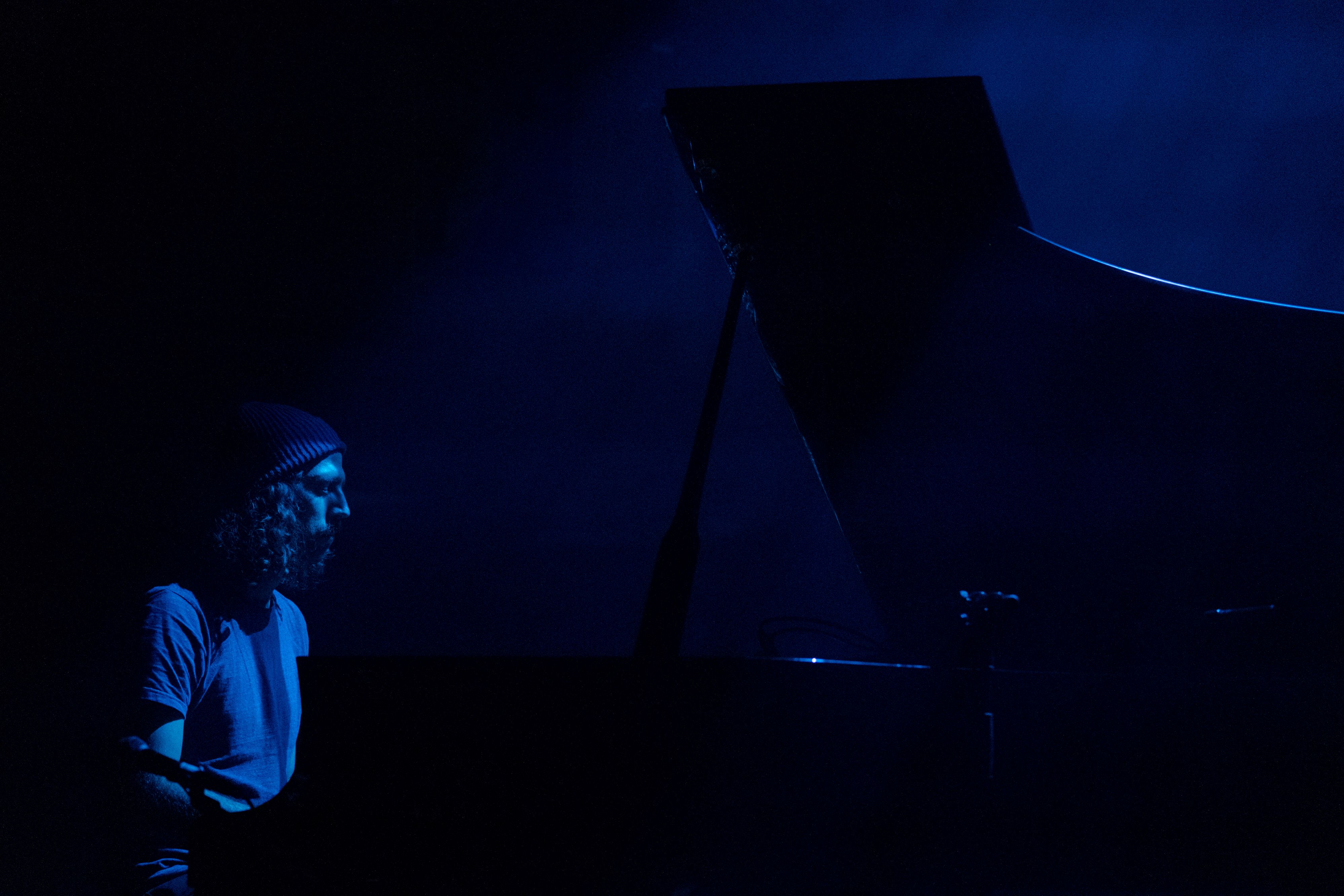
Name: Raphael Loher
Nationality: Swiss
Occupation: Pianist, composer, improviser
Current Release: Raphael Loher's new album Hug of Gravity is out October 17th 2025 via Hallow Ground.
Recommendation for Lucerne, Switzerland: What I love most about Lucerne are the nearby mountains. One peak that I visit several times every year is the Mittaggüpfi.
Topic I am passionate about but rarely get to talk about: I am a great admirer of a musical style called Bulawayo Blue Yodel. It is a mixture of country-western elements with rhythms and melodies from Zimbabwe, South Africa, and Kenya. The yodeling and singing of Sammy Ngaku stir something in me that I have yet to find words for.
If you enjoyed this Raphael Loher interview and would like to find out more about his music, visit his official homepage. He is also on Instagram, Facebook, and bandcamp.
For a deeper dive, read our KALI trio interview, which features Raphael.
Are there examples of minimalism in music – and outside of music - that impressed you early on?
I was drawn early on to the films of Tarkovsky, though I’m not entirely certain they belong to minimalism.
Still, there are elements in his work that echo its sensibility: the long takes where time stretches until it becomes tangible, the sparseness of dialogue, the deliberate and almost tactile attention to sound. Yet what captivated me most, from the very beginning, were not these formal qualities alone but the moods and images he conjured.
The composition of the hotel room in Nostalghia, for example, has fascinated me from the very beginning.
In the way I approach material and subtle variations, Anni and Josef Albers have been touchstones I return to again and again. Anni’s abstract composition Camino Real or Josef’s endless meditations in Homage to the Square are works I can look at for hours, and still they remain inexhaustible. I remember vividly the first time I encountered one of these pieces in person.
In music, a turning point was discovering Morton Feldman’s Palais de Mari. The score of that piece nearly always rests on my piano, a companion I open sometimes just to play a page or two.
Intermission 6 is another piece I return to again and again, one that I not only play but also use as a ground to compose my own versions.
Do you tend to find that, as many claim, “less is more?” Are the notes you don't play really as important as the ones you do play?
I don’t believe this statement is ever simple, because it always depends on the situation, or the vantage point from which something is seen. To have less of one thing is, inevitably, to have more of another.
What matters, I think, is the consciousness of what is left out, the intention behind the omission, and how that gesture creates space for nuance and for subtle elements to emerge.
Do you feel as that making music is a process of adding elements until it is done – or one where you chisel away pieces from something that is already there?
I like it when music arises out of a process, when the process itself determines how the music will sound in the end, rather than me. In that sense, every actor and every material and also the surroundings has a voice, an influence.
At the beginning I try to make certain decisions – small anchors, perhaps – that make it easier not to lose my way and that help shape the choices that follow. And yet there are always moments when those initial decisions must be reconsidered, or when materials appear that had not been imagined at the start. That was the case with Hug of Gravity and the tape machine.
At first, I wanted to work only with the recordings I already had. But somewhere in the process it became clear that this would not be enough, that I needed to transform the material further. In the rehearsal room I had, for a long time, a Revox B77 from my uncle, something I had never really explored. It was during this process that I came to know the machine, making many mistakes along the way – mistakes that would leave their mark on the sound of Hug of Gravity.
So it was both: the deliberate choice of which sounds from the earlier recordings I would carry forward, and the unforeseen arrival of something new through the tape machine.
Many artists are becoming more minimalist in their music as the years go on, focusing on the “essence.” How is that for yourself and how would you describe your development in this regard?
As I described, a process can always turn in another direction if something else feels right in the moment.
I don’t want the course of my development to be guided by terms or definitions, but by the processes themselves, by the way they shift and carry me forward.
What were some of the starting points for Hug of Gravity?
During the pandemic I played ten very intimate concerts in my studio, each for only one or two people, as preparation for the recording of my first album, Keemuun.
For this composition I altered the tuning of the piano with modeling clay, stretching the boundaries of the well-tempered system that has long governed Western music. At the same time, I experimented with different ways of recording the instrument, so that each of the ten performances became its own small universe, documented in a different light.
Later, inspired by visual artists such as Sophie Taeuber-Arp and Thomas Schütte, I carried these ten recordings with me into a residency in the Blenio Valley. There I began cutting and rearranging the material, then transferring the fragments – about thirty pieces in all – onto a varispeed tape machine and back again into the computer.
And when that was done, I dismantled them once more, reshaping and recombining, so I could find new forms, each iteration both a disappearance and a return.
Do you like to set yourself limitations? If so, which were some of those limitations for the new pieces?
For me, it has become essential at the beginning of a process to set a clear framework and definite limitations. These boundaries allow me to dive deeply into different materials, to explore them fully.
I spent around ten years working on various compositions for a solo album, yet I could never finish them, because I would keep working until either I was no longer satisfied with the material or a new idea insisted on coming to the forefront. In that time, very little of my work reached completion.
With Keemuun, it was the first time I worked within a clear limitation: a selection of only ten keys across two octaves. In doing so, I discovered the richness and focus that such a constraint can offer. It was only through this limitation that I could create something like my own universe, a home to which I could always return. And yet, through working on Hug of Gravity, the composition of Keemuun has itself changed when I perform it live. So it is likely that each new work will continue to reshape my view of what came before.
For Hug of Gravity, the limitation at the beginning was that I would work only with samples from the ten existing recordings, using reverb and EQ. But in the middle of the process, the tape machine became an element of its own, introducing new possibilities and unexpected transformations.
Through this way of working, with clear limitations, I can continually create, discover, and develop different fragments of my musical universe, carving out a space – or a home – to which I can always return.
French producer Guillaume Duchastel told me: “Minimalism is about more than owning fewer things. It’s about focusing on what truly matters.“ What are some of your strategies for separating what matters from that which doesn't?
Perhaps it sounds simple, but what it really takes is time. Time to sit quietly and feel, to understand what it is that truly matters.
In my case, I often have a clear sense of what is truly important – both in music and in life. The real difficulty lies in trusting that feeling, in allowing it to guide the decisions I make.
Over the years, I have tried to observe this sense, to pay attention to it, and gradually to trust it more and more.
With so much incredible music instantly available, are you finding that you want to take it all in – or that you need to be more selective? How do you pick the music you really want to invest in?
Because there is an endless amount of fascinating music, I sometimes think it is not so much about the music itself as about whether I am ready to form a connection with an album or an artist.
Sometimes I listen to a wide range of music, exploring and moving between it, and yet there are often long stretches when I listen to the same album or artist for months on end.
During the lockdown, I listened almost exclusively to Karen Dalton and Mark Hollis. When I was in the residency where this album was created, I spent most of my time with Time Waits for No One by Eddie & Ernie and Seance by Maxine Funke.
[Read our Maxine Funke interview]
Would you say that minimalism extends into other parts of your life as well?
I always try to let music come into being through a process. In doing so, life is reflected through music and music through life.
In this sense, everything influences everything else in a reciprocal relationship.