Part 2
Jazz has always had an interesting relationship between honouring its roots and exploring the unknown. What does the balance between these two poles look like in your music?
In general, and especially with the trio I've just set up with Marta and Toma, I'm looking for a playing field that's as broad and inclusive as possible.
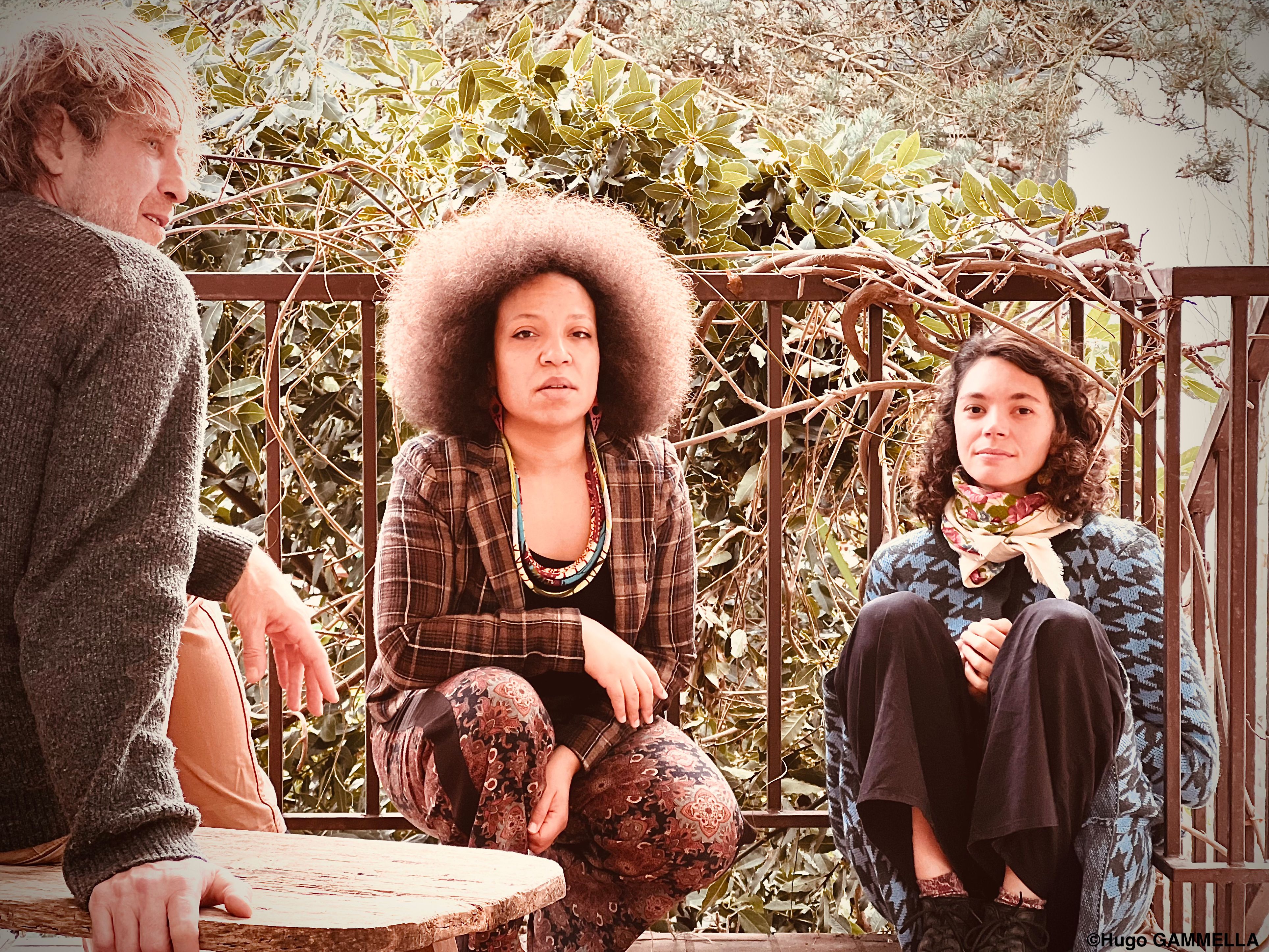
I've surrounded myself with two comrades who are not dogmatic, and the only discussion we had before playing together was about the idea of “etho-centrism,” a notion that Toma's friend Brice Soniano had thought and written about. Our backgrounds are multiple and diverse, and we haven't constructed our work together “against” a particular heritage.
The relationship that the three of us have with our instruments is very broad, and has its own metabolism over time: we have been nourished by traditions, and seek to digest them in order to appropriate them into our own personal vocabularies. This process of re-appropriation extends to stretching the instrumental gesture from the classical to the experimental, and even delving into and reworking the instrument itself.
As far as I'm concerned, I feel as if my bag is packed with all the different languages I've encountered along the way, much like writing instruments, and now I'm trying to invent by drawing with all of my pencils. My sketches aim to preserve the color, taste and smell of my passage, while celebrating the stage I'm at.
When I play, I often get feedback on my incarnation, what I personify. My relationship with music exists in a porous present, no doubt in a search for something extra-musical. I see music as a tool, a means, a locomotion. To soothe souls, including my own. To touch the untouchable. To honor the dead and love the living. To bequeath something beyond myself, something that evaporates.
This is the thread that binds my roots and the unknown.
Derek Bailey defined improvising as the search for material which is endlessly transformable. As of 2024, what kind of materials are particularly stimulating for you?
In my contemporary work, I like to play with references and evocations as material. Equivocal spaces, allusions, the space created by the superimposition of aesthetic planes and their potential interactions crossed by a kind of diagonal listening that creates a relationship between them.
Working in a trio, I love drawing three-dimensional spaces from different perspectives and working on our parallelism or intersections, and the poetic space created by the tension between distances and intersections.
I love what these heritages connect me to, refer back to and pull me into. I allow myself to step out of their frameworks and contexts to make them speak from afar. For me, this represents evocations as much as invocations. I love the multiplicity of perspectives and references created by a simple allusion, the emptiness and the fullness left hovering around it.
In the 7th track on the record, “Roll the Hammer,” I stubbornly invented an imaginary standard, as if washed out by time, with an anachronistic rhythm section, because I liked the tension created on this listening plane.
At other times, in a very free and open improvised context, I like to keep only a few rules of interplay linked to architectural jazz but offering other linguistic material.
The Montreux Festival intends to preserve its archive of recordings for future generations. Do you personally feels it's important that everything should remain available forever - or is there something to be said for letting beautiful moments pass and linger in the memories of those that experienced them?
I'm rather suspicious of the idea of an infinite archive with no time limit. If we say everything, all the time to everyone, we're no longer speaking to anyone.
By aspiring to eternity, we leave behind the continuum of time and crystallize it all into a block of matter without duration or texture. In this quest for the absolute, we lose the act and gesture of transmittal. No more room for desire. Its strong suit is its inconstancy, which gives rise to the care we take to keep it alive. To pass is to let others pass after us and accept losing along the way.
For me, the advent of digital technology may be the advent of an illusion. The illusion that nothing disappears and that everything remains forever, this ideology seems to me to be a new virtual definition of death. Life and death are two sides of the same coin, and even in the 21st century I don't see how we can reinvent that.
In short, I have nothing against the archive, but I'm wary of the infinite cloud. It's an illusion, because when the sun explodes there will come a time when the cloud will disappear too. I'm all for collecting and transferring as long as it's an embodied intention and not a fantasy that in reality suffocates minds and pollutes the planet.
Are there approaches, artists, festivals, labels, spaces or anyone/-thing else out there who you feel deserve a shout out for taking jazz into the future?
The future belongs to everyone. Advancing musical diversity today means connecting, becoming partners, building together and weaving a network. In fact, it's the only thing that has reconciled me with social networking. Theaters and their various players can no longer function alone. Despite our misfortune, this will teach us to work together.
I won't be able to name check the entire constellation here, so I'll just mention those who have accompanied my development in France and supported me along the way. They are not limited to jazz, but have nurtured my approach to it: the labels «Relative Pitch Records» and «Circum Disc», the “Muzzix” and “Zoone Libre” collectives, the “Lagunarte,” “11H11”, “Dédalus”, “Solange”, “Discobole,” “Rêver,” “Haoma,” and “Coax” companies that I had the chance to meet near or far.
In addition, the irreplaceable concert venues such as “La Malterie,” the “Centre Culturel Libertaire” and “les Instants Chavirés”, clubs in Poitiers, Tours, Nantes, Brest, conventional stages, festivals such as “Météo”, “Jazz à Luz”, “Jazzdor”, «Baignade sauvage» …
... creative centers and radio programs that resist all odds, such as Anne Montaron's “À l’improviste” or Christophe Frémiot's “Les oreilles libres”, magazines from “Revue & Corrigée” to «Les Allumés du Jazz» and « Citizen jazz”, and transatlantic networks like “the Bridge”, the colossal repertory of improvised music concerts in Paris that aka JJGFree copiously lists in the “agenda informe,” not forgetting the distribution, programming, workshop and teaching spaces that I've come across on both sides.
The list is still very long, and even here I'm forgetting, I'm missing a lot and I'm afraid of getting my knuckles rapped!