Published
Part 2
How do you feel your sense of identity influences your collaborations? Do you feel as though you are able to express yourself more fully in solo mode or, conversely, through the interaction with other musicians? Are you “gaining” or “sacrificing” something in a collaboration?
In terms of purely musical improvisations, I definitely gain from the interaction with others and many of my favorite musical experiences and “products” are the result of the give and take of musical ideas, of mutual development and sharing.
Self-expression is not really as important to me as the wonderful feeling of creating as part of a dynamic process, and after some of the best improvisations I have an almost mystical feeling that I have been a channel for creative forces outside myself or between myself and others.
On the other hand, a lot of my improvisational work has been creating music for dance, theater, poetry performance and various forms of visual arts (exhibitions, live painting, video and film), whether with other solo artists or companies. In these situations I often work solo, as a multi-instrumentalist and, though I am interacting with the other artists, I enjoy being able to respond quickly, fluently and directly on a musical level.
When you're improvising, does it actually feel like you're inventing something on the spot – or are you inventively re-arranging patterns from preparations, practise or previous performances?
When I am improvising with others, I try to be as free as possible from personal agendas in order to be able to respond directly to them, and prefer having no pre-determined strategies.
If I am playing solo cello without technological support, on the other hand (currently my least favorite mode for improvisation), I will sometimes make at least a mental list of what sorts of materials I would like to use and what the dramatic or energetic development might be. In a group/ensemble setting, the content, flow and development of the music is our mutual responsibility — and belongs to all of us equally.
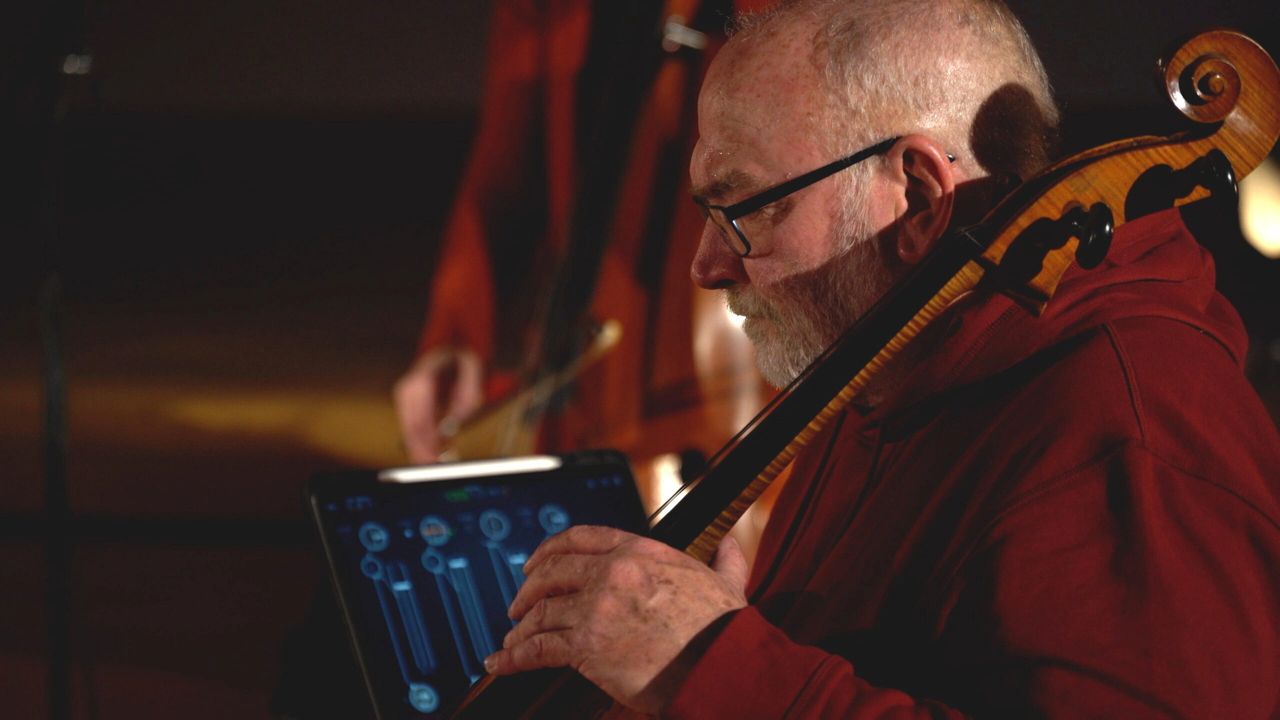
With most of my solo electronic improvisations, a special hybrid situation arises through the use of generative sequencers which I can prepare to an extent beforehand but which present me with sources of randomness and uncertainty, much like responding to other musicians. I can also influence them in real time to provide a sort of dynamic meta-composition which I find very edifying.
In this way I can do a solo performance with modular synthesis which can be a highly complex dance through a world that manifests elements of both solo and ensemble improvisation, both improvisation and composition.
In a live situation, decisions between creatives often work without words. How does this process work?
I assume that my answer to this in the case of a musical ensemble is clear from what I have said. In many of the collaborations with artists from other media, a variety of situations can arise or be agreed upon as to who is following whom and to what extent the process is fully interactive.
An interesting experiment with this was with a painter who worked on a sheet of plexiglas suspended in the middle of the space. We agreed that when she was painting from behind the surface, I would tend to follow her. When she was standing between the surface and the audience, she would tend to follow me.
In general I would say that words and concrete descriptions of processes which have yet to unfold are much less useful, stimulating and creative than just being very aware and in the moment, without a pre-determined plan.
There are many descriptions of the ideal state of mind for being creative. What is it like for you?
I would refer to my statements above about “openness” (both with regard to others and to the creative spirit which manifests itself throughout nature).
One aspect of free improvisation which I cherish and which makes an enormous difference in the way my senses function is when I can eliminate the need for visual awareness (like reading scores, etc.), close my eyes and focus only on the auditory.
My reaction times and musical focus improve dramatically when I am free to just listen and respond.
How do you see the relationship between sound, space and performance and what are some of your strategies and approaches of working with them?
Obviously, if there is a particular disposition of musicians in a performance space or if there are other site-specific aspects, that will influence the extent to which the musicians can interact, how well they can hear one another, etc.
The relationship between sound and space is much more fundamental when we are working with live electronics where sounds can move through space or where the perception of space can be altered with reverbs, delays, panning effects, etc.
Even in purely electronic recorded music, the placement in and movement of sounds through space is a significant aspect of the acoustic experience.
In a way, improvisations remind us of the transitory nature of life. What, do you feel, can music and improvisation express and reveal about life and death?
All of nature testifies to the transitory nature of life far beyond anything specific that improvisation has to offer, and the very real possibility of recording improvisations in audio and video relativizes the volatile nature of such modes of expression.
On a more positive note, good improvisations are often the result of supremely cooperative interactions and as such can serve as an example of what humans can achieve when they collaborate and communicate in a free, open and truly intimate mode of constructive expression.