Published
Name: Stephan Thelen
Nationality: Swiss
Occupation: Composer, guitarist, producer, sound artist, improviser
Current release: After the first volume featuring David Torn, Stephan Thelen teams up with Markus Reuter for Rothko Spaces, Volume 2. The album is available directly from his bandcamp store. About the third volume, he reveals that it
“has already been recorded, based on guitar improvisations by Jon Durant and, on one track, by Bill Walker. The new element that I added in volume 3 was a large church organ, which is interesting because Jon’s grandfather was a church organ designer. Jon and I also recorded a guitar and piano duet in which I played with mallets on the strings inside the piano. That track might be on volume 4, I’m not sure yet. As soon as the series feels finished, I plan to release a box set with all volumes.”
Pre-orders will start December 6th 2024.
[Read our David Torn interview]
[Read our Markus Reuter interview]
If you enjoyed this Stephan Thelen interview and would like to stay up to date with his music, visit him on Facebook, and bandcamp.
For a deeper dive, read our earlier Stephan Thelen interview.
The Rothko Spaces project is not directly about synaesthesia. Just as a point of departure, though, I'd love to know what happens in your body when you're listening and whether you're experiencing something that extends beyond the acoustic.
When I listen to music that I like, I’m usually transported to some kind of a “place.”
This place can be an imaginary landscape or a building or any kind of three dimensional space. This is also why I like to listen to music with good and large headphones that block out the sounds from the outside world: they allow me to concentrate better on the images that are being evoked by the music.
For me, it's not so much about colours, although the places that I “see” do have them. It’s more about the mystery, the emotions and the memories that an unknown place can conjure up.
Have there been instances were you felt a strong connection between sound and something visual? Do you feel a rhythm in paintings or achitecture, for example?
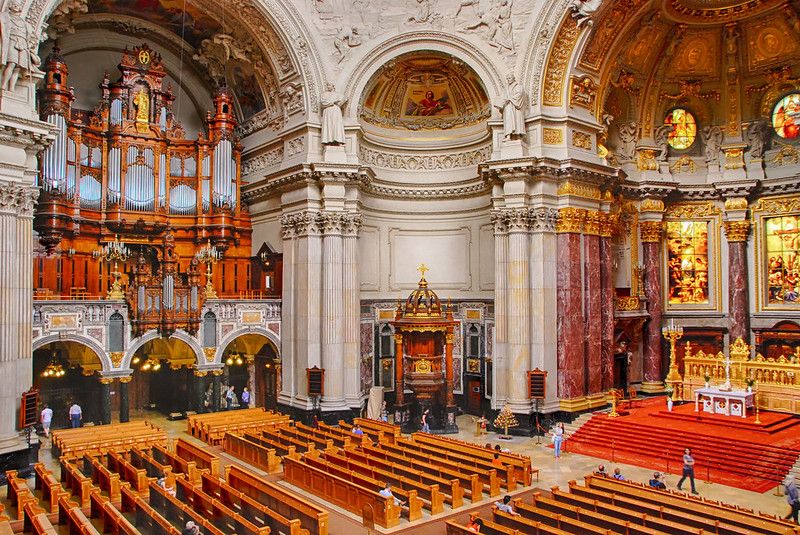
Yes, definitely, very often. I remember well for example when I visited the Berliner Dom for the first time. 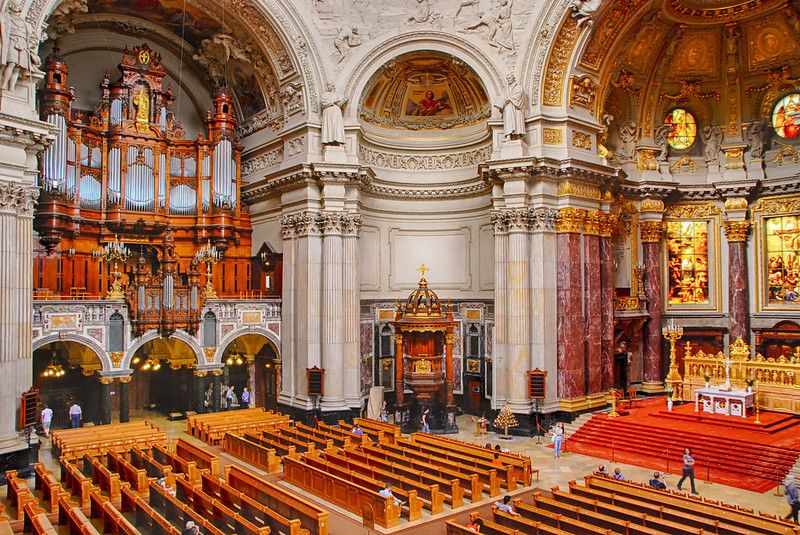
Berliner Dom Photo by Norman Z / Smiley Man with a Hat
I immediately heard patterns in my head that were inspired by the impressive architecture and that were later used in one of my compositions.
In relation to sound, one often reads words like “material”, “sculpting”, and “design”. Do these terms make sense for your understanding of music and your own creativity?
Yes, absolutely. I often work with polymetric patterns for example, and these feel very much like three dimensional sculptures that you could touch and rotate, looking at them from different angles.
For yourself, can you talk a bit about how you're working with the overtones and distortion signals from your guitar or other instruments/tools to shape the music you're playing?
I have always been interested in getting out the overtones of an instrument as much as possible, because they have such an atmospheric character.
In my band Sonar, we based the whole concept on the natural harmonics of guitars tuned in tritones and in Rothko Spaces, the idea was to use distortion and feedback, both very effective ways to get more overtones.
When did you first see a Rothko?
I’m not sure when I saw a real Rothko painting for the first time, but I do remember the first time it really hit me hard and that was at the Tate Modern in London, probably in the early 1990s.
I always thought Rothko was the perfect artist. He lived in Manhattan during the 1950s and 1960s, working in huge lofts. In my mind, that the was the most exciting time and place to be alive. His path as an artist is so inspiring, starting somewhere and then slowly, step by step, getting rid of all unnecessary elements until he reaches the core of what he wants to express.
It’s mind-boggling to me how he creates abstract works of art that are so powerful that people who stand in front of them are in fact moved to tears.
You mentioned that Rothko liked to listen to Mozart. That's interesting - I, as it were, do not “hear” that in his paintings. How about yourself?
Stylistically, I don’t see any real connection between his abstract and modern colour fields and the classical music of Mozart from a different era.
But – if you think of the requiem for example - Mozart’s music does have a tragic side that I can connect with Rothko.
Many painters like to listen to music while painting and I know of many musicians who are inspired by visual cues. How do you think this feedback mechanism between the two worlds works?
I think anything that inspires you in one way can help you be expressive in another way.
A special smell for example can also inspire you to create a piece of music, as Brian Eno has repeatedly said about his ambient pieces.
[Read our Brian Eno interview about climate change]
It's quite intriguing that the album title of Rothko Spaces references “spaces” - Rothko himself was very much drawn to extending beyond the canvas himself. What are some of the qualities these spaces, as differently as individual guitarists may interpret them, share?
With modern technology (reverb and delays), it is very easy to give the electric guitar a very spacious sound and almost every guitarist today has his or her own way of using space in the sounds that they produce.
As a young guitarist, I was very inspired by Pink Floyd’s David Gilmour and King Crimson’s Robert Fripp. Fripp even calls some of his pieces “soundscapes.”
For the first volume of Rothko spaces, you hit upon the idea of combining David Torn's guitar with a string quartet. The way you describe it, this wasn't a conceptual consideration, but more of a gut feeling or what one might literally call a “vision.” I take it the choir in the second volume with Markus Reuter is a similar case. Looking back - why the string quartet, why the choir?
It was more the idea of combining massive feedback guitar à la Jimi Hendrix with a large string orchestra. Those are two sounds you don’t really hear together in our culture. But they were exactly the sounds that I heard in my head when looking at a Rothko painting.
I love string quartets, but here I was hearing a much larger ensemble of strings that included double basses. The guitar feedback part was important because Rothko’s paintings can be – in his own words - very violent.
This is what I was missing for example in Morton Feldman’s Rothko pieces: They are very beautiful, but they are very quiet and subtle pieces and, in my opinion, Rothko can be extremey “loud.”
The choir that I used on Volume 2 was simply because that was what I “heard” in my head when Markus was recording his tracks in Dresden for volume 2.
I'd love to know a little more about the assembly process for the first two instalments. Was it a quasi-improvisational, intuitive one or something more planned and constructed?
The pieces always start with an improvised guitar piece. This might be an improvisation that is based upon a conceptual discussion, but it is always spontaneous. The planned and constructed part comes later, when additional parts are composed around the guitar part.
Of course, I might also edit the guitar performance or only use small sections, which are then looped. “Enigma” from volume 1 is an example where this technique was used.
Since we're talking about spaces here, how did you work with the reverb from the recordings and additional reverb and sound modelling tools to create the acoustic canvas for the music to unfold in?
We always set up a lot of room microphones, especially for the recordings with Markus where we even had microphones inside the grand piano.
But I always also use additional digital reverbs and delays to a very large degree. Among these, specifically for Rothko Spaces, were Equalizer in Logic as well as the Valhalla Reverb. I took the strings from Hans Zimmer Strings.
I have a very pragmatic approach of using whatever sounds best, I am not a purist at all.
The album with Markus is an entirely different beast from the first instalment. Why did you decide to record your parts separately?
The album with Markus is different because his playing was very different. He took the feedback idea very seriously and set up a gigantic sound system that inspired me to try to achieve a huge sound.
The idea to record the guitar parts first and then add the other instruments later was very much part of the original concept. For me, it’s about getting the best out of both worlds: combining spontaneous improvisations (the guitar parts) with the more intellectual process of composition (the strings, percussion and choir).
You shared a quote by Rothko with Markus ahead of the sessions: “Tragedy is the only theme noble enough for art.” It certainly worked – would you say that you agree with that statement and why?
From a very early age, I certainly gravitated towards “serious” music, music that was about expressing deep thoughts and feelings about the mystery of life in the universe. I can enjoy dance music or music with a sense of humour, but the things I really admire are more serious.
So I do largely agree with that statement, although I wouldn’t say that something without a tragic element can’t be “noble.”