Published
Part 1
Name: Sugar Bomb
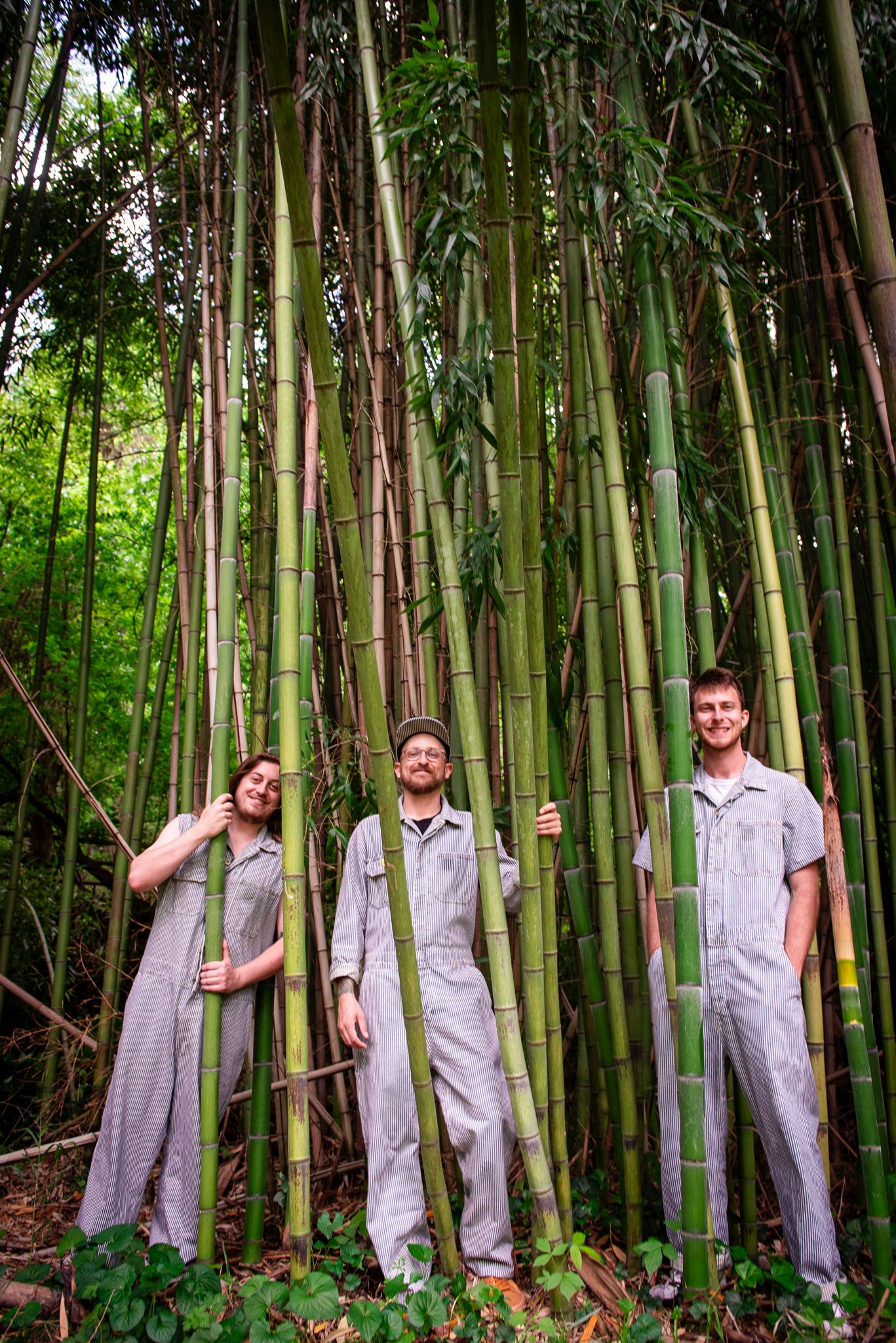
Members: Jacob Bruner (keys), Eli Kahn (bass, guitar), Joe Enright (drums)
Nationality: American
Current release: Sugar Bomb's new Explosive EP is out now. Order the vinyl LP directly from the band's bandcamp store.
Recommendations for Asheville, USA: If you’re ever in Asheville on a Tuesday night, I’d recommend checking out the open improvisation session at Sovereign Kava, led by the band The Lactones (which includes one of the members of Papadosio). It’s a super open format jam where you get 10 minutes with other improvisers - there are no songs allowed and it’s totally free improv. Sometimes it can get super heavy, sometimes it’s ambient, sometimes it’s unadulterated chaos but that’s what makes it great and then 10 minutes later, a whole new thing happens. I think that is a really interesting and special.
Topic I'm passionate about but rarely get to talk about: It seems like the way music in general is being consumed (largely through the lens of social media/video mediums/etc) is really changing the expectation for what music “is” by the listener. If it has chops, the chops must be insane and if it has a theme, the theme has to be hammered into ad nauseum, as though there is less and less room for subtlety because if it’s not grabbing your attention in 3-5 seconds, it’s on to the next thing. I’m sure this has been the case with music as it has evolved over centuries, but the change I’ve noticed in the past 5 years has been really stark.
If you enjoyed this Sugar Bomb interview and would like to stay up to date with the band and their music, visit their official homepage. They are also on Instagram, and bandcamp.
What were some of the musical experiences which planted a seed for your interest in jazz?
Jacob: When I first attended the old Tate Street Coffee jam in Greensboro, NC featuring UNCG faculty and top students I had a total awakening about jazz, live music, and improvisation. It shocked my system and I instantly wanted to learn about playing live improvised music that felt really good and brought people together
Joe: I got my first iPod when I was 10, and my dad loaded a bunch of music on it for me. Included in that was some Dexter Gordon, Miles Davis, and Art Blakey stuff. Though it wasn't really until age 18, my first year of jazz school, that I went deep into jazz. I was blessed to have a lot of mentors, professors, and friends showing me anything from some cool bop album from 1958 or something that just came out yesterday.
And having all my friends be musicians too. You know, we’d party and jam, and throw house shows, and all that. The social aspect is kind of the biggest part of the music thing, connecting through the music. Playing and listening is a very personal experience, but it comes to life the most when it is shared with other people.
Eli: I kind of got into jazz in a super round-a-bout way in middle school - I was a big fan of the weird instrumental tracks that were on some of the Beastie Boys albums and they had this vibe that I hadn’t really heard before (I think it was “Picture This” off of Hello Nasty).
I figured out I really loved the sound of the vibraphone on those tracks and so I went to the library and got some Cal Tjader albums, as well as some other stuff that just looked cool.
From there, I started inching into other facets of jazz, I remember seeing Dave Holland Quintet and The Bad Plus right after I finished music school (I studied classical guitar, not jazz so it was still outside of what I was playing at the time) & from there I just got super into wanting to play that kind of music, but also keeping rooted in my hip hop sensibilities, which got me into other stuff like Roy Hargrove and J Dilla.
[Read our The Bad Plus interview]
What does the term jazz mean today, would you say?
Jacob: It usually has chords with 7th unless it’s reeeally modern. To me, that’s the normie detection protocol of hearing a song with multiple chords with more than 3 notes which is usually something “jazzy”.
For me, Jazz is a story; a really complicated one that is still being written. There’s a long and specific history that goes back as far you like that encapsulates genetic diaspora and philosophy which happened to explode in America during the technological boom when recording and consuming music became accessible. You can point to the 1920s and it means one thing and then the 1940’s and 1960’s it means something a bit different in a defined terms.
Overall, it’s swing (rhythmic diaspora), harmony, language, and improvisation. When you give yourself to it, it only becomes deeper and more profound!
Joe: You could use the term “jazz” to describe a certain era or sound of the music, but to me, jazz is more of a religion, if you will. It's a philosophy to approach music with an improvisational, forward-moving, and experimental attitude.
When people “play jazz,” and it's like some standard played in a way you've heard over and over, and everybody takes turns playing a solo and they all generally follow the same start-small-then-build arc, I don't think that's jazz. That was jazz 70 years ago. I think jazz is and always will be more about the approach to pushing the music, and our feelings and spirits, forward into the depths of the unknown.
We call this group “jazz” because we are doing those things, both compositionally and improvisationally.
Eli: As one of the tracks on Nicholas Payton’s newest album states, “Jazz is a four letter word” and I think it alienates a lot of people - to me, the term doesn’t have a lot of meaning and is more of a description of an approach or philosophy behind improvisational music.
As of today, what kind of materials, ideas, and technologies are particularly stimulating for you?
Jacob: I love my synthesizers! There’s a wonderful YouTube video showing Oscar Peterson playing synths and describing how it affects what you decide to do musically.
Broadly, I consider the internet and consequent distribution of information to be the greatest factor in new musics. Never before has a generation that grew up with iTunes and YouTube been the prominent creative force in new music. Now we have people who grew up with the internet and are able to consume any music ever uploaded and consider all of it in the creative process which absolutely affects future outcomes.
Joe: Electronic music, and the way it has influenced how the drum kit sounds. There’s so many objects to put on drums and cymbals, and combining that with different drum heads, different cymbal stack combinations, bass drum muffling, etc. is infinite and amazing. Also, when you add microphones into the mix, it’s like multiplying that by infinity again.
Eli: I’m a big fan of electronic music / hip hop and the sounds that come from those genres that are seemingly impossible to achieve live, so I always love using effects/pedals to try to simulate sounds that would otherwise be really difficult to achieve.
Where do most of your inspirations to create come from – rather from internal impulses or external ones? Which current social / political / ecological or other developments make you feel like you need to respond as an artist?
Jacob: It’s not really a choice most of the time, but more of a by-product of my experience and dedication. I don’t always feel compelled to create, but when I do it cannot be separate from my experience of a person that dedicated life force to learning music.
I think any time energy is built up or flowing in certain ways, songs just come out because what you know is your outlet. If there’s anything in modern times that I feel give me impulses about creating, it’s definitely themes related to being honest and encouraging radical honesty, finding the beauty in your own unique experience and world, and PEACE for god’s sake.
Eli: For me, a lot of what inspires my writing comes from sitting with my instrument when I practice and trying to evoke the feelings I’m processing through my instrument, whether it’s from an emotional place or from an idea I’m trying to convey.
As far as the band, a lot of it comes from playing in the sandbox and seeing what resonates with all of us.
Tell me a bit about the sounds & creative directions, artists & communities, as well as the colleagues & creative hotspots of your current hometown, please. How do they influence your music?
Jacob: I feel blessed to be from North Carolina as my musical experience has been wildly vibrant and high quality. Asheville in particular has a lot of people with their own vision which is something I greatly appreciate. There are also many communities respecting different musical traditions which is also so important to acknowledge as musicians.
Some styles that come to mind that are alive and well in Asheville are: all things indie/modern, classical, jazz, old time, bluegrass, country, funk, soul, grateful dead tradition, jam band, Irish traditional and I could go on. I feel inspired by it all.
Eli: We’re all based in Asheville, NC which seemingly yields a lot of high energy funk & danceable music. While we aren’t really in that particular lane, I think the ethos behind having music that makes people move still heavily applies to what we do.
Oftentimes we function as a backing band for different artists (such as local songwriter/artist McKinney and Rebekah Todd), which has brought us into some different styles of playing in ways I didn’t really foresee when we started as a trio. I’m really grateful to get to work with these amazing folks that push us in a different direction.
What role do electronic tools and instruments play for your creative process?
Jacob: My phone does everything such as pull up reference songs, find information, write lyrics, write chord charts, annotate song arrangements, show me modern current musical happenings around the entire world including ones near me today. Everything is mostly on handheld computers besides high capacity editing on a computer or something.
I prefer analog everything but I’m a shit organizer so how many songs did I lose in old notebooks and even lost iphone voice memos. F*cking hard drives influence the creative process these days!!! Can I curse?
Joe: Everything. We voice memo our writing sessions. I can record any gig or set with a field recorder. It's really the digital audio thing, I'm so grateful to be around in this time.
What made “Rubber” really sound the way it does, was that we recorded Jacob on the Fender Rhodes through an SP-404 that Eli was tweaking in real time. This set up the album version to unfold as this lo-fi, crunchy thing to bop to (very slowly).
We have a live album coming next year, which we recorded at a restaurant gig. The fact that I can show up with my laptop, interface, and some mics, and create a great sounding album from that, is wonderful. It allows us to be as self-made as possible. We engineered Sweet & Explosive ourselves, and we produced and mixed it ourselves.