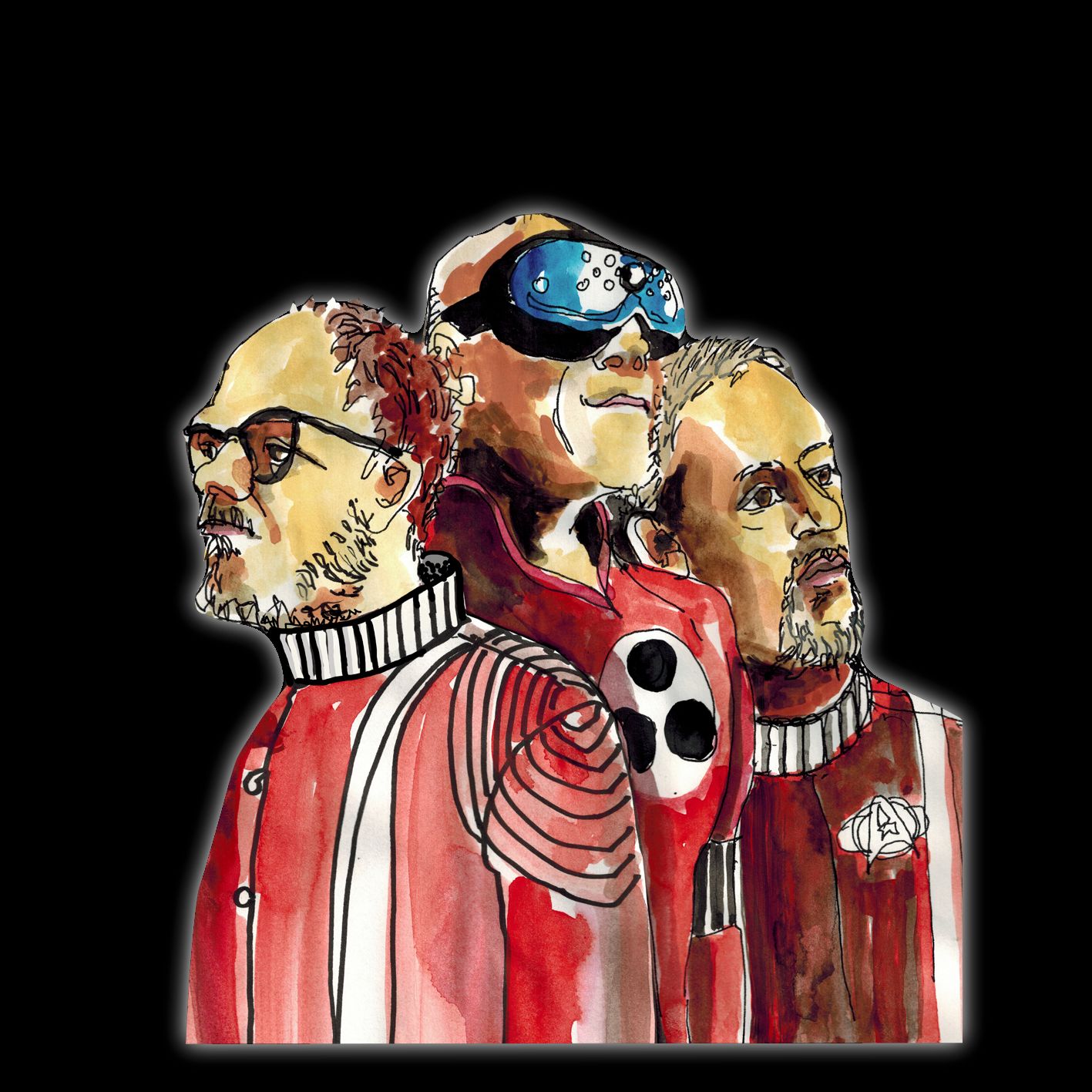
Published
Part 2
Tell me about one or two of your own early Kraut pieces that you're still proud of (or satisfied with) – and why you're content with them.
Andreas: I still like the musical setting of Georg Trakl's “Traum und Umnachtung” (Dream and Insanity). It combines fixed melodies with improvised sound collages, which I think support the text very well.
Leander: When I started releasing music in the mid-1980s, my musical focus was elsewhere, although the use of rhythmic delays and the desire to make the guitar sound different from or more than a guitar were always present.
These elements certainly found their way into Moka Efti's first record, Die Suite, which was released in 1992 but was written in 1989/90. Otherwise, I only really came back to Kraut after the founding of TaboTago in 2015, and I still consider our first CD, Kymatica, to be a successful album.
Bernhard: In this context, I must mention two releases: Blast, which I released with Markus Reuter under the name centrozoon — the double O of centrozoon is a direct reference to Krautrock, by the way …
… and Elsewhere, a solo album I released in 2018. I would describe these as my main contributions to the Kraut case.
Obviously, I don't need to list all the TaboTago releases here, too, do I?
What instruments or equipment are you using to create your music? Are there any vintage instruments that you find essential to get your sound right?
Andreas: I use analogue and digital synthesizers as well as reverb and echo devices. I would describe my homemade analogue synthesizer, which I enjoy using and use often, as a vintage device.
Leander: I have always kept up with the times. I use guitars, basses, various effects devices, software synthesizers (including analogue synth emulations) and, more recently, a digital hardware synthesizer.
I find the “analogue vs. digital” debate pointless. I simply use the best of both worlds, as it makes sense to me. I can understand the hype surrounding vintage instruments, but I don't participate in it. Showing off vintage gear is rather boring to me.
However, I did use a particular pitch shifter from the early 90s (which is already “vintage” for young people) for a long time, and it had a strong influence on what you would call “my” sound. I still own it, but I have since found space- and weight-saving replacements.
Bernhard: For practical reasons, I mainly work with software on computers, so I don't focus much on certain gear. However, from time to time, I desire a particular sound or sound quality. I then try to analyse that sound in order to recreate it using my own methods.
Often, I start modifying the sound already while I'm still approaching the sound I initially aimed for. I do this because, during the process, I understand what I particularly like about the sound I want to recreate, and I realise which aspects I want to emphasise. For me, that is actually the part I really enjoy.
Could you describe your creative process on the basis of your most recent Kraut-leaning release?
Andreas: No, not really. The actual creative process takes place while jamming in the studio. And I can't say what makes it so special.
Leander: TaboTago's latest album, Simulacron, like the band's numerous session releases on Bandcamp, was created from improvisations in the studio.
Bernhard: Well, basically, listening to music is what brings me into that zone.
Another main aspect is creating an environment that enables me to perform in that manner. This environment is essentially a specific software configuration and a set-up of controllers that I can work with very intuitively and ergonomically.
Tell me a bit about the role that improvisation and inventive arrangement techniques (like cut-up) play for your work?
Andreas: Our music is mainly created through improvisation in the studio. We don't really use modern arrangement techniques, except for sequencing.
Leander: Improvisation, live looping and sequencing play a big role, both in the music I make and in the music TaboTago makes.
I found “cut-up” techniques, such as those used by Holger Czukay on his 1979 album Movies with tape, as well as in My Life in the Bush of Ghosts by Brian Eno, or the albums by Loop Guru, musically interesting and exciting.
I find newer techniques that work with sampling and glitches funny, but very tiring to listen to in the long run. Timestretching, on the other hand, appeals to me more.
Bernhard: I start each new track from scratch.
Although the laptop in front of me might suggest otherwise, it is technically empty. What I have is a sort of matrix into which I can play directly. This matrix multiplies, processes and varies what I am playing. This method enables me to compose and arrange in real time. This also enables me to react to what my co-musicians are doing.
Ultimately, it isn't a certain keyboard or sound I am playing can be considered my instrument, but the entire setup I use to create music.
I got into Kraut via Tangerine Dream and early Ash Ra and to me, the motoric beat was never quite as important. Today, it seems as though it's the defining element. Are you interested in it? Are you making use if it? What makes it special to you?
Andreas: No, I don't use the Motor Beat. Everything is still much more static for me :-)
Leander: I've always liked the Motor Beat as a repetitive element that emphasises the meditative character or a certain expansiveness in the music. I also like it because it's less about virtuosity on the drums and more about laying down a steady rhythmic foundation.
Coming from Jazz, Jaki Liebezeit said: “I want to play monotonous. There is something new and a challenge in that.“ I've used the Motor Beat less in the past, but it will be found in some current pieces that have not yet been released.
Did you ever visit one of the birthplaces of the genre – Berlin, Düsseldorf, Munich – or any spaces related to the history of Kraut? Do you own any paraphernalia from the era?
Andreas: Yes, I live in Berlin and have been to a few concerts. I own a reel-to-reel tape recorder from that era. An AKAI GY210D with a Hi-Com noise reduction system that was retrofitted.
Leander: I grew up in the Lower Rhine region near Düsseldorf and have been living in Berlin since 2000. However, I can't say that I feel the “Kraut Spirit” in either of these two cities, neither then nor now. Perhaps it would be different if I had been born 10 years earlier.
Since I'm not into museum-like thinking and collecting, I don't own any paraphernalia from that era.
Bernhard: I once walked past the house in Schwäbische Straße, Berlin Schöneberg, where Edgar Froese and the likes used to live. I must admit that I wasn’t really overwhelmed. It was just an ordinary Berlin house in an unremarkable, calm neighbourhood. But I probably prefer it this way, rather than finding out that it's become another overrun tourist attraction.
As it happens, the house I live in also has a certain Krautrock history, as it is said that the first record by the band Ton Steine Scherben was recorded here in one of the rear buildings. In any case, it's hard not to come across places related to Krautrock in Berlin.
Several of the original Kraut pioneers recently passed away or withdrawn from making new music. If some of your personal favourite artists were affected as well – can you share a little what did their music meant and means to you?
Andreas: Tangerine Dream was one of the most important bands for me. With the death of Edgar Froese and the subsequent personnel changes in the band, the musical character of the band was lost for me.
Leander: TaboTago was launched in 2015 immediately after the death of Tangerine Dream founder Edgar Froese, because the three of us realised that we were strongly influenced by the band's music, independently of each other. We wanted to express that.
In principle, nothing has changed in that regard, even though we have developed our own sound and our own working methods over the past 10 years.
Bernhard: Klaus Schulze, Edgar Froese and the likes - these were all icons. I would even call them teachers or mentors, although I never met them personally. They paved the way.