Published
Name: Dig Dug Dug
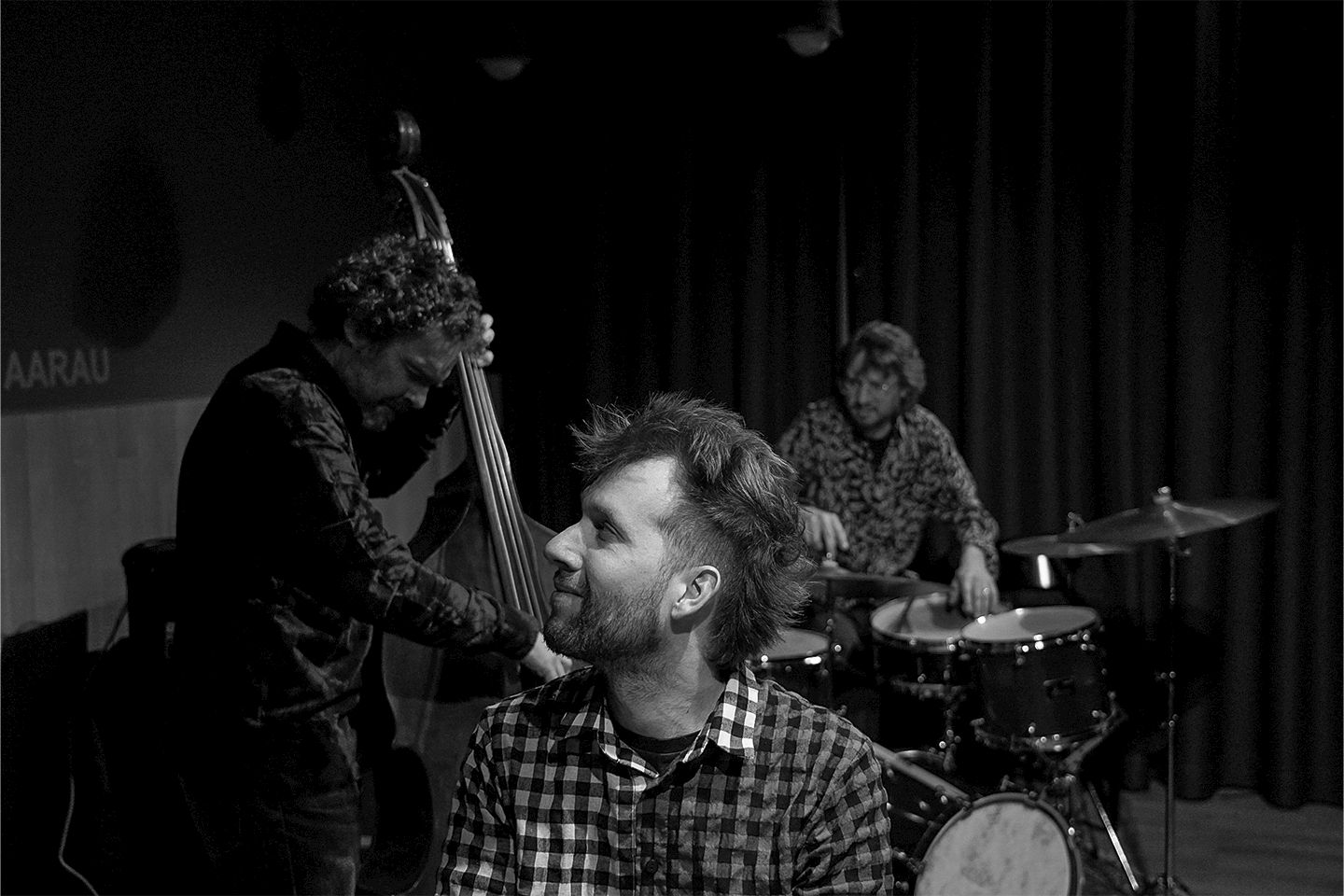
Members: Thomas Florin (piano), Baenz Oester (double bass), Samuel Duhsler (drums)
Interviewee: Thomas Florin
Nationality: Swiss
Current release: The new Dig Dug Dug album Insolence is out via Unit.
Recommendations for Geneva, Switzerland: Listen to any concert at Cave12, or Urgence Disk, it keeps your mind always open to surprises.
[Read our Baenz Oester interview]
If you enjoyed this Thomas Florin interview and would like to know more about his music, visit his official homepage. He is also on Instagram, Facebook, and bandcamp.
When did you first consciously start getting interested in musical improvisation? What was your first improvisation on stage or in the studio and what was the experience like?
Like many small kids, I was improvising songs in front of my parents when I was around 3-4 years old. Then later, when I started piano lessons around 9, I was changing the rhythm of classical pieces, every time in a different way.
My first concert improvising was with the first jazz combo class I took at AMR (Geneva), when I first discovered this music, around 13 years old. It felt great, especially the part of the unknown and unexpected.
It was then that I understood how much I need to surprise myself all the time while performing.
Tell me about your instrument and/or tools, please. What made you seek it out, what makes it “your” instrument, and what are some of the most important aspects of playing it?
I don’t consider myself as a very virtuosic piano player. I’m in fact pretty limited. But luckily I realised that I love to express myself in a «limited» range of tools.
More specifically, I’m developing a range of tools in harmony / reharmonising, rhythmical figures, and specific gestures (along with rhythmic patterns) language, as well as some extended techniques inside the piano.
I’m also using an electronic extension called «CtrlKey» in other projects.
How would you describe your own relationship with your instrument – is it an extension of your self/body, a partner and companion, a creative catalyst, a challenge to be overcome, something else entirely?
It took time to feel a sense of proximity / extension of my self with the piano. The fact that the contact with a piano is in fact «distant» didn’t help (pressing a key which moves a hammer before hitting a key).
I started to play the trumpet when I was a teenager, I fell in love with the much more «direct» link I could have with an instrument. With a lot of practice, I could later find this link with the piano, but I had to do a detour through an other instrument first.
When you're improvising, does it actually feel like you're inventing something on the spot – or are you inventively re-arranging patterns from preparations, practise or previous performances? What balance is there between forgetting and remembering in your work?
I feel is it mostly on the spot, but made possible thanks to a «know how» developed through practice and playing.
But unavoidably, their are some repetitions happening, since playing is a slow evolution towards new and unknown material.
Artists from all corner of the musical spectrum, not just “free jazz” have emphasised the importance of freedom in their creativity. What defines freedom for your improvisations?
I find my own freedom in being connected to and trusting my own enjoyment / pleasure while performing.
In Dig Dug Dug, I totally feel this coming from the other musicians as well, and this is, I think, a key element of our joyful and generous music
Taking your recent projects, releases, and performances as examples, what, would you say, are the key ideas behind your approach to improvisation?
It depends on the project / band, each comes with a different language (for instance I’m also playing in more «contemporary» improvised projects like Re-Ghoster).
With Dig Dug Dug, I’d say I’m really in a jazz-context, diluted with a more sonic/textural approach.
Within my compositions (like “To Breathe”), or jazz standards (“Making Whoopee”) on our latest record.
In your best improvisations, do you feel a strong sense of personal presence or do you (or your ego) “disappear”?
I’d say that from my perspective, the best improvisations are made of the «purest» choice / decision within a musical context.
This can both mean a strong ego / personal presence or taking a step back. It all comes down to listening and taking decisions.
What are some of your favourite collaborators and how do they enrich your improvisations?
Apart from my band mates Bänz Oester and Samuel Dühsler, I love to play with Nicolas Field (drums and electronics, in Re-Ghoster, FDF trio).
Some of my favourite impro-partners are Nate Wooley (trumpet, in Re-Ghoster Extended), Yasuhiro Yoshigaki (drums), Shinpei Ruike (trumpet, we have a duo album called «Hazardous Communication».
Each improvisers has his/her own way of listening, reacting, and has a different taste (= language).
[Read our Nate Wooley interview]
In a live situation, decisions between creatives often work without words. From your experience and current projects, what does this process feel like and how does it work?
I rarely talked with improvisers in general (and I didn’t encounter many improvisers talking with words), and somehow I don’t feel a need for it.
Stewart Copeland said: “Listening is where the cool stuff comes from. And that listening thing, magically, turns all of your chops into gold.” What do you listen for?
In a really weird way, I spend very little time listening to music (recordings), but I try to go to concerts as often as possible.
But talking about my own listening in a playing situation, I 100% agree with this statement.
There can be surprising moments during improvisations – from one of the performers not playing a single note to another shaking up a quiet section with an outburst of noise. Can you tell me about such situations from your own performances and how they impacted the performance?
Suprise is an absolute required element for me while playing in any situation, I think. Surprising myself, the others artists, the audience.
I feel surprise is almost inseparable from improvisation.
As a listener, do you also have a preference for improvised music? If so, what is it about this music that you appreciate as part of the audience?
Live improvised music as a listener has something special for sure, especially in the way something unexpected is shared between musicians and the audience simultaneously.