Published
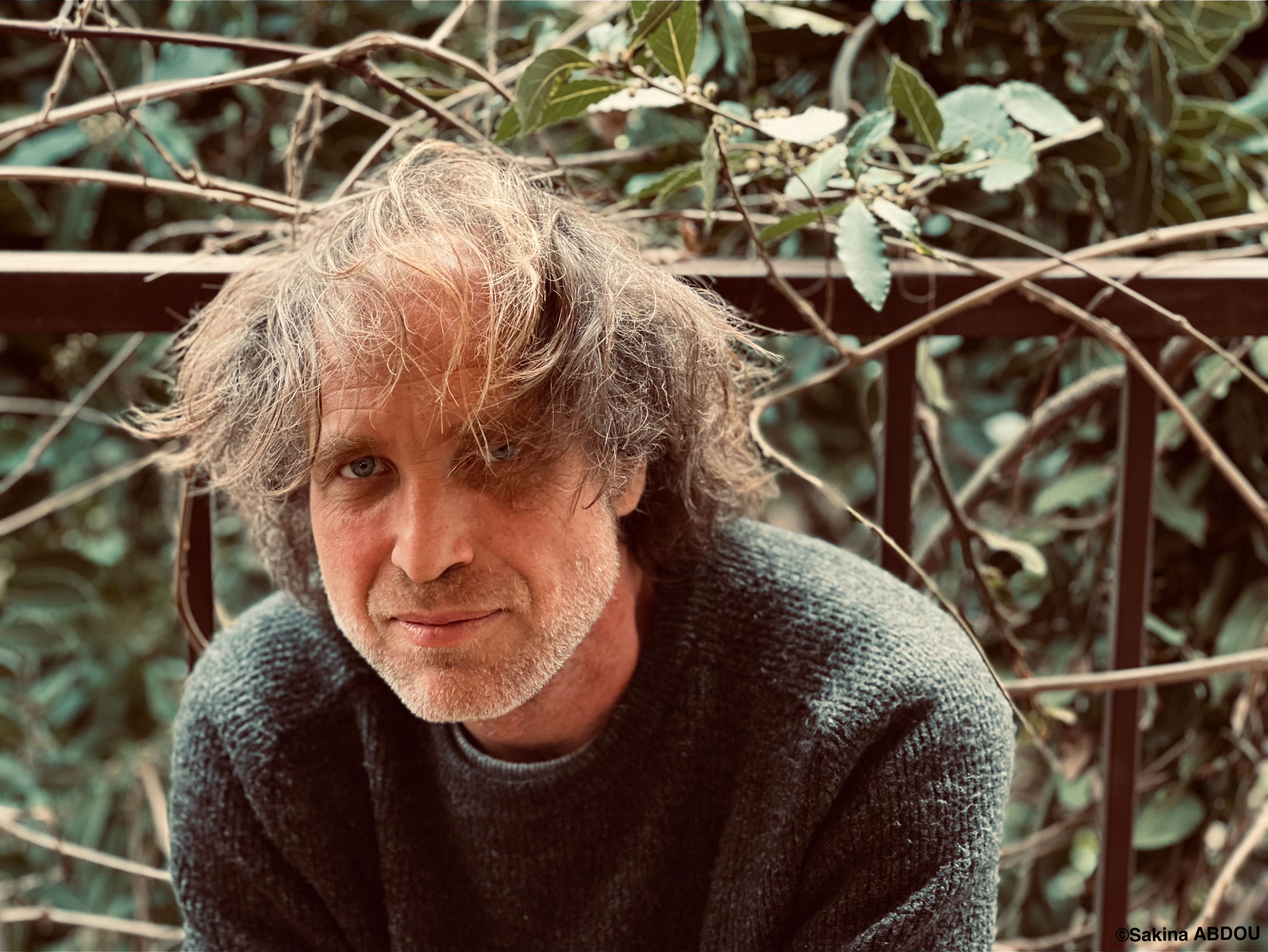
Name: Toma Gouband
Occupation: Drummer, improviser
Nationality: French
Recent release: Toma Gouband teams up with Marta Warelis and Sakina Abdou for the album Hammer, Roll and Leaf, out via Relative Pitch.
[Read our Marta Warelis interview]
[Read our Sakina Abdou interview]
[Read our Sakina Abdou interview about Directions in Jazz]
If you enjoyed this Toma Gouband interview and would like to find out more about his music, visit his official homepage. He is also on Instagram.
What was your first drum set like and what are you using today? What, to you personally, are factors in terms of build and design that you appreciate in drums and percussion instruments?
I started drumming by putting together a set of pots that I placed on the ground. I have a very joyful memory of that moment, a real celebration.
After that, I got a snare drum, then a traditional drum kit with a bass drum, snare, toms, cymbals, and hi-hat. Traditional drum kits are really the product of industrial standardization. By nature, a drum kit is a gathering of percussion instruments that can be played with all four limbs. Anything goes! The pioneers of this instrument, musicians and engineers, were very inventive, and I believe that preserving, or even reclaiming, that inventiveness is essential.
After returning from a trip to the Baka Pygmies, I felt the need to change the geography of my instrument, while retaining its essence of being able to play foot/hand coordination. This led me to play a horizontal bass drum and to find solutions to make it playable: modifying the hoop and the pedal’s striking direction. I was mainly looking to receive sounds and a setup that made me eager to play.
After some exploration, I also modified the instrument played by my left foot and replaced the hi-hat with a pedal striking a resonant stone. Later, I reintroduced the hi-hat, which I consider one of the greatest inventions for the drum set. The bass drum offers a larger playing surface than a snare, which opens up possibilities …
The snare is a complex subject, directly tied to military drums. I also searched for a snare sound that suited me, less metallic, with other ways to create a buzz: for instance, just placing a few small stones on the drumhead can fulfill this function. But this topic is endless and constantly evolving. What I find essential is to play an instrument that resonates with us personally …
The question of the instrument involves not only the drum or surface we strike or rub but also the tool we use to make that gesture. There are more options than sticks, brushes, or mallets. So, for the brush function, I started using leaves and branches, and to play resonant stones, I used pebbles, which led me to develop other techniques. It's hard to do a roll with pebbles, but it’s possible to find other movements and adapted techniques … the discoveries are endless.
Late Rush-drummer Neil Peart said: “The equipment is not an influence. It doesn't affect the way I play. It's an expression of the way I play.” What's your take on that?
I believe everything is connected; in a sense, the material itself contains gestures, it invites certain rhythms, certain speeds. Our approach to the material will lead us to play in one way or another so it resonates. The movement adapts to the material … it's more about the level of adaptation to the instrument that allows us to express ourselves most freely.
And, of course, there are rhythmic phenomena. A 3-for-2 rhythm will always be a 3-for-2, regardless of the instrument. If we try to play a 3-for-2 in water, we’ll have to adapt to the resistance of the water, and we won't be able to play as fast as in air. If we play in a very reverberant space, we’ll also adapt our speed so the music can be. The same rhythm can be played in countless ways, and the acoustic, instrumental, and contextual influences are very impactful.
I often wonder if we would play the same way on another planet, where sound propagation and gravity differ from those on earth …
Drumming is an integral part of many cultures and traditions. Which of these do you draw from in your playing – and why?
I am, of course, influenced by all kinds of music, everything I hear. These are languages with distinct accents and words.
However, it's true that 3-for-2, binary or ternary swings exist in all cultures; it's the placements and grooves that differ. So behind all music lie common phenomena. And it’s this that interests me, the source phenomenon of rhythm. Sometimes, in improvisation, we discover territories that remind us of a particular type of music, even though it wasn’t intended. In this case, we connect with the same source that created a similar image, leading to a similar type of landscape.
I also think there are many forces beyond us that we’re not necessarily aware of; music is deeply mystical, transcending all times and spaces. The constant beat of a "boom boom" is phenomenal – no matter the culture or place, it affects the body and consciousness in the same way. I am, therefore, more interested in the phenomenon than in the style.
What were some of the main challenges in your development as a drummer/percussionist? Which practices, exercises, or experiences were most helpful in reaching your goals?
I studied jazz drumming, but also various other musical languages. Speed and technique were a priority, much like an athlete’s approach. For that, I had to study marches, the traditional drum. I also had to understand the playing of predecessors, studying and analyzing their language. I transcribed all the great jazz drummers ...
At the same time, independence between the limbs has always been a passion, so I spent a lot of time studying polyrhythms. To be able to play them, I tried to represent them, finding imagery to embody them.
Freedom on the instrument has always been a strong motivation to keep working on difficult exercises. I love this process where you struggle with an exercise, it seems insurmountable, you try and retry, very slowly, until the moment when you get it, when everything becomes simple and obvious. At this point, you assimilate it, and it becomes part of your language …
What do you think you're doing different than other drummers?
I don't know; I think everyone is unique, but not everyone allows themselves to be unique. I've always loved climbing trees because I knew no one else had been there before, and there was something new to discover …
I approach music in the same way … discovering unexplored places …
How do you experience the concepts of "groove," "swing," and "rhythmic feel" in music?
I love when the rhythm is alive and retains its mystery, whether free or within a tempo …
What is the relationship between harmony, rhythm, and melody? How do non-percussion instruments contribute to the overall rhythmic texture of a piece?
Rhythm and melody are the origins of music; melody makes the rhythm sing, and rhythm structures the melody. They work together.
Every manifestation of music is rhythmic, and this isn’t exclusively the function of percussion instruments; many improvisers have shown that a piano or a guitar can become percussion.
But the melodic sense, even in a purely textural context, seems essential to me. One way or another, the music must sing, even if it’s just whispers and creaks.
Different drums have a distinct sound, and drums and percussion are also timbral instruments. What drum sound are you aiming for, and how are you making use of the timbral potentials and possibilities of your instruments?
Explore, search, find combinations of gestures and materials … The vocabulary of gestures builds up gradually, each discovery integrating into the language being constructed …
I love discovering a material, a surface, finding its acoustic openings, trying to make it sing. Let's try playing with just what's around us, water, ground, air … music is possible on any medium.
In relation to drumming, Stewart Copeland said: “Listening is where the cool stuff comes from. And that listening thing, magically, turns all of your chops into gold.” What do you listen for?
Listening is the most complex subject. Listening has multiple forms; all senses can listen. Listening is presence and letting go, a trust, and listening is also a non-listening.
We don’t only listen to sound or placement; we listen to everything that vibrates …
Do you feel that honing your compositional/songwriting skills has an effect on your drumming skills?
Yes, definitely. I compose using generative graphics whose source is polyrhythmic, which greatly influences my language. I think there’s an infusion of all our research in our playing and our discourse in improvisation.
I believe it’s very important to do research; composing is searching in a time less tied to the moment than playing.
How has technology, such as drum machines and sequencers, impacted the way rhythm is created and perceived? Has it been a concrete influence on your approach?
Yes, of course, technology is a tool, and the results reveal other possibilities.
I don’t work much with machines, but I keep these sounds in mind, which resurface in an acoustic playing context.
Physical strain is a particularly serious issue for many drummers. How does it manifest itself, how do you deal with it, and to what extent does it affect your creativity?
Playing music shouldn’t be painful; if it is, then the approach is wrong. It’s possible to play fast, loud, and long with a relaxed approach; this is part of technical learning.
Tension in the body is not good, no matter the music. It’s more of an awareness than a workout.
Many recording engineers have remarked that the drums can be particularly hard to capture. What, from your perspective, makes drums sound great on record and in a live setting?
I've worked with very skilled sound engineers to capture my sounds. There are good sound engineers and less skilled ones; it’s a matter of listening and technical ability ...
Often, only a few microphones are needed. I remember an exceptional recording session using three overhead mics, two in front and one in the back ...
Drums and percussion are remarkably often used for physical therapy / healing. What, from your point of view, makes them particularly suitable tools for this?
It’s a primary function of music, and each sound derived from a material has its own power over the body. The drum is particularly powerful, as are crystal and resonant stones. Some people have the knowledge to identify which sound affects specific parts of the body and psychology.
But what’s even more powerful is the musician—their rhythms and gestures, their instincts, their ability to impact others consciously or unconsciously. Music is there to do good; it is nourishment for the soul ...