Published
Part 1
Name: Ton Sur Ton
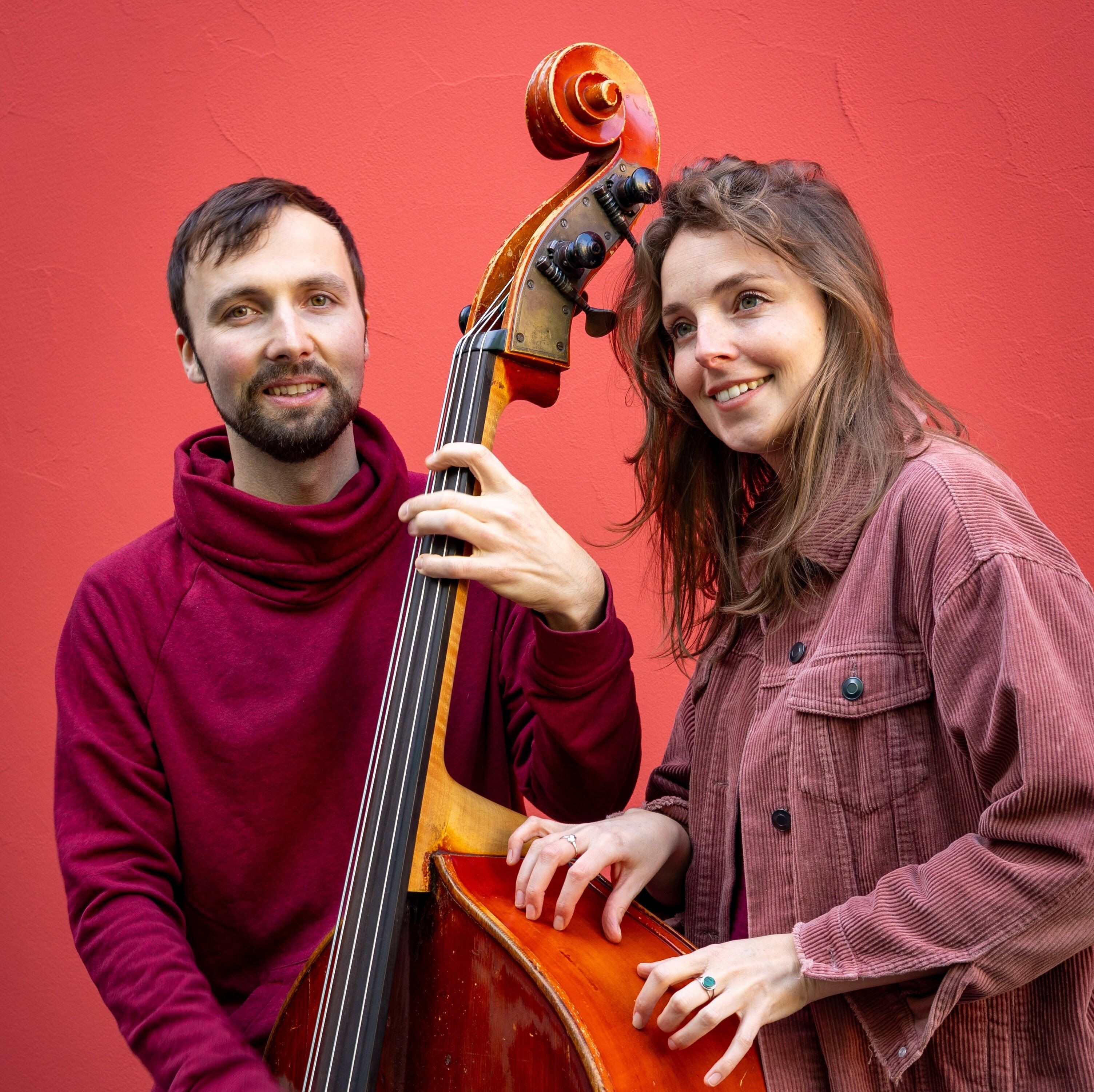
Members: Sylvie Kljin, Christoph Utzinger
Nationalities: Dutch (Sylvie), Swiss (Christoph)
Occupations: Vocalist, composer (Sylvie), bassist, composer, engineer (Christoph)
Current release: Ton Sur Ton's new album Camaïeu is out via unit.
Christoph's recommendation for Bern, Switzerland: You should definitely have a swim in our river (Aare)!
If you enjoyed this Ton Sur Ton interview and would like to know more about Sylvie and Christopher's music, visit Sylvie Klijn's official homepage and Christopher Uitzinger's Instagram profile.
When it comes to experiencing strong emotions as as a listener, which albums, performances, and artists come to mind?
Christoph: The album Revealer by Madison Cunningham comes to mind spontaneously. I discovered her just as this album came out. It captivated me immediately and I was able to dive in from the very first note.
The opening track "All I've Ever Known" in particular feels like a kind of symphony to me – it keeps developing from one section to the next and doesn't let go of me. Every time I hear that song, it takes me on a journey and pulls me out of my surroundings, no matter where I am or what I'm doing.
I feel the same way about "Borderline with My Atoms" by Hiatus Kaiyote.
Sylvie: For me, the Chaconne in D minor played live by Hélène Grimaud immediately comes to mind. Busoni’s arrangements are so deeply romanticized that they feel like volcanic eruptions of emotion. I listened to it constantly when I was still studying classical piano.
Lying on the floor in the living room, completely pulled out of the world for fifteen minutes at a time. I’ve always had enormous admiration for Grimaud as a pianist.
Beyond classical music, Radiohead is a band that reaches emotions in an incredibly honest way for me. Their last three albums (In Rainbows, The King of Limbs, and A Moon Shaped Pool) seem to return to my life every few months.
There can be many different kinds of emotions in art – soft, harsh, healing, aggressive, uplifting and many more. Which do you tend to feel drawn to most?
Sylvie: I’m very drawn to lyrics. For me, it’s all about a story being told in the right way: something deeply personal, yet still universally recognizable. That’s what can really move me emotionally. Hearing the right song at the right moment can make music feel incredibly intense and emotional to me.
At the same time, I’m also hugely attracted to Brazilian music, where the subtlety of the rhythms creates this dancing, uplifting feeling. I love that combination of lightness, movement, and emotional depth.
Christoph: For me, music strongly evokes a sense of connection – on one hand, with the people around me, known and unknown, with whom I share a listening or concert experience in that moment.
On the other hand, with myself when I listen to music alone. This can manifest as nostalgic excursions, or, when I'm listening on the go, it can pull me out of everyday life and allow me to immerse myself in a world of my own.
I have had a hard time explaining that listening to death metal calms me down. When you listen to a song or composition, does it tend to fill you with the same emotions – or are there “paradoxical” effects?
Sylvie: I tend to absorb the emotion of music very deeply. The energy of what I’m listening to can influence my conversations and my thoughts; my body feels different, and I think I even breathe differently. So I usually end up feeling emotions that closely mirror the ones being conveyed through it.
Christoph: I would describe my experience of emotions as broadly synchronous with the music. A paradoxical effect does occur for me, however, with calm music in which I can't discern any artistic statement or intent. That genuinely irritates me.
In as far as it plays a role for the music you like listening to or making, what role do words and the voice of a vocalist play for the transmission of emotions?
Sylvie: For me, words, storytelling, and the right nuance in lyrics play a huge role. I’ve always been very focused on vocals and on the singer’s voice, but also more broadly on language and sound itself. I love it when I don’t fully understand a text at first because it’s in another language, yet I can already feel the emotion in the voice. Then, as I gradually unravel the meaning of the lyrics step by step, it becomes like a puzzle in which the message slowly reveals itself. I really love that process.
I’m also very drawn to unpolished, natural voices: little to no vibrato, an honest tone. Especially when it comes to emotional expression. For our album, our producer Matthias Kohler suggested, particularly on the most emotionally charged pieces like “I Repeat,” that I return to a more narrative, almost spoken style of singing.
That really helped, and I feel the result on the album is much more moving because nothing feels overproduced or overly performed.
Christoph: For me, the voice is often the most immediate entry point into a piece of music. That said, I don't mean to imply that instrumental music is inaccessible to me – I love, listen to, and perform a great deal of it. But whenever a voice is present, it becomes my primary orientation within the music.
My relationship to words is more ambivalent. On one hand, I feel that every piece of music or composition needs to carry a message – that is my personal artistic standard. At the same time, I hold equally firmly to the idea that music should be accessible to an audience without explanation and without the need for verbal mediation.
When it comes to experiencing emotions as as a creator, how would you describe the physical sensation of experiencing them? [Where do you feel them, do you have a visual sensation/representation, is there a sense of release or a build-up of tension etc …]
Sylvie: With the voice, emotion is of course incredibly physical.
When I sing, I’m deeply focused on the story itself. I visualize it and experience it almost as if I’m living through it as an actress. It often feels as though I’m truly reliving the emotions and singing them out. There’s something very cathartic about that process.
In intimate or sad songs, I naturally add more breath to my voice, which makes the sound feel more vulnerable and fragile. In more extroverted passages, I sing in a more direct way, placing the sound slightly more forward and nasal. The emotional state immediately changes the physicality of the voice.
When I was still playing classical piano, I often found it remarkable how your entire body can be devoted to shaping a single note with exactly the right nuance. Even without words, it felt intensely emotional. But the voice almost seems made to convey emotion directly, whereas on the piano it can feel much more difficult. And once you’ve played a note on the piano, you can’t change it anymore.
Christoph: In the best case, I can give myself over entirely to the music while playing and feel the emotions it carries as an intrinsic part of the experience. The two merge into one – music is emotion and vice versa. In those moments, I can't and don't want to separate them any longer.
Unfortunately, that complete state of immersion isn't always possible, and it's often not as straightforward as it sounds. As independent artists, we typically carry multiple roles simultaneously – booking, funding, management, and more – all of which are our own responsibility. During certain periods, the time left for actual music-making is alarmingly scarce. And we do still have private lives.
The challenge for me is to navigate all of these roles and to be able to let them go when stepping on stage for a concert.
When it comes to composing / songwriting, are you finding that spontaneity and just a few takes tend to capture emotions best? Or does honing a piece bring you closer to that goal?
Christoph: It varies considerably for me. My compositions usually emerge from a spontaneous idea or improvisation. Sometimes that initial idea is already shaped by a particular emotion, which then carries through into the final composition.
At other times, the starting point is a more playful, exploratory element, and the emotional depth only emerges through the process of working the composition out.
Sylvie: Compositions often come out of improvisations, so they are very spontaneous and created without thinking about a final result. I record those improvisations and then consciously let them rest for a few days, so I can gain some distance from the material. After that, I listen to it again and work with the take or part of the take that really speaks to me.
But the source is always something spontaneous. I find it difficult to compose from a rational place or to spend a very long time trying to puzzle out a melody. When that happens, it usually signals to me that it simply isn’t working.
Finding harmonies and lyrics, on the other hand, is very much a puzzle-like process. It takes a lot of time; sometimes it works in one go, but there are also moments where a lot of tinkering and shaping is needed.
How much of the emotions of your own music, would you say, are already part of the composition, how much is the result of the recording process?
Sylvie: When you go into recording, you’ve usually already done the groundwork in terms of what emotional layers you want to access and how you want to communicate something. What’s essential in the recording process is that there is space and vulnerability to capture that state in a way that can last forever.
Without the original source material, you simply can’t access those emotions. But with Matthias Kohler, we really worked on the internal state you need to be in during recording. That meant, for example, actively searching within yourself, having conversations about the songs, and creating the calm needed to get to the core of certain sections.
That approach was very valuable to me, and also a new way of working in the studio.
Christoph: Beautifully said, I completely agree.