Published
Name: Simone Borghi aka Morning Seance
Nationality: Italian, Vienna-based
Occupation: Producer, composer
Recent release: Morning Seance's new album Eternal Life Makes Your Past Grow Too Big is out via One Instrument.
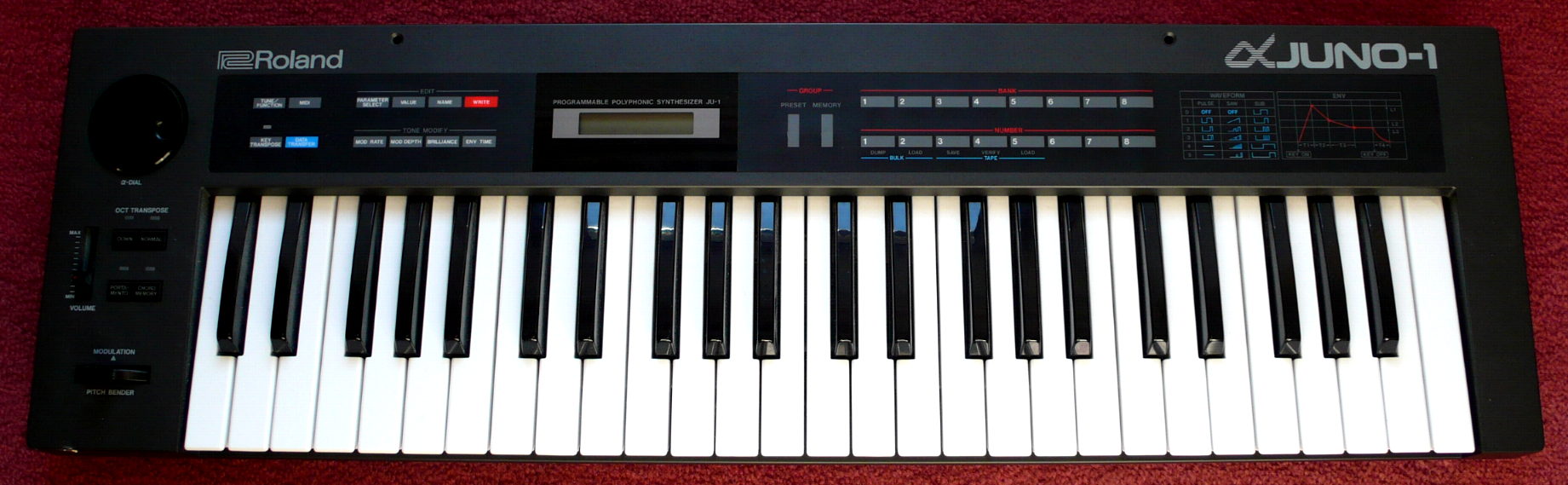
Tool of Creation: Alpha Juno-1
Type of Tool: Analog polyphonic synthesizer
Designed by: Roland Corporation
Country of origin: Japan
Years produced: 1985-1987
If you enjoyed this interview with Morning Seance about the Alpha Juno-1 and would like to stay up to date with his music, visit him on Instagram, and bandcamp.
What was your first encounter with the Alpha Juno-1? What was it about it that drew you in?
What drew me in was not really the synth itself, but the world it seemed to open — this slightly faded, late-’80s atmosphere made of glossy optimism and strange melancholy.
The Alpha Juno-1 sounds like the future as imagined back then: television jingles, cheap sci-fi effects, the first home computers, the feeling of being surrounded by technology that was still magical. When I play it, I feel like I’m back in that world I only half-remember from childhood — neon, VHS textures, plastic surfaces, synthetic emotions.
It’s not nostalgia exactly, but a way of inhabiting that time’s idea of the future.
Just like any other instrument, the Alpha Juno-1 has a rich history. What are some of the key points from this history for you personally?
Honestly, the history of the instrument played no role for me in the making of the album.
What, to you, are some of the most interesting recordings and -performances by other artists featuring the Alpha Juno-1?
I saw Philipp Quehenberger perform live several times with a Juno Alpha 1, and those are the only performances with the instrument that really stayed with me.
What are some of the instrument's stand-out features from your point of view? How would you describe its sonic potential?
Without a doubt, its envelope — above all. Using an editor, a virtual replica of the PGM-300, I was able to modulate it, which gave me a huge range of expressiveness.
Of course, the odd array of waveforms also deserves mention.
Prior to using it for the first time, how did you acquaint yourself with the Alpha Juno-1? Will you usually consult a manual before starting to work with a new device – and what was that like in this case?
There was no need to consult the manual since its structure isn’t complicated — it’s a classic subtractive synthesis architecture.
But for some of my Eurorack modules, especially the digital ones, I still need to go back to the manual now and then.
Tell me about the process of learning to play the instrument and your own explorations with it.
I would have never used it without a virtual editor — creating sounds with just a few buttons and a tiny screen would have completely put me off.
Also, I never actually played it by hand, only through a peculiar Max for Live sequencer, which turned out to be an amazing combination.
It’s a bit of an obsession I have: I can listen to music played by hand when it’s made by others, but in my own work that feels unacceptable — inevitably too human, too conventional.
Tell me a bit about the interface of the Alpha Juno-1 – what does playing it feel like, what do you enjoy about it, compared to some of your other instruments?
I usually work with modular synthesizers — that kind of open, flexible workflow suits me well.
But with an instrument like the Alpha Juno-1, I’ve learned to enjoy its strong personality. It feels like a small world of its own, already alive but still full of surprises.
What are specific challenges in terms of playing the Alpha Juno-1?
I guess it was about avoiding sounds that felt too clichéd.
But with the editor, the Max for Live modulations, and the sequencer I mentioned, I ended up really happy with the results.
What interests you about the Alpha Juno-1 in terms of it contributing to your creative ideals? How do you see the relationship between your instrument and the music you make?
What interests me about the Alpha Juno-1 is how it shapes imagination rather than just serving it. It’s not a transparent tool — it has this distinct personality that turns every idea into something slightly nostalgic, slightly futuristic. That in-between quality feels very close to the world of Eternal Life Makes Your Past Grow Too Big.
I like instruments that resist control, that impose their own logic. It’s never about expressing something I already know, but about discovering something half-buried — something that sounds familiar but comes from somewhere I can’t quite remember.
For Eternal Life Makes Your Past Grow Too Big, what did you start with? What role did the Alpha Juno-1 play in it?
For this album, I started with a simple idea: to use only one instrument and see how far I could go with it. Every single sound you hear on Eternal Life Makes Your Past Grow Too Big comes from the Alpha Juno-1 — nothing else.
I didn’t know about the label One Instrument when I began, but when I later discovered their concept, it felt like a perfect match. I’ve always liked the idea of squeezing a machine until it reveals something unexpected, something beyond its intended use.
So when Aimée Portioli (Grand River) reached out and said she wanted to release it, it felt completely natural, like the project had found its right home.
[Read our Grand River interview]
[Read our Grand River interview about the magic of sound]
What other pieces of gear or software are currently important in your creative process?
At the moment, I’d say the following, among others: Metropolix and Sealegs by Intellijel, Chaos by Clank, Loquelic Iteritas Percido and Desmodus Versio by Noise Engineering, and Odessa by Xaoc Devices.
How did the material for Eternal Life Makes Your Past Grow Too Big take shape?
The material took shape quite intuitively. From the beginning, the Alpha Juno-1 gave me this strong emotional impression — that strange mix of melancholy and synthetic optimism I mentioned earlier.
I followed that feeling rather than any structure or plan. It was more about building an atmosphere, and eventually distorting it — letting that emotional tone guide me until the music started to sound like a place, suspended somewhere between memory and imagination.
When performing live or in the studio, how does the Alpha Juno-1 interact with other instruments?
I’ve never used the Alpha Juno with other instruments.
What makes the Alpha Juno-1 sound great on record and in a live setting? How did you approach that for your new release?
What makes it sound great is its personality — it’s imperfect, slightly unstable, and full of emotion.
I didn’t try to polish that; I just let those qualities come through, both in the recordings and in the mix.