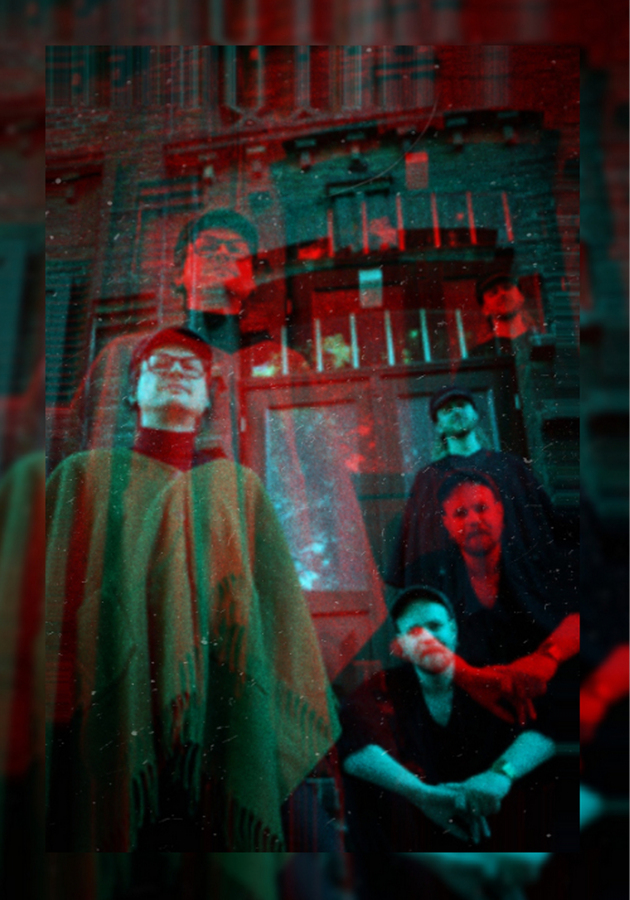
Published
Name: Utopia Union
Members: Hanno Janßen (drums, production), Johnny Röhl (bass, lap steel), Matthias Dabrowski (guitar)
Interviewee: Matthias Dabrowski
Nationality: German
Current release: Utopia Union's new album Peak Experiences is out via Poly Unique.
If you enjoyed this Utopia Union interview and would like to know more about the band and their music, visit them on Instagram, Facebook, and bandcamp.
How would you describe your personal relationship with Krautrock? When and how did it start?
During my time in Berlin, I hung out a lot at my friend's record shop. I helped out when he was busy with other stuff. Around 2008, he got some NEU! bootlegs and I snapped up a copy and loved it ever since.
When I was a teenager my other friend's parents owned CAN and AMON DÜÜL II records which we would listen to occasionally. It was “too weird” for me back then, I liked punk and metal more.
Tell me about one or two of your favourite Krautrock records please.
In the past two years, I've found POPOL VUH to be the most significant Krautrock band.
Their Album Agape Agape had probably the biggest influence on me. That special atmosphere gave me a lot of peace and quiet.
Also GURU GURU's Hinten has been crucial, that groove and the exceptional guitar playing totally got me.
Krautrock always seemed like a phenomenon connected to a very specific era in German history. What about this music and its time do you connect with?
The BBC documentary Krautrock - The Rebirth of Germany reveals how Krautrock musicians rebelled against the post-Nazi regime and Anglo-American rock. They wanted to start something entirely new and do their own thing.
I think they were even more radical than punk rock in the late 1970s.
That post World War II feel in Germany must have been horrible. A dystopian and devastated landscape if you think of Berlin, which was bombed so badly. Those sounds of TANGERINE DREAM or later Klaus Schulze in this dystopian environment must have sound very alien for the majority.
I think It was also a very special and unique era with that feeling of “everything is possible“. This time represented a cultural reinvention, with musicians challenging existing musical and social norms.
Many of the original Kraut musicians loved blues, rock, and psychedelia; they were intrigued by electronics and improvisation; they rebelled against virtuosity, classical education and the superficiality of Schlager on German radio. How much of that do you recognise in your own creative preferences and interests?
We aimed to create unpredictable songs that transcend traditional rock structures, focusing on surprising listeners through unique sounds, rhythms, and styles.
While embracing rock and electronic music, we maintain a DIY spirit and of course as Krautrockers back then, we reject the superficiality of Schlager music.
Both in the music and the way it was made, Krautrock was about imagining different worlds. What is the experience of listening to this music like for you and what kinds of worlds is it taking you to? What is your preferred way of listening to it?
Great art and music are like these amazing windows into different ways of seeing the world. The coolest artists totally mess with your head - they make you look at things differently and think about stuff you've never even considered before. Take Krautrock bands, for example - they weren't just making music, they were blowing people's minds with totally new sounds.
Vinyl is where it gets really special for me. There's something awesome about taking a record, dropping the needle, and just getting lost in the music. It's way more than just background noise - it's like hitting pause on all the rush of everyday life. You're not just listening; you're actually paying attention and letting the music sink in.
The best art isn't just pretty or entertaining - it challenges you, makes you uncomfortable sometimes, and helps you see the world in a completely new way. It's like a direct line to understanding more about yourself and everything around you.
A lot of the Kraut spirit came to life through musicians living in communities, playing and recording together every single day. Have you ever tried working and creating in such a constellation? Is it possible to emulate this process from a home studio?
We're lucky enough, that our drummer Hanno runs the "Dickfehler Studio" in Aurich, which made our recording process incredibly organic and spontaneous. Unlike many bands who rehearse songs and perform them as they have rehearsed them in the studio, our approach was more fluid and intuitive. We experimented with songs, recorded them and had time to listen to them. If we weren’t happy with the result we played them differently and recorded them again. We captured the album then in a single day-long session.
For Johnny and Hanno, the studio is more than just a workspace; it's practically a second home. They're constantly tinkering and fine-tuning the acoustic environment, treating the space with the same care and intimacy one might reserve for a living room.
This approach—relaxed yet purposeful—allowed us to capture a genuine, unforced musical moment. The studio became not just a recording space, but a creative sanctuary where musical ideas could breathe and evolve organically.
What, to you, are the main elements that make something “Kraut?” What are the practises of the musicians from the 70s that inspire your own practise today?
I think the freedom of writing music that doesn’t have to follow a certain pattern is for me a big goal in playing “Krautrock“.
Music that is not limited to anything and gives you any opportunity for your creativity. It’s not restricted by conventional structures or expectations.
I got into Kraut via Tangerine Dream and early Ash Ra and to me, the motoric beat was never quite as important. Today, it seems as though it's the defining element. Are you interested in it? Are you making use if it? What makes it special to you?
This is actually a really interesting question. I was thinking about that a lot. Are we truly a Kraut or Kraut influenced band, or do we simply integrate motorik beats into our instrumental music? You’re absolutely right, saying the motorik beat seems today to be understood as Krautrock. NEU!'s Hallogallo is for many the epitome for Krautrock.
I started digging into the roots of this music, checking out the musicians who inspired the Krautrock scene. Like Holger Czukay from CAN - he studied “Neue Musik“ with Karlheinz Stockhausen in Köln. Darmstadt and its “Internationale Ferienkurse für Neue Musik“ were an important spot for Neue Musik in the 1950s. I started looking for musicians who attended the “Ferienkurse“. This led me down a rabbit hole of listening to musicians like Terry Riley or Steve Reich, and then somehow I ended up deep into traditional Indian music.
Traditional Indian music is not linear and about moving from point A to point B - it's circular. You don't follow a strict structure; instead, you just sink deeper into the sound through repetition. So when we talk about that motorik beat, it's not just a rhythm - it's a way of getting lost in the music, of creating this ongoing, hypnotic groove.
So the motorik groove is an element, but also crucial for Krautrock.
Did you ever visit one of the birthplaces of the genre – Berlin, Düsseldorf, Munich – or any spaces related to the history of Kraut? Do you own any paraphernalia from the era?
Back when I lived in Berlin, I got this opportunity to visit the EINSTÜRZENDE NEUBAUTEN studio. They're probably not what most people would call a Krautrock band - more like industrial experimental noise artists. But, that would be a story to tell.
Their setup was mind-blowing, especially their "instruments" - we're talking about massive metal plates and even a jet propulsion engine they'd use to create sounds.
Are there approaches, artists, festivals, labels, spaces or anyone/-thing else out there who you feel deserve a shout out for exploring interesting directions for Krautrock?
There's this cool label called SVENSK PSYCH AFTEN that I'm really into. Sven, who runs it, is a total DIY guy - he even draws all the album covers himself. He lives in this tiny cabin deep in the Swedish forest and releases records in limited runs. He's just a pure music lover doing his thing without any big expectations.
Then there's Bureau B from Hamburg, which is crucial for Krautrock fans because they do these amazing re-issues of classic records. They also released DATASHOCK, this wild experimental sound collective, that I would call contemporary Krautrock, if you want.
And artists like JAN JELINEK - his album Tierbeobachtungen feels kind of Kraut to me, even if it doesn't fit the traditional mold. I'm sure there's a ton more out there that I haven't even discovered yet.
[Read our Jan Jelinek interview]
Several of the original Kraut pioneers recently passed away or withdrawn from making new music. If some of your personal favourite artists were affected as well – can you share a little what did their music meant and means to you?
DAMO SUZUKI (most knows for his work in CAN) has passed away recently. A great spirit and a creative guy.
We actually named the song “Dunkelziffer“ after the collective which he was part of.
We liked to pay tribute to him and we liked that German word, which is a great metaphor.