Published
Part 1
Name: Vesna Pisarović
Occupation: Singer, songwriter, composer, multi-instrumentalist
Nationality: Crotian
Current release: Vesna Pisarović's new album Poravna is slated for release June 6th 2025 via PDV. It features collaborations with Tony Buck, Axel Dörner, Noël Akchoté, and Greg Cohen.
[Read our Tony Buck interview]
If you enjoyed this Vesna Pisarović interview and would like to stay up to date with her music, visit her official homepage. She is also on Instagram, tiktok, and Soundcloud.
When did you first consciously start getting interested in singing? What was your first performance as a singer on stage or in the studio and what was the experience like?
I think I must have been eleven when my father took me to an audition for an amateur music festival in my hometown, where he convinced the jury to give me a chance to perform even if I was too young – the festival being for adults. The jury resisted initially, but due to my father’s insistence or persuasiveness (I could not tell between them) they did give me a chance.
I remember that I practiced for hours and hours – and of course I was completely petrified before the performance – but in the end it felt entirely natural being on stage with musicians in front of an audience. Surprisingly, I won the audience’s first prize. A kid must have been more charming then adults.
However, ever since that moment, I became aware about the voice and the stage as things somehow sacred to me.
If you're also playing other instruments, how does the expressive potential of these compare to your own voice?
I play flute – and I play piano as well. I studied flute for six years in music school, but I never developed a real passion for it. Perhaps because it is not an easy task to play the flute and sing at the same time!
With the piano, I have a slightly different attitude – given that it serves my voice, I do approach it meticulously and methodically. But only up to a point – I never reached a level of playing on it which would make it equally expressive as my voice.
So, all in all, I cannot really make this comparison.
Singing is an integral part of all cultures, and traditions. Which of these do you draw from – and why?
I’m from the region of Slavonia, an eastern part of Croatia where there exists a tradition of folk singing based on basic harmony, accompanied with plucked string instruments, the most famous one called “tamburica”. I was exposed to this music and this tradition since I was kid.
The timbre of the voice which is usually called for in these songs is specific – it tends to be very loud, extremely sonorous, slightly nasal and very projective. So, singing loud, singing in harmony, singing sonorously, this has always been natural to me.
Also, my mother loves Bosnian traditional songs – the tradition of Sevdah which is precisely what I touched upon on my upcoming Poravna album – and she introduced me to this music at an early age. We would sing it in harmony or in unison whenever we could.
What were some of the main challenges in your development as a singer/vocalist? Which practices, exercises, or teachers were most helpful in reaching your goals – were there also “harmful” ones?
Maturing one’s own voice and gaining control and mastery over it is a difficult and lengthy process.
I went through many different vocal teachers, through many different schools, different techniques, but also different musical environments, different styles, different manners of expression, different demands placed upon vocal artistry. In the end, I settled upon the following: that technique follows form and content, rather than the reverse.
I would now describe my vocal technique as a complete patchwork: I take things from many different sources, I engage in different practices and exercises – some often coming from outside vocal teaching, for instance from saxophone studies, or from some other instruments, or from phonetics – but I also very often invent exercises of my own, depending on the material that I am working on, and especially the language that I am working in.
What I found most harmful in this lengthy quest were attempts to blindly apply technique either universally, or to materials or forms which are entirely foreign to it. One needs to beware of universal panaceas concerning the voice – or universal methods, which do not exist, really.
The proper method is actually the reverse: first get engaged and immersed with the material – and then only later see and explore what works and what does not from a technical point of view.
What are the things you hear in a voice when listening to a vocalist? What moves you in the voices of other singers?
A certain range of qualities in sonority, fullness, roundness, projection, diction, phrasing, use of vibrato, dynamics, focus, control, etc.
When I listen to Carmen McRae, Nat King Cole, Phil Minton, Ella Fitzgerald, Barbara Hannigan, Maria Joao, Whitney Houston, to name only some – these qualities are obvious.
Each of them, I would say, uses her or his voice as an instrument.
[Read our Barbara Hannigan interview]
How would you describe the physical sensation of singing? [Where do you feel the voice, do you have a visual sensation/representation, is there a sense of release or tension etc …]
I like to say that I am a “physical” singer, as I truly engage my whole body to produce the sound. Thus, while practicing, besides warming up my voice, I always need to warm up the whole body too.
But, while singing, I usually like to work “visually” with the piano keys, that is: when I memorise the melody well enough by playing it on the piano, including learning the chords and the voicings – I will “see” or “feel” the melodic development with my voice too. Also, I like to practice with the tuner, which is a somewhat contentious thing for singers.
Furthermore, I somehow believe that every singer has a certain tone which feels the most natural to the bodily composition and disposition of the voice. Mine is, I am quite certain, B1. Which is also the tone with which I start my daily exercises. Sometimes I spend a good hour singing it loud, soft, short, long, focusing on the beginnings, on the endings of the tone, on vibrato, on tremolo.
When I feel that it opened up and that it resonates in my entire body and in the room, I continue by adding intervals, melodies, songs, etc.
We have a speaking voice and a singing voice. Do these feel like they are natural extensions of each other, ends on a spectrum or different in kind?
Often we can hear opinions that singing is only extended speech and thus extended human language.
This might be true for some individuals, or for some languages or ways of speaking. The way Nat King Cole sings, for instance, the way his meticulous swing vocal phrasing is embedded in certain “spoken” qualities of the American idioms of English, does make a strong case for such an opinion.
And yet, there is no universal vocal technique and every voice is different, being rooted both in personal, bodily idiosyncrasies as well as in the vast differences of languages and modes of speech, which demands very different approaches to problems or techniques. From my experience, singing and speaking are rather different mental and physical activities. One actually interrupts the other.
I have a personal experience in this regard: namely, I come from a region in Croatia with a very distinct dialect of the spoken language, one where there is a tendency to shorten every long vowel, as well as to lengthen every short vowel. It is a speech which is very direct and sonorous, but over the years I realised that it is my dialect itself which presents a huge obstacle for my singing technique, especially for breathing and air support and control.
None of my vocal teachers in The Hague, London or Berlin could help me diagnose or overcome these issues – it took years of experiment, analysing, listening, trying, failing, as well as having recourse to phonetics, which I studied at the university, to find all sorts of tricks to deceive myself and find ways to release the constricted air flow – in the throat, the chest, the neck, etc.
In the end, I would say that learning how to use your voice – and how to teach others to do the same – demands having many tricks up your sleeves. One cannot consciously move, lift the vocal chords, or the larynx, neither stretch the soft palate in one clear and determined controlled motion – rather, it is all done by imagination, through metaphors, through ways of deceiving yourself – and very often also by going against the way in which the spoken voice actually sub-consciously works.
How do you see the relationship between harmony, rhythm and melody? Do you feel that honing your sense of rhythm and groove has an effect on your singing skills?
In the beginning, there was rhythm. A pulse, a certain repetition, a certain continuity of movement – out of which the world was born. What is fundamental to music, in my view, is precisely this: phrasing, moving, feeling the “beat”, a certain “groove”, etc.
A tone in itself – or the technique to produce it – are not sufficient to make music happen. A certain feeling for movement is necessary and fundamental – upon which melody and harmony are in the end anchored. This is what gives every performance a sense of direction and also a purpose. This is what composes movement: its dramatic aspect, its dynamics, its beginning and end.
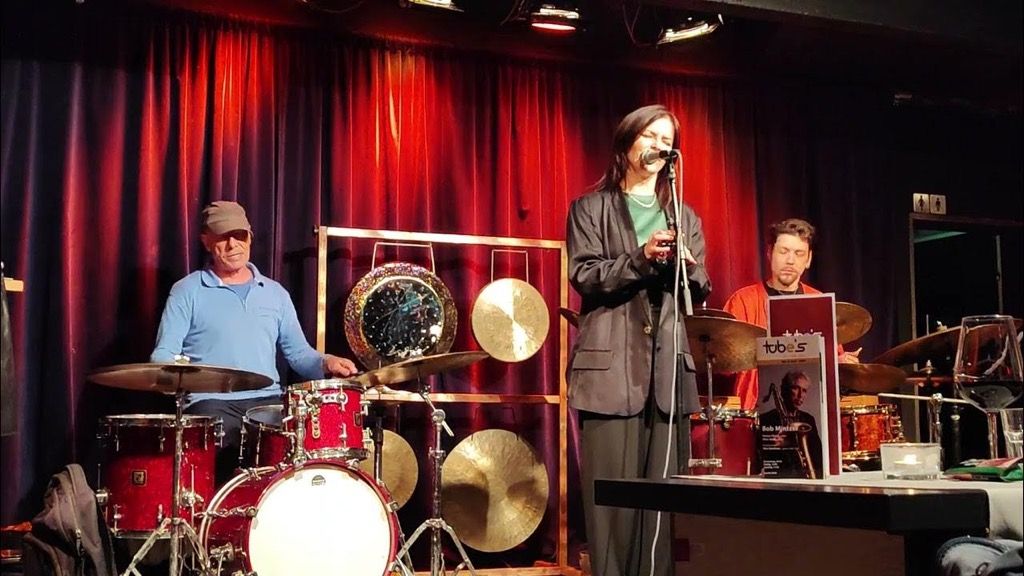
And I must say that in this regard I was lucky to be able to play with great drummers in my adventures in free jazz and improvised music. Since 2014, I had been regularly playing and touring with John Betsch, who did wonders in his work with Steve Lacy. His own feeling of the groove, the way he makes the cymbals and the snare drum “move” in time and space – this has been for me an invaluable experience. But also, recording and playing with Tony Buck is another universe in itself.
In the end, performing in pop music as well – especially in large productions, where everything is tightly arranged and choreographed – made me feel much more rhythm conscious.