Part 2
Do music and sound feel “material” to you? Does working with sound feel like you're sculpting or shaping something?
Absolutely! What I mention at the beginning about sound having a tactile element to me, I like to imagine it as something physical. Perhaps not as a sculpted object, but a place.
A lot of the eco-listening that I employ when I do my work is quite literally grounded in a place, in a voice, in a species, in a biome … so there is something very physical and earthly about the reality of working with these sounds.
The extraction of them feels intangible but I remember recording them and the physical experience of doing so.
How important is sound for our overall well-being and in how far do you feel the "acoustic health" of a society or environment is reflective of its overall health?
It is very important and perhaps I’d like to twist where the question could go into thinking sonically about the question of diversity.
We are often busied by the counting of visible things. For example, how many individuals of a certain species can we count in this ecology or area, or how many can we estimate using faecal samples etc.? This is very helpful when assessing population growth or potential endangerment of a species.
But moving outwards into a broader picture, how could we look or rather, hear the diversity of a place? Acoustic ecology is now being deployed to consider the health of an environment by the diversity of its sound and how we trace this acoustic diversity over time.
In simple terms, the more voices we hear the richer the environment and across time, if it begins to get “quieter” (and therefore, less diverse) are we looking after this environment’s health? This can be applied to both above earth ecologies and soil health.
Sound, song, and rhythm are all around us, from animal noises to the waves of the ocean. What, if any, are some of the most moving experiences you've had with these non-human-made sounds?
I have two anecdotes about non-human sound making.
My doctoral studies were in bioacoustics and the evolution of rhythm in primates and hominins. Part of this work was assessing rhythmic behaviour in one of our closest cousins, the chimpanzee! I was introduced by Professor Koops to this behaviour that chimpanzees exhibit called buttress drumming.
Chimpanzee individuals were observed using their hands and feet to drum buttresses - large tree roots that often grow with a “membrane” like structure so there is a decent enough surface area for it to be drummed. I had no idea that chimpanzees did this. We had precise idea why, other than a strong hunch that it was likely something to do with long-distance communication, many thanks to researchers from the 90s. Turns out that is indeed the case and there have been several studies published since!
I love this anecdote because it is a reminder of how little we know, and how often we overlook the behaviour and communication styles of other species, even the ones that are the closest to our own, as noise-making. Like it has no structure, no form, no culture, no purpose … and yet, why wouldn’t it?
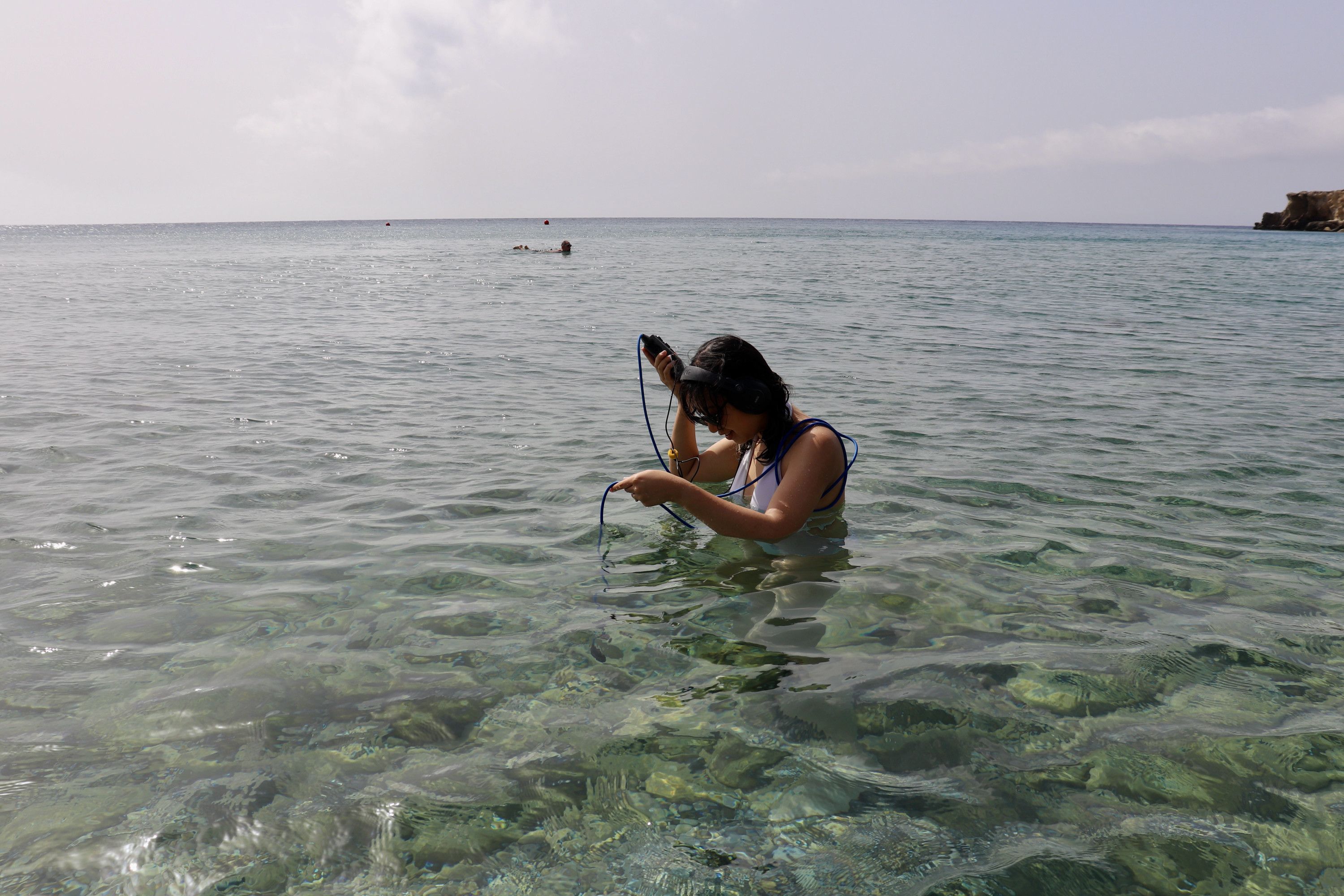
The most intimate of sounds I love recording is the sound of ants. I feel like I have a special love for ants, having spent many hours watching them carry grains of sugar as a child. Using contact microphones to take any kind of recording such as the very gentle (and yet chaotic) rustling of ants crossing the microphone, is a very intimate way of listening.
I, and now we, am hearing them through their touch. Their contact as they move from soil to microphone and soil. It is because of this phantom-touch that I often find that working in the soil, the Earth’s skin itself, the most moving. That with technology we are able to amplify and make present the voices of creatures and environments that too often are disregarded as silent and invisible.
What a gift that microphones have developed (and are continuing to develop) to allow us to do so!
Many animals communicate through sound. Based either on experience or intuition, do you feel as though interspecies communication is possible and important? Is there a creative element to it, would you say?
Ha! This is a great question. I actually feel like this would so much better articulated by one of my PhD supervisors, Dr Arik Kershenbaum who has written incredible books and publications about this very topic! I hope my answer is somewhat coherent.
I hate to be a downer. But no, I don’t think that interspecies communication is possible, at least not in the way the public imagination compels us to think about this. Specifically, I don’t think a Disney-esque Dr Dolittle reality or anything close to that would happen. This is partly because I am very wary of us humans anthropomorphising communication and sound signalling through the lens of human language.
The presumption that animals have language in the linguistic form that modern humans have evolved to develop it as a system of communication both overestimates and limits what animal species can do. They already communicate using sound, each species to a different rate and some, we can argue, do so as a form of cultural behaviour.
However, to achieve interspecies communication, that implies that somehow their form of communication is aligned or can be understood through the framework of human linguistics or human signalling systems. It is not that human language is better, it is simply different.
For example, for those of us who have pets, we through prolonged interaction and us building a relationship with a dog (for example) can tell roughly when they’re hungry depending on their expression and maybe some sounds they make. They’re not coming to us and necessarily articulating: “I am hungry, please feed me the food that you get out of the bag that is sitting in the kitchen cupboard.“ But we know what they mean without the syntactic structure of language.
This is not to say that animals are not intelligent, simply that their form of intelligence and communication systems have evolved differently.
Rather, what I would be interested in pursuing is, how can we build the context from which we can understand the complexities of nature, its ecologies and the diversity of species that occupy these spaces alongside us. Not in direct communication (thus expecting them to somehow meet us at our human communicative requirements) but to listen to them. Really listen to them.
Tinnitus and developing hyperacusis are very real risks for anyone working with sound. Do you take precautions in this regard and if you're suffering from these or similar issues – how do you cope with them?
I work with sound constantly so it can definitely take a toll, if you’re not careful! It means my ears are constantly exposed and “in use.”
In general, just being prepared and aware of where you’re going and bringing hearing protection with you is a good start. For example, bringing noise protecting earplugs and having them in your bag at all times is good practice. You never know when you’ll need them, whether you’re heading to a gig or just out and about.
Almost ironically, the worst sound exposure stories I have were during my time living in London. The Northern tube line is a killer for the ears, regularly between 90-120dB. Because of these realities of living in urban environments, it hasn’t been gigs or my work that have been what I most careful about. It’s construction work, traffic and public transport.
We can surround us with sound every second of the day. The great pianist Glenn Gould even considered this the ultimate delight. How do you see that yourself and what importance does silence hold?
Silence … are we ever truly in it? At least for those who experience little to no hearing impairment, we are surrounded by sound and it is a constant.
For me, the relationship is less to do with absolute silence and more to do with connecting with the “quietness” and how important that is to have a break away from intense listening or sound-making.
Deliberately working with sound as an occupation means that I am always listening and my ears are in use in a way that makes them prone to fatigue. Hearing too much … in a sense. While this is a privilege to do so, it means I have grown more aware with how I spend my time away from this type of listening.
Perhaps it sounds very cliched, but I try to spend a lot of time outside without headphones in. Walking through parks and the woods near where I live as a form of sonic peace. It’s far from silent but it’s certainly not busy with recordings and music, which in its own way is a form of silence.
Seth S. Horowitz called hearing the “universal sense” and emphasised that it was more precise and faster than any of our other senses, including vision. How would our world be different if we paid less attention to looks and listened more instead?
I mean, I am blessed to have such a strong sense of hearing. It’s probably my strongest, while I am aware that may not be the case for many, many other people.
Despite this I’m not entirely sure that it is more precise or faster; light travels faster than sound and while I can estimate in which direction I heard something or what a sound is, it often requires a combination of senses to confirm a sonic hunch. However, this imprecision does point out the very bias we often have as humans; we rely too heavily on sight and touch to guide us. For some reason, these more dominant senses make things feel more real.
The intangibility of sound and the imprecision and, often, vagueness of some of its qualities, are perhaps its strengths. Sound is immersive. We can “hear” behind us and around us in a way that sight is limited. We can even hear things that happen thousands of miles away, the eruption of Krakatoa for example.
Perhaps poetically, I believe that it means that the act of listening should most definitely command more attention as it opens (in a literal sense, opens our ears) without as many immediate physical boundaries that sight presents.