Published
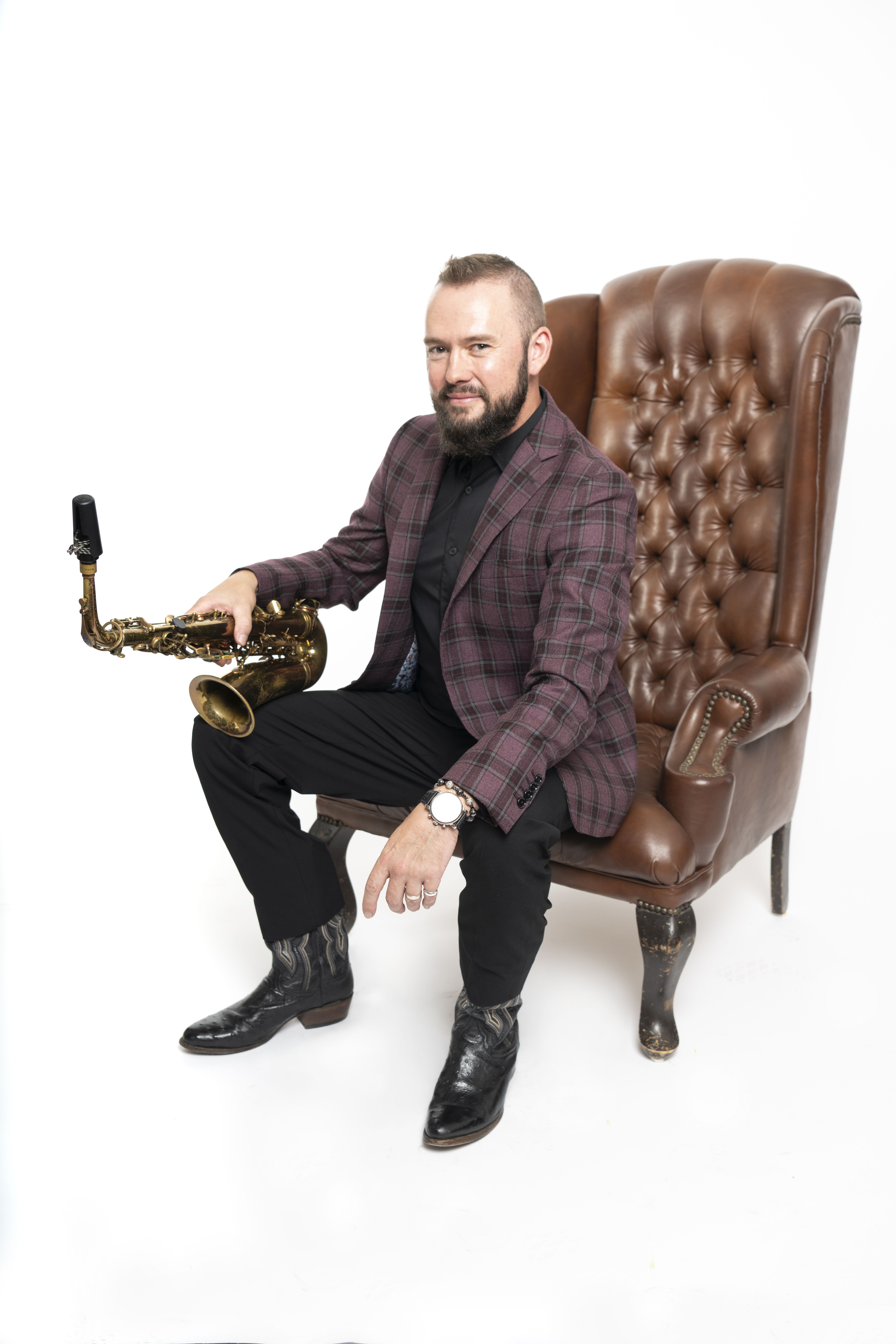
Name: Wes Smith
Nationality: American
Occupation: Composer, saxophonist, producer, improviser
Current release: Wes Smith's new EP We, the funky Volume 1 is out now.
If you enjoyed this Wes Smith interview and would like to stay up to date with his music and upcoming live performances, visit his official homepage. He is also on Instagram, and bandcamp.
When I listen to music, I see shapes, objects and colours. What happens in your body when you're listening? Do you listen with your eyes open or closed?
The style of music and the environment can really make for a wide variety of experiences.
Background music in the car during rush hour is a very forgettable thing. The music will only leave a superficial impression and I frankly prefer no music at all during those kinds of moments. But a live concert, where there are no distractions; this can create a really wonderful exchange between the mind and the body while the music is happening.
When I listen to the choir at Church, I don’t think I have many moments during my week that connect my mind, body and emotional world together quite as well. Music can help us to live life more vividly, almost a higher fidelity of reality.
How do listening with headphones and listening through a stereo system change your experience of sound and music?
I know musicians and producers who frequently mix and produce content ‘in the box’, with headphones and digital plug-ins. I understand that sometimes that process is a necessity.
But whenever possible, in my opinion a true stereo image produced by a good stereo system is always preferred. It goes back to your first question of ‘what happens in your body’. With headphones, most of the body is not receiving vibrations.
In a live concert setting, or with a true stereo system, your whole body is receiving the vibration of the music.
Tell me about some of the albums or artists that you love specifically for their sound, please.
I think I gravitate towards albums that have a more raw, almost a ‘demo’ feel to them.
A semi-recent album that comes to mind is ‘Camden Sessions’ by Butcher Brown. The musicians and their performances are all really top-notch of course and the mixing and mastering of that record is not overly polished, not suffocating.
Sometimes I hear modern jazz big band records, where every instrument has been so precisely EQ’d and the fader automation is certainly very dense.
There’s a lot going on in those records musically, so I understand the necessity for all that processing. But there’s something magic in the Count Basie / Frank Sinatra tracks where all the digital processing simply wasn’t available.
[Read our Butcher Brown interview]
[Read our Butcher Brown interview about improvisation]
This idea of a ‘perfect’ album sound culminates in a lot of modern pop. I don’t want to insult anyone here, so I’ll give credit where credit is due; the production teams on all the modern pop stuff, they are masters of their craft.
A lot of modern pop tracks have been mixed, mastered and processed into perfection. You can hear every instrument at every level, the vocals are perfect, etc. And I think that can be a problem, because now it’s clinical - sonically speaking.
I’m listening to ‘Here Comes the Sun’ 11 out of 10 times over any modern pop and R&B.
Do you experience strong emotional responses towards certain sounds? If so, what kind of sounds are these and do you have an explanation about the reasons for these responses?
The modern world is loud and I think high decibels (dB) in general can cause our nervous system to experience things like stress, irritation or excitement. I think the loudness of city life (70-85d), almost certainly affects peoples’ emotional responses.
Specific sounds for me? I guess fire and police sirens aren’t my favorite. Loud fireworks after midnight on the Fourth of July aren’t exactly pleasant to my emotional world, but my bad for being American and living in Los Angeles hahaha.
The sound of moving water in a river, or the sound of ocean waves conversely are something I could be around all day. I know this might sound funny coming from a musician, but relative silence (anything below 50dB) generates quite pleasant emotional responses for me.
There can be sounds which feel highly irritating to us and then there are others we could gladly listen to for hours. Do you have examples for either one or both of these?
I think there are some ubiquitous sounds like trains, airplanes, traffic that probably no one really likes all that much. Maybe the hustle and bustle of New York City is a very special combination of loud, wonderful, exciting and overwhelming … initially.
I think ‘loudness’ and high dB levels are fairly opposite of the environment that our nervous system got wired up in. But the vast majority of us live in urban areas, so we simply get accustomed to that loudness for better or worse.
Are there everyday places, spaces, or devices which intrigue you by the way they sound? Which are these?
The quiet hush of a library is always reflective and intriguing for me.
There’s obviously noise and activity happening, but it’s very full of intent. That gives it a different quality somehow.
Have you ever been in spaces with extreme sonic characteristics, such as anechoic chambers or caves? What was the experience like?
Having been able to record in iconic places like Capitol Studios in the Capitol Records tower, EastWest, Westlake, The Village and Sunset Sound, etc - I love getting to those places early before the hustle and bustle of the production begins. You can enjoy and take in the almost sacredness of those spaces where great artists recorded absolutely incredible music over the years before you ever got there.
And then the quietude goes away and the exhilaration and demand of the recording process begins. Recording studios are certainly spaces of extreme sonic characteristics to be sure!
What are among your favourite spaces to record and play your music?
Unfortunately I can count on my right hand the number of times I’ve recorded there hahaha … but Capitol Studios in Hollywood, CA is just a sublime place to record and make music in.
Do music and sound feel “material” to you? Does working with sound feel like you're sculpting or shaping something?
As primarily a woodwind player (saxophone, flutes, clarinets) music and sound absolutely feel ‘material’.
If I’m playing pop music, I want my saxophone to be bright and piercing - like a bolt of lightning. If I’m playing for a more subdued situation like the somber moment of a piece for Film/TV, the sound has to be more warm, more refined.
Like an old book or something like that.
How important is sound for our overall well-being and in how far do you feel the "acoustic health" of a society or environment is reflective of its overall health?
I think this is a really interesting question.
I said earlier that most of us living in the modern world experience a lot of ‘loudness’, which our nervous system likely interprets as ‘stress’ or ‘excitement’. I think ‘excitement’ is just fine, there’s nothing wrong with a lively soccer game or something like that. But the ‘stress’ caused by the modern world’s loudness isn’t so good.
Maybe most of the day ‘stress’ is too strong a word, but let’s say the sound of the modern world has a constant ‘distraction’ built into it. Listening to other people’s ‘loudness’, like for instance someone is just straight up on speaker phone inside the grocery story. A loud airplane overhead, a fire engine (sirens blaring) responding to an emergency - I think all these little constant distractions certainly breaks up our perceived sense of continuity. That’s probably not great for our ‘acoustical health’.
The rate at which social media use (specifically youtube shorts and tiktok videos), dings our dopamine levels is well documented in reducing our ability to focus our attention on one thing for more than a few moments at a time. I think in general, people’s ‘acoustic health’ would improve with more quiet in their daily life.
Sound, song, and rhythm are all around us, from animal noises to the waves of the ocean. What, if any, are some of the most moving experiences you've had with these non-human-made sounds?
Non-human-made sounds, I like that.
I remember taking my children up to the mountains during the winter one year. For a while they stomped around, threw snowballs at each other, did some sledding. Joyful noise. Then that slowly gave way to them just standing there, listening to the gentle rustle of the wind, the dampened sound of the snow.
It was just a few moments before they got bored and we had to move on to the next thing, but what a special snapshot of life that was.
Many animals communicate through sound. Based either on experience or intuition, do you feel as though interspecies communication is possible and important? Is there a creative element to it, would you say?
My daughter has a little pet bird - when we come home from school he is chirping away, making all kinds of fun sounds. So he certainly knows the sound of us and on some level he’s probably excited to no longer be alone in the house.
I’ll whistle to him and periodically he will sort of whistle back. So there’s certainly interaction, but I don’t know if that interaction necessarily crosses the threshold into ‘communication’.
A dog or cat certainly has the capacity to tell you when they’re hungry or when they want attention, so on that level I think interspecies communication has been happening for quite some time.
Tinnitus and developing hyperacusis are very real risks for anyone working with sound. Do you take precautions in this regard and if you're suffering from these or similar issues – how do you cope with them?
I wear ear plugs almost constantly while teaching music, also when I am playing music during a live club date.
For a recording session I won’t use earplugs - getting all the available sonic information is critical in that environment.
We can surround us with sound every second of the day. The great pianist Glenn Gould even considered this the ultimate delight. How do you see that yourself and what importance does silence hold?
I think that silence is golden, as the saying goes. Maybe Glenn Gould was talking about a very specific quality of sound every second of the day - the top shelf stuff, so to speak. Meaningful conversations with dear people, Bach, Mozart or Billie Holiday. That kind of thing.
My children went through a big Minions phase so we were watching ‘Rise of Gru’ there for a while. There’s a funny scene where Alan Arkin’s character captures the protagonist Gru and puts him on this cartoonish torture device that spins him around playing constant disco music and bringing a saw closer with each rotation.
Alan Arkin’s character says, “If 48 hours of Disco don’t kill you, that saw will!” Hahahah, so stupid - but really true. Silence is Golden.
Seth S. Horowitz called hearing the “universal sense” and emphasised that it was more precise and faster than any of our other senses, including vision. How would our world be different if we paid less attention to looks and listened more instead?
What an interesting question! I have to respectfully disagree with Mr. Horowitz.
Science confirms for us that human beings only see a small fraction of the light/energy spectrum and we only hear about 20hz-20khz. We can’t even hear our planet’s well-documented Schumann Resonance, I think that’s like 5 or 6 hz ? In a very real sense, we are unable to experience most of reality.
So ‘looking’ versus ‘listening’, really quite subjective things. I wouldn’t presume to say that Van Gogh couldn’t receive or express anything less refined as he looked at and created his ’Starry Nights’ versus Debussy when he heard and composed one of his String Quartets.